The thoughts, observations and adventures of a software engineer and licensed amateur radio operator call sign M0NRD (previously 2E0NRD and M6GTG) with an interest in all things radio related.
Most HAB (High Altitude Balloon) tracking in the UK involves the use of 434MHz ISM devices due to the ready availability of suitable antenna and receiver equipment due to it sharing the 70cm amateur radio bands.
868MHz ISM devices are available but are not as widely used. Back in December I posted about trying to track a flight by HAB Enthusiast Dave Akerman who is experimenting using LoRa devices on this band. I had limited success receiving that flight and another ones so when I saw that Dave was planning another flight today using 868MHz LoRa I had a rethink on how to approach tracking it.
The antenna I used was a collinear one built from cheap satellite coax, similar to that I built for ADB-S however rather than having a long coax run to the LoRa gateway I opted to put the Raspberry Pi up on the pole at the base of the antenna to limit any loss.
The antenna can be seen connected to the Raspberry Pi and LoRa add on board, the Pi has a WiFi dongle.
The antenna was inserted into a piece of conduit to keep it upright and it and the Pi were strapped to a 5m painters pole (using a plastic lid as an insulator)
A USB power pack was also strapped to the pole to keep the Pi powered, hopefully you can see it in the photo below.
The pole was put up and was about the same height as my normal dual band collinear
Well it all worked extremely well, and got a lot of decodes as can be seen by the pie-chart generated by the habitat.habhub.org system, the third best receiver only bettered by Dave himself (M0RPI) and a station nearer to the flight path.
You can see my geographical position relative to the flight below (I am the station NNE with the green line, about 160km away) and received a lot of telemetry strings even when the height of the balloon meant I was outside the 5 degree above the horizon circle (shown in green).
The Pi was connected to my network via WiFi and controlled by a Putty console on my shack PC
It was a useful experiment and I am thinking of installing a dedicated mast mounted LoRa receiver with 868 and 434MHz antennas (and possibly pre-amps and filters) following this result.
Due to the restrictions on airborne amateur radio operation in the UK High Altitude Balloon (HAB) enthusiasts have been forced to utilise licence exempt low power devices in novel ways to make radio trackers for their payloads. I have written plenty on this blog about my HAB tracking, the UKHAS distributed listener network and my own flights.
Until recently the preferred method was to use RTTY transmissions, however the advent of the IoT (Internet Of Things) has seen manufacturers of radio modules develop devices to increase both the range and reliability of communication between 'connected' embedded devices.
One such development are LoRa devices, primarily for devices to connect to a global wide-area network LoRaWAN, more information can be found at the LoRa Alliance in addition there are some open hobbyist networks such as The Things Network using these devices.
Using chirp spread-spectrum modulation these LoRa devices are marketed as being capable of robust, interference and fade resistant communication over longer distances and higher data rates.
The UK HAB community has begun experimenting with these devices and one of their keen proponents is Dave Akerman (M0RPI). Dave has developed both payload software for the "Pi In The Sky" PITS tracker along with Anthony Stirk (M0UPU) and gateway software in collaboration with Robert Harrison M0RJX. The 'gateway' is the necessary receiver element to upload the data to the tracking system. (all software is on the PITS Github page)
Dave gave an informative presentation on LoRa at the UKHAS 2016 Conference which is now available online (starts around 3 minutes in)
I had intended to fly a LoRa transmitter on my 2015 Hamfest balloon but it stopped working at the eleventh hour and hadn't done anything else with LoRa till recently.
Spurred on by the conference presentation and the fact more and more flights are carrying LoRa I invested in one of the Raspberry Pi expansion boards sold by Uputronics and built up another prototype tracker with a working LoRa module.
I have done talks at various radio clubs and societies and demonstrated it working but hadn't actually received a 'real flight' as opportunities have been scarce due to the weather. However in the few weeks I have tracked a couple of flights receiving both telemetry and image data, getting a couple of complete images from the imaginatively named 'SPACE' flight.
Dave Akerman also flew a flight experimenting with multiple payloads using Time-division multiplexing (TDM). It had 10 small of "AVRLoRaNut" trackers (of Anthony M0UPU's design) all set to the same frequency (434.450MHz) and same transmission mode. The trackers took turns to transmit, with each one allocated a particular transmission slot in a 20-second cycle. The cycle was GPS-timed but, if any tracker lost GPS lock then it derived timing from the transmissions from the other trackers (the LoRa devices are also receivers) All 10 trackers were suspended from the same balloon. This was in preparation for the 'Operation Outward' re-enactment next year (Steve Randall gave a presentation on it in the above conference video starts 1 hour 16 mins in)
I successfully received telemetry despite the flight not being local and constantly heading away from me as can be seen in the screen shots.
Always a busy man Dave also flew a flight with an experimental camera setup. The SSDV images this time came from a Nikon compact camera, connected to
the Raspberry Pi via USB, and using gphoto2 software to take and transfer images
to the Pi where they were stored, resized and converted to SSDV format
for transmission. These were large images with a high quality
SSDV setting so lots of packets per image, approx 1400 per image in testing.
This flight was using a 868MHz LoRa device, rather than the usual 434MHz due to the IR2030 restriction on bandwidth and duty cycle. Dave was using his Turbo-X or Mode 4 setting which is as fast as LoRa
will go within IR2030 bandwidth restrictions (approx 8 packets / 2k
bytes per second)
I hastily ordered a 868MHz device and soldered it in the spare slot on my gateway and built a collinear for 868MHz similar to the one I built for ADB-S reception (see video here).
You can see it lashed up just below the dual-band collinear - not ideal mounting and it wasn't tested in anyway, built blind! The less than optimal setup at UHF, the insane data rate and the distance (>100miles) were going to make reception difficult, so I was pleased I did manage to receive telemetry and image packets.
Most of the current LoRa development in the HAB community has tended to be on the Raspberry Pi due to the use with SSDV and the easy availability of cameras and ready built kit. LoRa is of course available on the Arduino platform and I had purchased a couple of 'Dragino' shields (pictured below) with a LoRa device on.
Dave has done some work on a AVR tracker software and a simple Arduino 'Serial' LoRa receiver. The receiver connects to a host PC appearing as a serial port and by running some gateway software the receiver can be configured via the serial link and received data is sent back to the gateway to be uploaded to the Habitat tracking system and SSDV system - the software can be seen here during the 'Operation Outward' test flight.
This gateway software is written in Pascal using Delphi and is not as functional as the Raspberry Pi Gateway software. Dave has made the source code available but I am not au fait at all with Delphi however I installed the free development IDE and intended to get in and make modifications but it seems to require a non-free(?) library for the serial comms so ditched the idea.
Instead I have spent the last few days developing a C# .NET version using Microsoft Visual Studio (the community version is free) and also have been modifying the Arduino code in the receiver to add functionality, such as storing the SSDV images locally.
It is still a work in progress but I have made a video showing the current state
Anyway as Cilla Black would say it's been a Lorra Lorra Laughs!
Here I am a month after the last post and it is has been a month of very little 'radio antics'.
I was acutely aware that since the end of September my wife had become a radio widow so promised not to lock myself away in the shack for a while and have been doing some much needed painting and decorating around the house.
I haven't been in much of a radio mood anyway as I have been unwell and am still not fully over my last wobble. Band and weather conditions have been rubbish with a sustained period of high wind and rain including storms Abigail and Barney. As a precaution I dropped the pole and it became apparent I had some maintenance to do on the OCFD.
The shack too had been in need of some sorting out, which I thankfully I did muster enthusiasm to tidy up.
While being largely uninspired I haven't been completely radio silent, I did get on air for the South Kesteven ARS 2m net but found myself suffering some QRM again
It isn't the first time I've seen this sort of signal, but I had thought it had gone away, it seems it is back and stronger! This was an ARISS contact I monitored back in 2013 before I was licensed with a similar noise.
After using the SDR to identify the noise I realised I have been neglecting the FUNCube Dongle for far too long. So ordered some new SMA adapters from HamGoodies and pressed it back into service. I have been using it to decode the telemetry from the FOX-1A (AO-85) satellite with the updated software and have now got myself on the leader board even if the collinear is currently horizontal about four feet off the ground!
South Kesteven ARS had a talk in October by Sean Burton 2E0ENN about amateur DMR where he demonstrated some handsets and the new DV4Mini which allows gateway and internet linking.
I remembered I dabbled a few years ago with decoding PMR DMR using the SDR and a scanner with a discriminator tap using various programs but they were very hit and miss at the time. I reacquainted myself with the various projects and had a go at decoding some amateur transmissions.
I downloaded the latest program called DSDPlus (support at RadioReference.com) and monitoring the nearby GB7RR DMRPlus repeater managing to get some clear decodes with little effort.
Finally this week I gave a presentation at SKARS on the subject of HABs and how to plan a HAB launch. Following on from the Eggsplorer-1 and Hamfest "Pigs In Space" HAB launch I decided to try to explain everything I had learned for anyone else contemplating giving it a go!
It was a long talk (perhaps too long) as I covered everything from building the electronics, software, making the payload box, getting the right balloon, parachute, gas, obtaining permission and then the prediction, launching tracking and recovery.
It has been five days since PINKY and PIGLET had their successful flight into the stratosphere. I have been studying the telemetry data and the photographs. I am really pleased with them but it makes the failure of previous Eggsplorer-1 mission to get any wow images more painful.
I checked out the telemetry statistics on http://habitat.habhub.org/stats/ and was impressed with the number of people who tracked (as can be seen in the pie chart below) I know that several interested parties have since visited the UKHAS wiki and have been asking questions on the IRC channel on how to do a flight and/or develop their own trackers. Naturally I have also been thinking about some possible future flights.
While the novelty of flying something into space, be it a toy pig or an egg is satisfying I would like to make any future flight serve some purpose, whether collecting more data or ideally doing some experiment with radio even if it within the constraints of the UK draconian regulations when operating in the air!
One set of data I did extract was the temperature profile during the flight. PINKY had two sensors, one internal to the Styrofoam box, the other external. PIGLET also had a temperature/pressure sensor but it was giving odd readings during the flight so have ignored that.
The graph shows internal/external temperature recorded by PINKY against altitude, there are two plots for each showing the ascent profile and the decent. The lowest temperature recorded by the external temperature was -49.5°C (-57.1°F) and the foam did a good job of insulating the internal electronics, though it drop below 0°C during the decent.
One thing I will do on the next flight (if it happens) is take a lot more photographs, using a 32GB memory card I could have held a lot more images. Also I will look at embedding the GPS coordinates (geotagging) into the image files.
I will also put on board a video camera, I did purchase a cheap dash cam type for £20 one off eBay for the Eggsplorer-1 but didn't use it because of sea-landing, I need to sort out powering it as the internal battery wouldn't last for the duration of the flight.
I have still to investigate the issues with the LoRa as to why it failed. This weekend Dave Akerman is flying three balloons in succession with LoRa tracker modules. They will be set up to work in a mesh, receiving and repeat each others telemetry. Sounds an interesting experiment, I will have to set my LoRa gateway back up and attempt to receive them.
The National Hamfest high altitude balloon flew on Saturday and Pinky Pig reached a maximum altitude of nearly 26km (25,927m / 96,873 feet) as pictured above.
The flight originally planned for Friday had to be postponed due to wind direction and restrictions but I had sort approval for both days and was able to fly on Saturday. The conditions were perfect on launch day, clear blue sky with little cloud and almost no wind. Flight prediction put it landing around 25km away.
Both payload trackers worked flawlessly, PINKY the high speed RTTY successfully sent SSDV as well as telemetry and the backup tracker PIGLET sent the slow speed RTTY telemetry. Trackers from all over the UK as well as France, Holland and Poland received data and uploaded data to the UKHAS website.
The flight can be seen visualised in Google Earth below and while the 26km altitude was impressive it was around 4km less than I'd planned.
The launch certainly created a great deal of interest at the Hamfest, on the Friday we setup the club tent for South Kesteven ARS with a tracking station and demonstrated the payloads to interested visitors. Stewart (M0SDM) used his Land Rover with a push up mast for a pair of collinear X-50s so we could receive and decode. The mast and the Land Rover generated just as much interest.
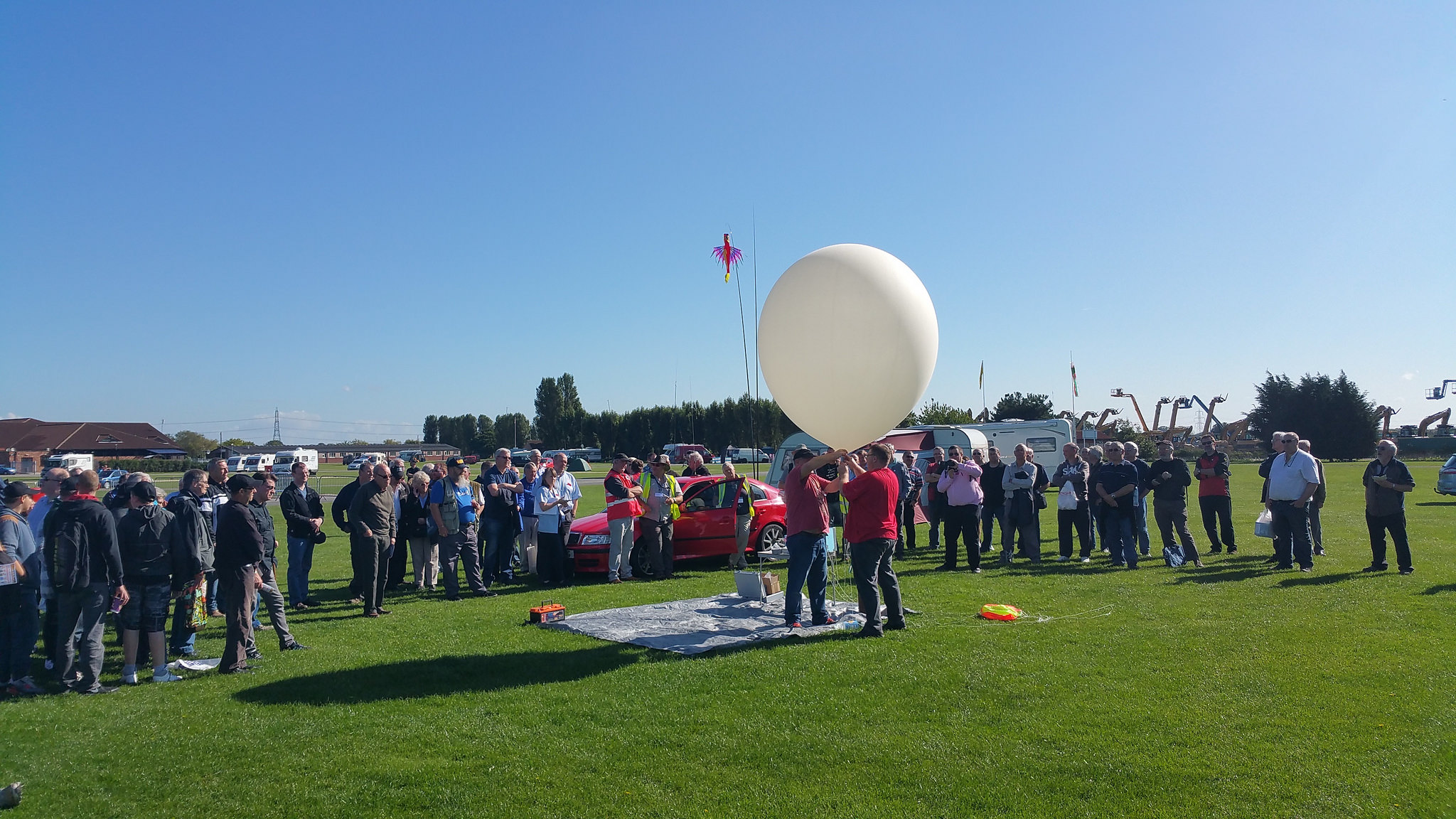
On the Saturday I was assisted by my brother David (M6GTD) and just before noon began filling the balloon watched by a large crowd, as can be seen on Dave's (M0TAZ) blog http://m0taz.co.uk/2015/09/national-hamfest-2015/
Once filled to give the correct lift I sealed it off and checked everything was working then without a breath of wind slowly let the balloon rise, taking the weight of the payloads and once I was sure there were no aircraft flying nearby I let her go. The sky was clear and the balloon went up near vertically and could be seen for quite a long time as it ascended. Representatives of the RSGB and RadCom were in attendance to take photos and did a quick interview.
The tracking station was then full of people as the telemetry and pictures started to be received. It was great to see the huge interest in the balloon.
As the balloon started to near the planned maximum altitude I began to get ready to set off to recover it then suddenly I was told it had burst sooner than expected. I got a hurry up at which point the laptop and mobile connection decided to stop working! However I knew where to head off with my poor brother trying to sort it out as I drove.
Stewart telephoned and gave me directions of where the live prediction and tracking had put the landing spot. My wife also set off from home to come and assist. In the car we were receiving a signal but were struggling to decode and couldn't get on the internet to check the tracking.
I eventually pulled up near the landing zone, while trying to decode the weak signal another car pulled up with two radio amateurs who had been tracking the balloon. I was a little preoccupied and they eventually said they were off and wished us luck. I then realised we were the wrong side of the hill and turned around and drove up to the top and the signal strength increased.
Stewart had phoned to tell me to find the Viking way footpath, as we reached ground zero we saw the other amateurs car and they were setting off down the footpath! It was my flight I wanted to be the first to find it!
My wife then pulled up and was about to set off after them! Then I started getting successful decodes! With the new landing position in the GPS my wife raced off in hot pursuit as I sorted out the car and then followed her with my brother. It was a reasonable walk of around 800m and as we got near it became apparent the other team had been using the online tracker and had only got the last received position which had been sent from around 254m altitude. However the payload was still transmitting strongly and we were decoding it and it was reporting it was in fact at 115m altitude - they were therefore several hundred meters in the wrong direction.
Our accurate location gave us the edge and a quick hop up a bank into a stubble field and a 200m jog my brother spotted the parachute... we had found Pinky and Piglet and got there first!
I was surprised to find most of the balloon still attached, it hadn't so much burst as split in a single tear
The payloads had no damage, other than the antenna being bent by the landing
PIGLET had landed as planned and tested, I had put the battery pack at the top of the box the top heavy center of gravity causing it to roll on landing so the antenna would be upright. It was in a perfect orientation hence the strong signal.
The other chase team turned up and congratulated us then left... my apologies but I was in my own little happy place to be sociable. We then then had the obligatory team photograph before setting back to the Hamfest.
It has been an excellent experience and adventure. The pictures are better than I could have hoped for! Thanks to my understanding wife, my brother David and Stewart for setting up the antennas for the tracking station and manning it on his own while we went off to recover the payload.
Thanks to the organisers of the National Hamfest and Graham Boor (G8NWC) for asking me to do the flight and helping fund the venture and I hope it succeeded in publicising the event and the hobby.
Given the latest flight path prediction, weather forecast and approval restrictions I will unfortunately have to likely postpone the National Hamfest high altitude balloon till Saturday.
The forecast for tomorrow is strong gusty winds at ground level which isn't ideal for launching, but that is the least of the issues.
The current flight predictions for tomorrow are not good. The prediction model used is accurate and for the size of balloon I have and the amount of helium at my disposal even a maximum fill giving the maximum ascent rate and assuming the calculated decent rate for the parachute it is still putting the likely landing right on the coast. Earlier in the week the landing wasn't quite as marginal but as the model's data set have been updated it has drifted further eastward, it is odds on it will actually land out to sea.
However the real show stopper was when I received the CAA approval for the launch this morning. They have put a restriction not permitting a launch if the balloon and payload is likely to go on a North Easterly or Easterly path that could interfere with operations on local military airfields.
This is the predicted flight path, generated by the CUSG Landing predictor at predict.habhub.org and the flight path currently goes directly over RAF Cranwell but not at a high enough altitude.
Flight prediction for Friday
Saturday is forecast to be a much calmer day with a predicted path as shown below
Flight prediction for Saturday
There would be no issues with the airfields for that flight path and has the advantage of going almost straight up and landing close by.
Apologies to those wanting to track on Friday, but the situation is out of my control and I would be foolhardy to ignore the prediction and it is very unlikely it will change significantly to allow a flight tomorrow so I hope you can all track on Saturday. I will still be at the Hamfest tomorrow with the equipment if you want to know more about what it is all about.
Not long now! Just three days left till the National Hamfest and hopefully the launch of my second high altitude balloon.
Balloon, parachute and helium have all been purchased and payloads have under gone final testing and have been put to one side ready for the flight which should hopefully be around 12pm on Friday 25th September.
The SSDV payload callsign PINKY
will transmit on 434.575MHz USB RTTY 300 baud 880Hz shift ASCII-8 no parity 2 stop bits.
SSDV Test image
the backup telemetry tracker callsign PIGLET
will transmit 434.150MHz USB RTTY 50 baud 380Hz shift ASCII-7 no parity 2 stop bits
They will transmit using the UKHAS telemetry protocol and can be tracked on tracker.habhub.org for information on how to receive and upload data to the tracking system visit the UKHAS wiki some information and useful links have been collated on the AMSAT-UK website
I was hoping to also transmit using the LoRa system, using the callsign PERKY. The transmitter had been successfully tested but a last minute gremlin has struck and it stopped working this weekend, I have been unable to locate the fault and suspect it is the actual module and with time being short have all but given up getting it working. If I do get it working it will be on 434.450MHz in Mode 1
PERKY seen working on SDR
PINKY & PERKY tracker
I have already detailed the PIGLET payload in an earlier post. The PINKY/PERKY payload is constructed on strip board and was originally meant to to be a prototype, hence the rubbish layout. I had planned to build a better laid out version but the tight time scale, stresses and demands of work, commitments with the radio club not to mention nursing the wife as she recovers from a major operation scuppered that plan. Being pragmatic I decided it didn't need to be work of art to work! I have secured all the connections with hot glue and it has been drop tested several times.
"Pinky" pig will be the passenger on the day, donning his fetching headset. Getting him in the right position for the camera was tricky.
I am still waiting for the CAA approval, should hopefully get it soon. I have put in a request for both days of the Hamfest just in case, the latest prediction at predict.habhub.org shows if I get the fill right I might just escape a watery landing on Friday, however Saturday looks more promising at the moment - also the forecast for Friday at the moment also has strong gusty surface winds, which could make the launch problematic. I am still planning for Friday since conditions and predictions do change.
Friday prediction as of 22/09/2015
Saturday prediction as of 22/09/2015
I and other members of South Kesteven ARS will be in attendance with a tracker station on the day, so please introduce yourself and perhaps join the club?
Please don't mention anything to do with other pigs in the news..
Already a week into September and not long now till the National Hamfest where I and the South Kesteven ARS are launching a high altitude balloon launch subject to CAA approval. The documents have been submitted so just waiting for the nod.
The balloon and parachute have been purchased from Steve Randall (G8KHW) at Random Engineering, using the same size as I did for the Eggsplorer-1
I had joked about sending some "Ham into space" on this flight but following the smelly end to Eggsplorer-1 have opted to play it safe and avoid food! Instead will be sending up a toy pig (well a small squeaky dog toy)
Similar to the Eggsplorer-1 the main tracker will be a Raspberry Pi fitted with a camera and two transmitters.
The tracker is based on the "Pi In The Sky"
code base/design by Dave Akerman (M0RPI) and Anthony Stirk (M0UPU) with
some modifications since I am building
on simple strip board using a different GPS module/interface and omitting any
power supply monitoring.
On the Eggsplorer I used an old Pi Model B but was forced to butcher it to reduce the power demand by desoldering the network/usb chip.
This time I am using a Model A+ which is smaller/lighter and has a much reduced power demand and with the locking
micro-SD card socket will hopefully prevent a repeat of Eggsplorer-1's failure mode.
PINKY & PERKY are progressing well, just waiting delivery of some strip board and they should be completed in the next day or so.
PINKY will be 300-Baud RTTY, sending telemetry along with SSDV image packets using the UKHAS format.
PERKY will be using one of the LoRa modules again sending telemetry and SSDV but with greater resolution and speed, but will require a LoRa receiver/gateway (see Dave Akerman's website).
While the SSDV is attractive to tracker enthusiasts the high speed RTTY is more difficult to receive, so I will be flying a secondary 'backup' tracker. The use of a backup proved invaluable on the Eggsplorer when the main tracker failed.
PIGLET will be a 50-baud RTTY transmission with telemetry and should prove easier to receive.
I finished PIGLET at the weekend
Again built on strip board it is based around the ATMEL ATMega128 micro-controller using the Arduino system with a number of off the shelf modules connected to it.
It has one of the GY-GPS6MV2 GPS modules I blogged about last year feeding into the UART. The NTX-2B transmitter (frequency agile version from Hab Supplies) and a I2C BMP180 pressure/sensor module (not visible as mounted to measure external conditions) It also has a small boost converter to supply 5V and extract all the available power it can from the 3-AA lithium battery pack.
One change compared to the EGG1 tracker is to use a PWM output from the Arduino to generate the RTTY tones rather than a register voltage divider (guide here) which seems to give a cleaner signal.
The antenna is simply copper wire making a 1/4 wave ground plane. The 'box' are some layers of styrofoam glued together with UHU-Por with duct tape, some straws and beads for safety. Just needs the batteries fitting and the lid fixing with more duct tape and PIGLET is ready to fly.
Full details of frequencies will be posted nearer the time.