Wednesday, 5 February 2014

Second contest, getting the hang of it.

Spent a fun evening in the shack taking part in the UKAC 144MHz contest. It was nice and warm with the heating on and I a few bottles of beers on standby!


I was a bit more organised than the 50MHz contest last week. I got the computer running the Minos logging program. Just before 8pm I raised the antenna and double checked the VSWR and had a quick listen around on the band before the start and heard a few operators setting up. All looked good and then before I knew it we were off!

Due to my inexperience I operated in 'search and pounce' mode rather than calling CQ. I kept going outside and turning the antenna in a new direction and then spent several minutes searching up and down listening out for CQ calls.

I soon made a few contacts and fumbled along but my confidence increased as I got the hang of the exchange required.

I was jotting down the information and almost made the mistake of relying on the computer logging till I made an error and when attempting to correct it end up in a total mess due to my unfamilarity with the software. Thankfully I was able to sort out the log and carried on, but lost some time doing so. 

Thankfully the rain held off but the wind was blowing quite strongly and the antenna was waving about a little so didn't have it at full height, not that full height was particularly high anyway and more often than not I suspect my antenna was pointing in the wrong direction!
  
At the end of the night I only managed 10 contacts, but was pleased none the less, scoring 930 points.

 I have made a map of my QSOs and as expected they are limited by my surroundings 


View UKAC 144MHz - 4 Feb 2014 in a larger map

Many years ago I experimented with a PMR eQSO gateway (detailed here) and when doing that I created a couple of terrain maps were created using GEOG. Geog is a suite of programs written by Andy Talbot (G4JNT), some of which make reference to a database of UK terrain heights, to provide useful information for radio amateurs (and others interested in point-point working) The software is still available on Andy's new site

Interestingly the contacts appear to follow the direction of the Trent valley, while the surrounding hills have a masking effect. The contacts to the west in the Peak District are probably due to their height!

Roll on next week for the 432Mhz contest.. another antenna I have to sort out properly.


Tuesday, 4 February 2014

Antenna up ready for UKAC 144MHz

The antenna this morning
Back in 2011 my brother won a Innovantennas 4-element LFA at the National Hamfest, he couldn't make us of it back then so I adopted it. I have used it for reception but until now not for transmission.

I should say my brother has took his foundation exam and has the callsign M6GTD, so am expecting him to ask for his antenna back at some stage! ;-)

This evening is this months 144MHz UKAC contest and I spent yesterday evening getting the antenna set up properly so I could take part. Unfortunately the antenna was damaged just before Christmas and I have now replaced the boom insulators and straightened the bent director element.

It took a while to get the antenna VSWR down to a satisfactory level, not due to any fault but simply I had the adjustable sections of the active element loop too far out. They are now almost fully in, but at 144MHz the VSWR is a little over 1:1 and across the entire 144-146MHz the maximum is around 1.3:1 so I am hoping it preforms reasonably well, even with 10m of RG-58.

As suggested I have a 'ugly' rf-choke inline, which you can see on the photo. The antenna is clamped just under the vertical collinear, and hopefully this won't affect its performance.

I can put the pole up to around 5m, but the top section isn't that substantial and has a reasonable loading with the yagi and the collinear on it, but the pole it is securely guyed so for temporary use should be okay. Well that is what I thought till I saw the weather forecast


The wind speed and gusts look a little worrying, peaking at around 40mph between 21:00 - 00:00!

The only saving grace is that I will be manually rotating the antenna I will be out checking on it regularly during the contest!

Best of luck everyone taking part...

Monday, 3 February 2014

FUNCube-1 a thank you received from space!

I posted a few weeks ago about issues I and others were having decoding the telemetry from FUNCube-1. Initially this seemed to be related to a dashboard software update, but even downgrading to an earlier version has been giving variable results.

What seems to have been the issue is a reduced quality of received signal. Operators with higher gain, optimised antennas appear not to have seen problems. Why there has been such a fall off isn't clear, the power output of FUNCube-1 hasn't altered and appears not to be tumbling.

The FUNCube team have now released a new version of the Dashboard Software. Version 820 can be downloaded from http://funcube.org.uk/working-documents/funcube-telemetry-dashboard/ The major change in Version v820 centres on improved decoding routines which give better results, especially with weak signals at low elevations and simpler antennas.

I have been running this now for several days and can confirm it is much better, as promised low elevation passes now get successful decodes and night time passes when the telemetry is on low power get successful decodes something I wasn't getting before.

Now I have the shack sorted I have set up a dedicated receiver using the original FUNCube Dongle using the X-30 white stick collinear and this has been pulling in decodes nicely.

This morning I had surpassed the 2000 telemetry decodes milestone, as can be seen on the rankings page.

Another nice result over the weekend was seeing my callsign in one of the FITTER messages
It is a nice touch that the FUNCube-1 have started acknowledging the receivers, hopefully with the improved software there will be more participants.

The next stage for me? Well must sort out trying to have a QSO via FUNCube-1 and the other satellites..

Friday, 31 January 2014

Wireless Woes


It was always my intention when I had my workshop/shack installed to install a permanent wired network link, however I never did and now it would prove a logistical nightmare.

When I first got wired up to the Internet with Diamond Cable back in the late 1990s it was via a second telephone line fed in to the 'computer room/study' which in reality was the small 'box/bedroom' at the front of the house.

Diamond Cable became NTL/VirginMedia and with the introduction of proper broadband the Cable Modem naturally got installed in the same front bedroom. I have always had several computers networked together but mostly in the same room via cables.

I eventually got a router with wireless capabilities the ubiquitous Linksys WRT54G and gradually more and more devices have been linked wirelessly. Laptops, smart-phones, a modified original X-Box running XBMC to play videos on the TV, Netgear MP-101 media player and a Nintendo Wii. More recently my new Canon printer and Samsung SmartTV are now connected to the wireless network.

Over the years I have acquired different routers and access points but I kept going back to the WRT54G as it didn't have as many compatibility issues and since the firmware was upgraded to Tomato and has proved to be rock solid. It covers the house reasonably well, but not so well at reaching the shack in the back garden, most wireless devices just give up. If they can see the network they seem unable to maintain a link.

When I fitted out the shack I was forced to find a solution. I could have gone out and got a wireless booster to fill the blackspot, but as I had a collection of various wireless routers/access points I investigated possible solutions that didn't involve any expenditure. I made the assumption that the superior antennas and design of the RF circuits in the access points would overcome the range issue. I was sort of correct and in the end I managed to get a Netgear WNR2000 configured using WDS to connect to the main house wireless.

Sadly the WNR2000 is quite frankly rubbish and often needs to be rebooted to get the link established, when it works it is great but too often it doesn't! The other major issue was the implementation of WDS will only work with WEP encryption.

WEP is potentially insecure, I was getting more and more concerned about this so when I finally deprecated the last remaining WEP only devices in the house I have switched to WPA, ironically I had hoped to use WPA2 but alas some devices are WPA only!

Doing this has broken the shack network so I was back to square one. During the recent forced clearout I found a forgotten Buffalo router, mind you looking back you can see why I had forgotten it.

A quick check and joy of joy it turned out to be a WHR-HP-G54, a device supported by the Tomato firmware, so was duly flashed up to version 1.28

I have now got it setup as a Wireless Ethernet Bridge and seems to be working well (I may have been a bit harsh on Twitter back in 2009!) and seems more importantly to be relatively RF quiet compared to the Netgear WNR2000 A good result!

Now I have some connectivity should make next weeks 144MHz UKAC contest a little easier, if I can the 2m antenna sorted and work out how to use the logging program.

Oh and the picture at the top? From South Park "Over Logging (or The Day the Internet Stood Still)"a classic episode!

Wednesday, 29 January 2014

My first contest

Last night I attempted my first contest, the RSGB 50MHz UKAC

I am a complete novice at using HF, in fact I am a complete novice at transmitting anything!

My Chinese Baofeng handhelds have pretty much collected dust since getting my licence. However with the purchase of the FT-857D I must, despite my trepidation, step up to the microphone.

I had hit a snag when testing out the new radio, my antenna was showing high VSWR on 6m, even with the ATU I was struggling to get it to 2:1, therefore I decided to construct a simple dipole and sling it up with an ugly choke 'balun' I had constructed.

Due to some unexpected delays I was running out of time but eventually did manage to get something up, it was only around 2 meters off the ground and the VSWR still wasn't ideal, but I was ready.

At the appointed time, well nearly an hour late I started turning the dial and was met with a load of static, wasn't hearing anything! This continued for a quite a time then suddenly I started hearing "CQ Contest  CQ Contest" I listened in for a while to try to get the gist of the exchanges, wandering up and down the band.

Then I decided to have a go at a QSO, giving my callsign out, I waited nothing! "QRZ CQ Contest CQ Contest" another go.. still nothing.. and so on..

Changed frequency to another stations, tried again and I was heard, but they couldn't make out my call sign despite several attempts.. another change of frequency and the same results.

Now I know I had only got it set a 5W, the lowest I can till I get some confidence in my set up and am not going to damage anything! But I was a little disappointed, but I persevered until suddenly I was in the middle of my first contest QSO and my brain turned to jelly..

Thanks to M0MDY and his patience and prompting I successfully completed the QSO, details suitably written down. I carried on with no luck and called it a night just after 10pm, and went back in the house and manually entered the details of my solitary contact on the RSGB Contest website www.rsgbcc.org

Checking this morning and there I am at the bottom of the list, but not the very bottom, with a whopping 48 points.

http://www.rsgbcc.org/cgi-bin/claim.pl?Contest=50MHz%20UKAC&year=2014

Roll on next week, it is the 144MHz UKAC and I have a proper 2m YAGI... just got to work out how to mount it up on the poll and how to rotate it..

73s

Sunday, 26 January 2014

All systems go...

Excellent service from Waters and Stanton, Radiozing and M0CVO Antennas meant my FT-857D, PSU and HF antenna arrived the day after I ordered them. They have however sat in the boxes while I have struggled to reorganise my workshop/shack after the Christmas chaos.

I have disposed of a lot of junk being quite ruthless to reduce the clutter and have completely changed the layout, increasing the size of the desk and putting it on the other side of the room next to the workbench, which is much more logical.

The new look operation centre
I have finally summoned up the courage to drill a large hole in the wall to allow the antenna coax to enter properly, previously it has been done by squeezing it around the door!

Unfortunately the weather this weekend has been horrendous, yesterday I planned to erect the antenna but gave up following the intense squall which hit in the afternoon with thunder, lightning and hail! Today hasn't been much better with heavy rain for most of the day, the rain did finally eased off so I managed to erect a temporary mast with the 144/430MHz collinear on the top and the HF antenna underneath.  I know this isn't ideal as the mast is metal and may affect the HF, but seems okay. The forecast for the next few days is also a bit worrying but the mast is guyed at two heights so should be secure.

The antennas, with the stormy sky behind
I have literally just turned on the FT-857D and had a quick listen on the bands, it is very daunting for this first timer! The first thing I have worked out is how to drop the power output, current set a 5W for HF and VHF/UHF
 

I have a power/swr meter suitable for HF/VHF and UHF I purchased at last years Hamfest and I have it connected in the setup, and was trying to check the SWR but it wasn't registering anything when I pressed the PTT then I realised that with SSB enabled it wouldn't!! Switching to FM and I was able to check that everything was okay... Beginners mistake I know!

Now off to read the manual..

Tuesday, 21 January 2014

Got a proper radio, well it's on order!

Well I've finally done it..

I have ordered my first proper 'rig' It is a Yaesu FT-857D a nice small, portable/mobile unit that will give me access to the HF and 6m/2m/70cm bands in all-modes. It has took a while since I first identified it as potential purchase but thanks to some generous Christmas presents I now have the sufficient funds and following several recommendations have decided to take the plunge and ordered it from Waters and Stanton

She is a beauty!

I have a decent 7A PSU, purchased last year which I am sure would have sufficed for 10W maximum operation however I decided to also purchase a MAAS SPS-30-II 30A(35A peak) PSU. It was a good price from Radiozing and offers plenty of power for anything I am likely to run in the foreseeable future, and from the pictures and reviews seems to be built like the proverbial brick out-house. As well as the main connectors on the back it has spring clip terminals on the front as well as a cigar lighter type connector. Dual meters showing V/A and can be used in variable mode from 9-15V or fixed at 13.8V 
This is the beast!
I have also ordered one of M0CVO Antennas highly rated HW-20HP off centre fed dipoles as a starting point for HF. The antenna works in 6 bands (20, 17, 15, 12, 10 & 6m) without needing an Antenna Tuning Unit (ATU) which is one thing I haven't purchased, however Nigel(M0CVO) Chairman of SKARS (South Kestevan Amateur Radio Society) and owner of M0CVO Antennas has kindly offered to loan me an ATU in the short term.

Delivery should be later this week and I suspect I have a large learning curve ahead of me as I hit the airwaves! If you should hear me please be gentle..

Thursday, 16 January 2014

FUNCube Decode Issues

I had a pleasant surprise last week at the AGM/Prize giving evening of the South Kestevan Amateur Radio Society (SKARS) being awarded the Most Promising Newcomer!

I also had a small write up in Tim Kirby's (G4VXE) VHF/UHF section of the February issue of Practical Wireless about my I-Cube1 reception which I have mentioned on here before.


I haven't progressed very far with my Arduino projects. There has been a set back in the plans to build and use an Ultimate3 QRSS kit. I had incorrectly assumed as it was a kit being sold commercially that it would satisfy my foundation conditions. However I have been advised that Foundation license holders may use radio equipment constructed using commercially available kits which satisfy IR 2028 which is all a bit vague and woolly, but I don't believe this particular kit does.

There is a simple solution, I will just have to take my intermediate assessment and exam at the first opportunity!

I have been doing a little WSPR spotting, getting some nice spots.


Over the Christmas/New Year period I have neglected the FUNCube-1(A073) satellite and was slipping down the telemetry upload rankings, sad I know!

Now I have got back the upstairs 'shack' I set up my original FUNCube Dongle on the laptop running the dashboard application continually to capture/decode the telemetry using the loft mounted discone. I took the opportunity to upgrade to the latest version 8.14 of the dashboard software, however something was amiss when checking the statistics I was only adding the odd frame here and there, sometimes not making a single decode during the high power daylight passes.

I switched back over to the newer FUNCube Dongle PRO+ running my main PC, which I had also updated to the version 8.14 dashboard and saw the same behaviour, rather than getting daylight decodes of 30+ frames I was just getting the odd 1 or 2.

My first thought it was an antenna or interference issue, but checking the SDR waterfall the signal is still very strong with little QRM. Suspecting a software issue introduced by the update I checked the FUNCube forum and found a thread which appeared to confirm my suspicions.

I have a number of discussions on twitter with various people including David Johnson (G4DPZ)  an AMSAT-UK Committee Member and one of the developers of the FUNcube ground segment. David kindly performed an analysis of one of the passes yesterday where I managed just 2 frames, and from the results it does appear to be an issue at this end, rather than issue with the spacecraft.

I have uninstalled v8.14 and put back on an earlier version of the dashboard (v8.09) and thanks to a windows update last night have also performed a full reboot!

There was a good pass this morning at 62 degrees maximum elevation (to the east), followed by a lower pass at 22 degrees elevation (to the west so not so good) and it seems things have improved managing 68 and 17 frames respectively. So could this be an issue with the latest dashboard?

If anyone has suffered similar performance fall-off, or indeed not suffered any issues then please add some feedback to the FUNCube forum.

My copy of Radcom arrived but didn't have much time to read it..


The culprit! ;-)

Friday, 3 January 2014

Another Day Another Arduino Project

Yes another day, another Arduino project (seriously this is a great development environment)

As I mentioned in passing yesterday I have a number of Arduino based projects buzzing around in my head. One of them is to produce a satellite antenna pointer/indicator.

I have used an Android AR tracking solution before (flaky at best) and can see the relevant information in Orbitron or SatPC32 to know where to point the antenna but it is difficult to see a PC screen when stuck out in the middle of the lawn!

My idea is this, I will make a large tripod to which I can attach appropriate antenna as I need, then during the satellite pass it has indicators to show where to point the antenna manually.

I envisage the azimuth indicator to be a large horizontal circle with 36 LEDs positioned at 10 degree intervals, the elevation will be a quarter circle with 20 LEDs positioned at 5 degree intervals. Then during the pass the appropriate LEDs will light and assuming I keep the antenna aligned to these I should in theory get the best signal... Crazy??

Yes I know I could make or buy an azimuth/elevation rotator, eBay is full of low speed high torque geared DC motors with auto-stop/hold and numerous software solutions exist to drive them but this would require a bit more engineering and isn't something I can easily fabricate at the moment. My contraption would be much more rustic being made of rough cut timber!


Bright LEDs are ridiculously cheap and controlling this number from the Arduino will require the use of multiplexer drivers. The popular ones are the MAX 7219/7221

I won't go into the details of exactly what multiplexing is, other than to say that each display element (LED) is driven one at a time but by switching the electronics at high speed combined with the persistence of vision make the viewer believe the entire display is continuously active.

This technique can be used for individual LEDs, an LED grid matrix, or for 7 segment displays. Last night I successfully got a MAX7219 based 8-Digit 7-Segment LED module working.


The next stage was to investigate how an Arduino could calculate the appropriate azimuth and elevation data. Thankfully a library already exists qrpTracker (code is here), within this library is a port of the Plan-13 algorithm first written in Basic by James Miller G3RUH in 1990, subsequently ported to C by Edson Pereira, N1VTN and further updated by Howard Long, G6LVB.

Plan-13 processes keplerian elements, time and (optionally) observer location, and uplink downlink frequencies; it outputs satellite latitude and longitude, azimuth and elevation, and Doppler shifted frequencies. At the standard 16 MHz Arduino clock speed, this code can complete these calculations in approximately 30 ms. This code is reported to be highly accurate, if provided with proper data.

The important data are the observer location (longitude/latitude) and the current time. Step forward my well used GPS module which once lock is achieved can supply that data.

The next is get the appropriate up to date Keplerian twin element sets (TLE) and extract the appropriate information from it and pass that data to the Plan-13 functions.
 
The standard TLE follows the following format

You need to extract the Epoch Year/Day (including partial data), Inclination, Right Ascension, Eccentricity, Perigee, Mean anomaly and Mean Motion for a calculation (drag/orientation aren't critical) For the moment I have just extracted this manually from the latest TLE and entered it directly into the program.

After just an hour or so of research and programming I have the LED displaying the current azimuth and elevation of the FUNCube-1 satellite (AO73) based on the current position and time derived from the GPS!


The first four digits is the azimuth, the second four the elevation.


The next stage is to sort out the LED disc indicators, build the antenna tripod and formulate a method to upload the appropriate up to date TLE files from the PC which can be stored in the EEPROM of the micro-controller.
 

Thursday, 2 January 2014

Arduino, WSPR and AD9850 DDS experiments

Happy New Year!

Christmas is thankfully behind us so I can get back to what I enjoy doing once I have reorganised my workshop.

As you know I am currently developing a potential High Altitude Balloon (HAB) project and have been experimenting with the Arduino microprocessor platform and have constructed a basic prototype.

With the arrival of the GPS module(s) I have had it successfully working and even took it out for a test walk in the local area, receiving the data and uploading it to the UKHAS habitat system.


This project has revitalised my interest in 'hobby electronics' and I have ideas for a number of other Arduino based projects and have been splashing out on components from eBay. Just before Christmas I purchased an Arduino Mega board, this has more I/O pins than the current Uno and specifically some extra hardware serial ports.

Do any internet search for Arduino based amateur radio projects and it will results in numerous mentions of projects using ultra cheap DDS modules based on the Analog Devices AD9850/AD9851 chipsets.

DDS means Direct digital synthesiser and is a type of frequency generation which can be used for creating arbitrary waveforms from a single, fixed-frequency reference clock. Read the Wikipedia page for more details.

In a nutshell the AD9850 is a chip that under microprocessor control can produce a sinusoidal wave from about 1hz to 40mhz. In other words it is an accurate microprocessor controlled VFO (Variable Frequency Oscillator) or signal generator.

VFOs are the main building blocks of radio receivers and transmitters, so not surprisingly a lot of projects have utilised these modules, rather than the traditional means. Intrigued I ordered a couple of these modules for the pricey sum of £3.50 each!

Using information on George Smart's (M1GEO) website and Simon Kennedy's (G0FCU) blog  I quickly had a simple WSPR beacon running!

The Arduino uses the GPS module borrowed from NERD-1 for accurate time and then controls the output of the AD9850 DDS to generate the WSPR signal.

Before anyone panics I know at the moment I only hold a Foundation Amateur Licence so the construction of homebrew transmitters isn't allowed. This 'beacon' has no power amplifier and the antenna consisted of an inch or so of wire on the DDS output. I was able to verify the operation using my SDR receiver in the same room.

Construction of commercial kits is allowed under my licence so I have ordered a Ultimate3 QRSS kit from Hans Summers for the pricely sum of £17.50! This uses the same DDS module and same microcontroller as the Arduino.

In the meantime there is also more information and ideas on Eugenr Marcus' (W3PM) webpage about the use of these DDS modules, including making frequency reference sources and calibration using the GPS module.

My new year resolution is to get my Intermediate Licence as soon as possible..  but it has been great to get down to some proper experimenting...

Wednesday, 18 December 2013

Mentioned in Practical Wireless! and some Christmas stress

I am not a fan of this time of the year. I know Christmas is supposed to be a time for joy and a time for families to re-connect and come together. Well this year it is true, the only problem is they are all coming here for Christmas day, night and Boxing day!

This has meant I have had to tackle some long put off home renovation projects. The first was to redecorate the bathroom and what should have been a simple paint job has snowballed into a major project and has sapped a lot of free time. Thankfully it is now all but done.

The second was to turn the third bedroom back into an actual bedroom rather than the study/computer room/indoor radio shack it had become. Again this involved more work than planned including dismantling and remodelling of a home-made desk and the removal of piles of collected radio/computer junk and books.

The upshot of all this work and de-cluttering is my outside workshop has turned into a bomb site! Most of the junk has been dumped in it and it is very untidy with tools scattered everywhere. I also had a minor catastrophe when trying to retreive a workmate when my beloved 2Meter YAGI, fell off its perch breaking off the reflector and a director! Thankfully Justin at InnovAntennas was able to sort me out some replacement boom insulators

With all this upheaval, combined with work pressures I have been unable to really do any radio or electronics for most of this month. Do I sound like the Grinch?


Despite this I have been able to capture the odd FUNCube-1(AO73) pass and have nearly reached 1000 telemetry packets.

It came as a pleasant surprise was finding out I was mentioned in the January issue of Practical Wireless magazine. Tim Kirby (G4VXE) reported on my ISS SSTV capture and APRS experiments. Tim  the magazines VHF/UHF editor has his own blog and is someone I converse with on twitter (@G4VXE)

I realised I didn't blog my SSTV capture back in October, but did post it on twitter feed (@nerdsville)
Here is a scan of my mention and the picture.. I can forgive Tim misspelling my name, it happens a lot! It also seems I might get mentioned in the February issue to following my ICube-1 reception report.

From Practical Wireless - January 2014 Issue

From Practical Wireless - January 2014 Issue

Saturday, 30 November 2013

ICUBE-1 Reception Reports Needed

I have been messaging with Dr Khurram Khurshid the manager of the ICube-1 team and they are struggling a little

 ".. we received icube for a couple of days using FunCube / HumSat TLE's but not anymore we are looking for our own TLE's but haven't been able to track icube for the past few days"

They may officially ask for assistance but after unexpectedly making the first signal report back on the 21st November, I thought I was just ask if anyone could keep an ear out.

ICube-1 was released as part of the UNISAT-5 payload and if still functional is in CW mode on 145.947MHz and the message is "First Cubesat of Pakistan"

Some info/links http://amsat-uk.org/2013/11/25/unisat-5-mission-update-november-24/

I have done an analysis of my first capture  http://nerdsville.blogspot.co.uk/2013/11/im-famous-and-icube-1-move-and-velox.html

 The ICube-1 facebook page http://www.facebook.com/ICUBE1

Thanks Andrew M6GTG

Tuesday, 26 November 2013

I'm famous! and ICube-1, MOVE and Velox-PII telemetry decodes

My confirmation of ICube-1 successful deployment was featured on the AMSAT-UK website on Sunday.

Screenshot of the Amsat-UK webpage
My very quick and patchy decode of the CW beacon was sufficient to identify and verify ICube-1 but I had only been able to decode the words ***ISTAN and CUBESAT. For my own pride I wanted to decode more of the CW message "iCUBE-1 First CubeSat of Pakistan"

I had the IQ file from SDR# so could process it as much as I needed and have used a couple of Morse/CW decoder tools before, but find the free ones often struggle with the faint Doppler shifting CW, just a little too much noise and not enough signal.

Audible decoding isn't an option (yet) but I can visually decode, but the signal going up the waterfall shows the dots and dashes but is too quick for me, and ideally I would like it horizontal rather than vertically.

Then I remembered I had installed Spectravue a few years ago, Spectravue is a powerful spectral analysis/receiver program primarily for use with SDR devices, it was the program used to calibrate my first FUNCube Dongle.

Spectravue is able to take the IQ file and play it back at varying speeds, it can demodulate signals and importantly allows pausing of the playback and easy access to the section of interest, something SDR# is sadly lacking, also it allows a horizontal waterfall display and the ability to save images.

I set about processing and decoding and as you can see from the screenshots below, I managed to identify most of the message (the letters have been added later) The FUNcube-1 telemetry signal can be seen at the top of the images, along with some QRM.

Partial decode of ICube-1 CW beacon

Partial decode of ICube-1 CW beacon

During the process I also spotted two further signals from Velox-PII (145.980 MHz) and the First-Move Cubesat (145.970 MHz) - both of these were recorded in the first decent pass over the UK after deployment  (10:21 on 21 November 2013) the incorrect time shown on the bottom of the screen shots comes from the fact the files processed were copies and the file time stamp had been altered in the process.

I can only wonder when the first reception reports were made? Then again I shouldn't be greedy, one first-to-report is probably enough ;-)

Velox-PII Telemetry/CW beacon

First-Move Telemetry and partial ICube-1
VELOX-PII is the first Singapore picosatellite to operate in low-earth orbit, and was developed under the Nanyang Technological University’s Undergraduate Satellite Program. Details here including how to read the telemetry message.

FIRST-MOVE built by students at the Technical University of München. MOVE stands for München Orbital Verification Experiment. Details here

Thursday, 21 November 2013

Did I make ICube-1's first signal report?

Just like a excited child at the moment! Why you ask? 

Well this morning saw the launch of the numerous satellites from the Dnepr rocket including Funcube-1, and this morning saw the first passes over the UK. Like many others I eagerly sat in front of my computer awaiting the chance to decode the telemetry. However I was doing it remotely using a VNC connection as I was in work...

Sure enough at 10:21 the pass started and a nice strong signal appeared on the waterfall and the FUNCube dashboard sprang to life. I managed 29 packets on the first pass!

The upload ranking at the FUNcube data warehouse

However I noticed another CW signal further up the spectrum which seemed to be on the edge of the FUNCube transponder allocation (145.950MHz) I went to twitter and asked if FUNCube-1 was transmitting a CW beacon? Peter 2E0SQL thought it might be another satellite.


I had captured the pass as an IQ file, and set about trying to decode the CW. I had several attempt using fl-digi remotely but chasing a fast moving doppler on a laggy remote connection wasn't good but I seemed to repeatedly get ***ISTAN.

On the next pass the same thing happened, this time I got the word CUBESAT several times..

The signal had the same doppler shift as FUNCube-1 so was from the same launch constellation and a quick check and I spotted ICube-1 the first cubesat launched by Institute of Space Technology in Pakistan.. which was listed as broadcasting on 145.947MHz using AFSK.

It must be.. ***ISTAN... CUBESAT.... So I sent them a message on their Facebook page and they confirmed that at this stage of the mission they were indeed supposedly broadcasting a CW beacon and what I decoded was part of the message!

Khurram project manager of ICube-1 said "Thanx Andrew ... your message was a great relief for us"

and on their facebook page 
First Signal has been received from ICUBE-1 in UK ... Alhamdulillah the ICUBE-1 mission is successful ... Congrats everyone. Satellite will pass over IST around 9:30 pm today


So it seems lowly M6GTG may have made the first signal report confirming Pakistan's first successful cubesat deployment!

I am grinning madly at the moment!


Wednesday, 20 November 2013

November Satellite Madness!

I haven't done any satellite tracking of late, however this month sees 37 satellites being launched carrying amateur radio payloads. Yes 37!!

Yesterday three cubesats Pico Dragon, ArduSat-1 and ArduSat-2 were jettisoned from the ISS using the JEM Small Satellite Orbital Deployer (J-SSOD), a fourth TechEdSat-3p was released this morning.

Today also saw the launch of Minotaur-1 from NASA's Wallops Island containing 29 satellites, 12 of which are amateur payloads, they have all been deployed.

Tomorrow sees the Yasny Dnepr launch carrying 31 satellites, of which 21 use amateur radio allocations, including FUNCube-1.

Get along to the FUNCube website http://funcube.org.uk/ for further information and to download the handbook and the dashboard telemetry application, after all this is what those FUNCube dongles were designed for!

For up to date information check out the Amsat-UK website, and here is a handy link for a full list of payloads and frequencies http://amsat-uk.org/2013/11/13/three-amateur-radio-satellite-deployments-in-november/

 photo 71dca420-14bc-4c88-9bd2-1ac043cc785e_zpsad07389a.jpg

Thursday, 14 November 2013

NERD-1 development prototype

The NERD-1 HAB development prototype has been coming on in leaps and bounds. The first stage was to take the breadboard transmitter layout and construct a veroboard 'shield'  the transmitter module plugs into some sockets and the addition of an enable control allows me to turn it off and on. What cannot be seen on the photo below is a dual-colour LED to indicate the fix status of the GPS.

Veroboard shield with transmitter fitted
I am still waiting for delivery of the uBlox GPS module/breakout board which is on a slow boat from China, but in the meantime I have purchased a number of other breakout boards (pictured below) to evaluate potential additions and to generally experiment.

Top-Bottom, SD Card module, RTC/EEPROM module and GY-80 IMU
These include a SD Card module, which will be used to log flight telemetry via the SPI interface. The board on the right is a Real Time Clock (RTC) including a button cell and some EEPROM memory accessed and controlled via the I2C/Wire interface. This really isn't needed but was literally a couple of £s.

The smaller board at the bottom is the really interesting one! It is a GY-80 IMU clone, containing a three-axis gyroscope, three-axis accelerometer, three-axis magnetic sensor and a temperature and pressure sensor, again all accessed simply via the I2C interface. Popular in aeronautical RC and personal UAV projects such as Quadcopters it seemed worthy of some experimentation.

All the devices were purchased from Etang Electronics on eBay and was impressed as it all arrived the day after ordering.

I am using the only proper serial port for the GPS data and  I wanted some method of getting debugging and instrumentation from the device during testing. I could have constructed a software serial port but I had an unused LCD character display so decided to connect it up (won't be included on a proper payload!)

It looks nice and is 'cool' however the backlight LEDs do draw an awful lot of current so have been disconnected since the picture was taken.

LCD Character display
At the moment the whole thing is a little messy, but is functional and sits in it's own foam lined box!

The prototype connected up (still no GPS module)
The software development has been pretty straightforward, I am no stranger to the use of I2C and SPI in my day job and there are plenty of software libraries and guides available. Once I have perfected the software and settled on the final design then I am planning on constructing a veroboard flight prototype with all the unnecessary parts removed.

I have also yet to investigate another transmitter unit I have purchased.  

Friday, 8 November 2013

NERD-1 HAB Development begins!


The prospect of developing a High Altitude Balloon payload doesn't fill me with dread, after all "embedded software engineer" is my day job. It is a varied job including PC, Linux and other programming but it is mostly microcontrollers and associated electronics.

What did fill me with dread was the prospect of going out and getting some development kit! I like to switch off from work when I get home so I have never duplicated a development set up at home to resist the temptation to carry on working. So how was I going to go about this on a small budget?

The obvious solution was to use one of the educational and hobbyist systems like the RaspberryPI, Arduino, Propeller or BeagleBoards which have become increasingly popular. I hadn't kept abreast of any of them but after examining the work of HAB enthusiasts and some very rudimentary research I decided to try one out and the cheapest was the Arduino route.

So a quick trip off to eBay and I got hold of an 'Funduino' (an Arduino UNO clone) board for £9 and ordered a uBlox GPS module/breakout board from China (which is still to arrive) as well as a couple of radio modules including the Radiometrix NTX-2 used in many HAB flights.

We call me impressed, after installing the Arduino development system I had the board flashing an LED within 30 seconds! When I was learning electronics and computing back in the early 1980s at school I would have killed for a platform like this!

I took the liberty of downloading Steve Smith's (G0TDJ) ProjectHAB VAYU ino file as a starting point. This ino or 'sketch' file is Arduino terminology for a project. They may be called 'sketches' but rarely has any of my software ever been called a work of art!

This iteration of VAYU uses the RFM22B radio module controlled by SPI, whereas the NTX-2 is much simpler to control using a digital output and a few resistors. There are many handy guides on the UKHAS Wiki

The GPS data will be coming in serially on the UART the same as VAYU so it was trivial to make the modifications and remove the SPI control to get a barebones flight computer running. I was able to breadboard the NTX-2 and had it successfully transmitting from my lounge floor. It even passed its first environmental test of having one of my dogs lick the circuit board while powered up!

UNO and breadboarded NTX-2
The RTTY transmission being received in another room.
However the current payload might be a bit heavy even for a large latex.
 
The Payload!

The blue mouse shaped device on the left hand of the laptop is an old Haicom HI-204 GPS module which I have had kicking around for years. It is actually a serial device which once powered up starts outputting NMEA data at 4800 baud, this model has an intergrated serial-usb adapter.

When not running the Arduino IDE the UNO board appears as a standard serial port on the PC and can accept or output data, so all I needed to do was route the serial data from one port to another.

I of course made more work for myself by deciding to taking the open source SharpGPS C# based windows program and customising it. As well as decoding it can now forward the data and NMEA sentences from a GPS device on one port to another serial port. It can now log the raw data and play back logs to emulate a device for testing.

The nice thing is this program informs me of the location data, fix status and information about satellites and if and when I iron out some of the remaining bugs and quirks it will make a nice utility which I will make available. Here are some screenshots of it in action.


Now to the next stage....


Wednesday, 6 November 2013

SKARS HAB Presentation

Since my last update I have joined the South Kesteven Amateur Radio Society (SKARS) The society are looking at possible balloon launches as part of the Gravity Fields Festival 2014 In a rash moment I offered to give a talk and demonstration of HAB and HAB tracking for other members.

So last week I nervously turned up with my laptop and some kit. I had created a Power Point presentation to hopefully explain the whole concept. It was an introduction to HAB, the types of payload and balloons how they work, how operators track the flights and the UKHAS and its HabHub system.     


To demonstrate the use of the DL-FLDIGI decoding software I had a few SDR recordings which I could play back. I also wanted to show how you could use a conventional receiver so I created a 'demo payload' in a plastic lunch box.


It consisted of a simple PMR446 radio in VOX mode, connected to a MP3 player which was playing back a recording of a typical RTTY HAB payload. Steve Smith G0TDJ of ProjectHab was good enough to supply me a 4 minute recording of his VAYU-1 payload made when he was testing it.

I then had a scanner which received the transmission, so being clearly audible I was able to plug a lead into the headphone socket and the microphone input on the laptop to show the decoding.


I also demonstated some SDR recordings being decoded which illustrated the QRM, signal fading and drifting and some of the modes in use (RTTY/DominoEx). I also had videos showing the http://spacetracker.us/tracker in action (also posted on here).

Despite being apprehensive I actually quite enjoyed giving the talk and hopefully those that attended were entertained and found it informative.


Since then I have took the plunge and ordered a couple of transmitter modules including a Radiometrix NTX-2, an Arduino UNO development board and a uBlox GPS module so can start developing my own payload. So hopefully if I am asked by anyone else to give a talk I can show a live demo!

Friday, 18 October 2013

My APRS broadcasts received by the ISS

This evening I managed to successfully send some APRS messages to the International Space Station that were successfully digirepeated. It might not be a major technical achievement but after monitoring and decoding many passes in the past to now actually send something myself 300 miles up to something traveling at 5 miles/second left me feeling a little chuffed!

I screen capped the evidence from the website http://ariss.net which documents Amateur Radio data digipeated by the ISS. In order to appear on the page, a position report in a valid APRS format must be received and then digipeated through the ISS system, then be heard by an internet gateway station, which then forwards it on to the APRS Internet System.

Okay it sounds a bit more impressive when put like that ;-)

The map showing received stations, M6GTG is me!
The detail of my report
List of stations with time stamps, showing me!
List of digirepeated messages
The equipment I used was very similar to that I used for the APRS IGate setup last month.

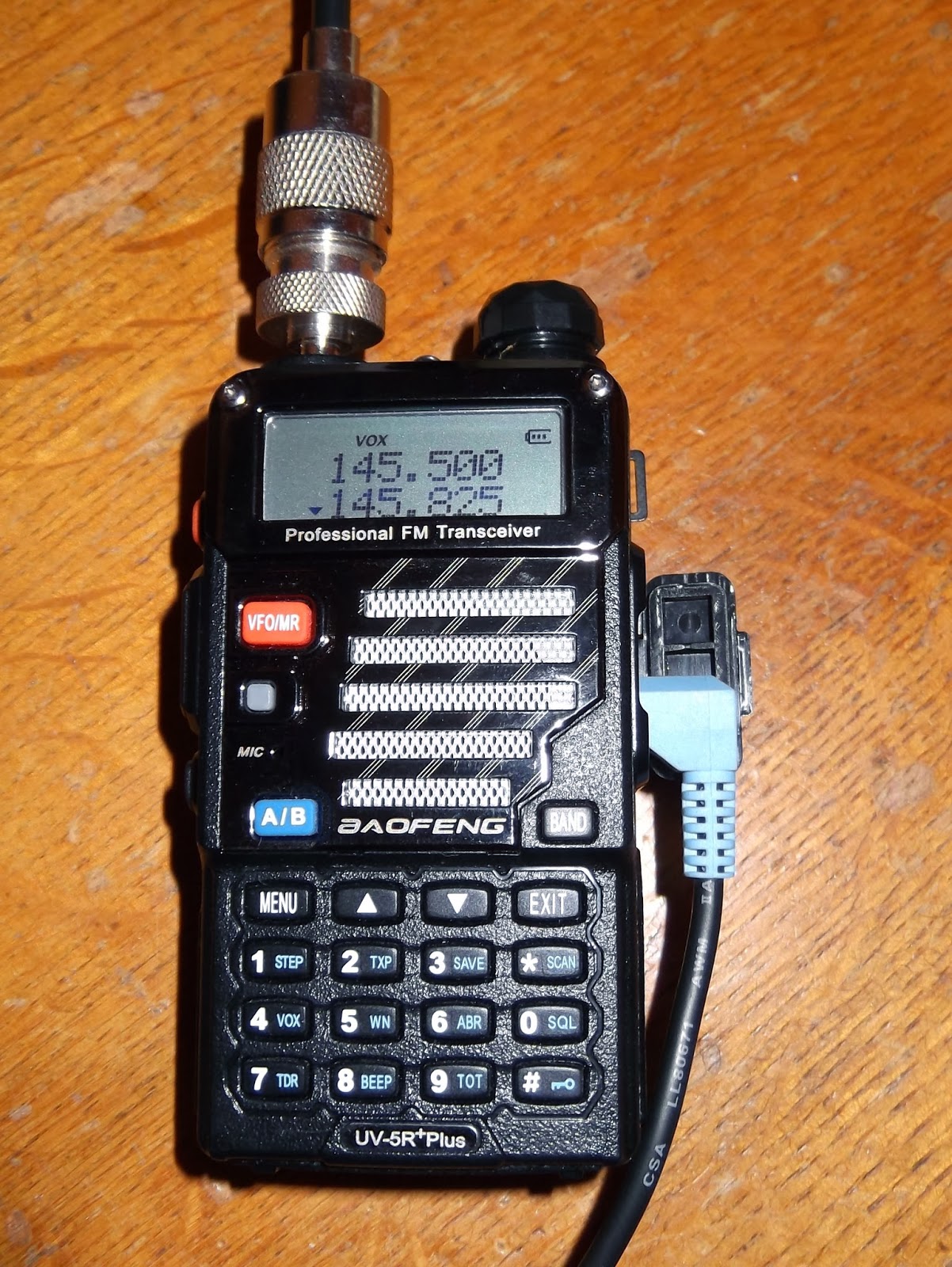
It consists of a small embedded PC running embedded XP, the sound card output was connected to the microphone input of my Baofeng UV-5R+ operating in VOX mode set to 145.825MHz. The radio was connected through my power/SWR meter in to the X-50 antenna. I used the UV-5R+ instead of the UV-3R since it has a little more power and better audio. I had a SWR of around 1:1.2 and outputting 4W.

The software I used was UISS from ON6MNU and the AGWPE packet engine. It has taken a little time to work out how to setup UISS into auto-beacon mode and putting in the time of the next decent pass (approx 45 degrees elevation) I set it to broadcast position and text data messages every 30 seconds.

The embedded PC running UISS
UV5R+ in VOX mode on 145.825MHz
The power meter showed 4W output, SWR about 1:1.2


I stood out in the dark, hoping to see the ISS pass over but the cloud cover was too thick and monitored using a handheld scanner. I heard my transmissions obviously and the ISS broadcasts as it repeated received messages, but I didn't know if any were mine till I got back to the PC.


Thursday, 3 October 2013

ProjectHAB

Well this a shameless plug for Steve Smith (G0TDJ) and his new ProjectHAB website/blog.

I met Steve last month at the International UKHAS 2013 Conference and he is embarking on his own journey into stratosphere and is busy building and programming his own payload. Steve had an exciting introduction into HAB tracking when he preformed an impromptu recovery of  Chris Stubbs (M6EDF) CHEAPO4 payload.

Steve with Chris Stubbs’s CHEAPO Pico balloon and payload after recovery

On a related note last night I attended a meeting of SKARS who themselves are looking at possible balloon projects for Gravity Fields Festival 2014

Tuesday, 1 October 2013

First reception of DANDE satellite

The US SpaceX company successfully launched a new upgraded version of its Falcon 9 rocket from California’s Vandenberg Air Force Base. The vehicle, carrying the Canadian Cassiope research satellite, lifted off at 16:00 UTC on Sunday, September 2013.

In addition to the main payload two satellites, DANDE and CUSat, carrying amateur radio payloads were also launched into orbit, both satellites have been reported as functional and transmitting away. Last night I had an attempt at receiving DANDE.

From Amsat-uk
DANDE stands for “Drag and Atmospheric Neutral Density Explorer.” Measuring drag and neutral particles in the lower atmosphere between 325-400 kilometers, DANDE will be measuring real time density, quantifying variations in altitude and over time, as well as providing in-situ model calibration data. The satellite is a low-cost density, wind, and composition measuring instruments that will provide data for the calibration and validation of operational models and improve our understanding of the thermosphere. Weighing approximately 45 kg, DANDE is classified as a nano-satellite that is about 18 inches in diameter.

The Colorado Space Grant Consortium (COSGC) has housed the project for approximately 7 years, in which about 150 students have been a part of the project through initial concept and design, to the current team of mission operators. There are two instruments on board which allow DANDE to make in-situ measurements rather than being passive or only carrying accelerometers. The subsystem ACC (Accelerometers) contains 6 accelerometer heads arranged in a circle which were built in-house. The NMS subsystem (Neutral Mass Spectrometer) also known as Wind and Temperature Spectrometer will survey the variety and quantity of numerous neutral particles in the Thermosphere. This data will be particularly interesting during periods of high
solar activity do to atmospheric effects seen at these times in the polar regions of Earth.

DANDE Telemetry System Information:
Beacon Downlink Frequency: 436.75 MHz FM
Callsign: dandecosgc
Data Rate: 9600 baud
Modulation: FSK
Transmit Interval: every 15 seconds
RF Power Output: 0.75 W
Antenna Polarization: linear

DANDE http://dande.colorado.edu/
DANDE Beacon Portal http://spacegrant.colorado.edu/beacon/index.php
Bruce Davis Project Dande Blog http://projectdande.blogspot.co.uk/
Using the most up to date TLE (from here) I worked out there was a nice late evening pass, so got out my homebrewed yagi, I posted a picture of it on my twitter account @nerdsville

I did manage to get a signal, but it was very weak so no chance of even trying to decode it. This wasn't helped when a connector on the coax fell apart a few minutes before the start of the pass and I was estimating where to point the antenna. I am a bit out of practice!

Below is a snapshot of the waterfall, I have highlighted the faint beacon bursts.