Thursday, 3 October 2013

ProjectHAB

Well this a shameless plug for Steve Smith (G0TDJ) and his new ProjectHAB website/blog.

I met Steve last month at the International UKHAS 2013 Conference and he is embarking on his own journey into stratosphere and is busy building and programming his own payload. Steve had an exciting introduction into HAB tracking when he preformed an impromptu recovery of  Chris Stubbs (M6EDF) CHEAPO4 payload.

Steve with Chris Stubbs’s CHEAPO Pico balloon and payload after recovery

On a related note last night I attended a meeting of SKARS who themselves are looking at possible balloon projects for Gravity Fields Festival 2014

Tuesday, 1 October 2013

First reception of DANDE satellite

The US SpaceX company successfully launched a new upgraded version of its Falcon 9 rocket from California’s Vandenberg Air Force Base. The vehicle, carrying the Canadian Cassiope research satellite, lifted off at 16:00 UTC on Sunday, September 2013.

In addition to the main payload two satellites, DANDE and CUSat, carrying amateur radio payloads were also launched into orbit, both satellites have been reported as functional and transmitting away. Last night I had an attempt at receiving DANDE.

From Amsat-uk
DANDE stands for “Drag and Atmospheric Neutral Density Explorer.” Measuring drag and neutral particles in the lower atmosphere between 325-400 kilometers, DANDE will be measuring real time density, quantifying variations in altitude and over time, as well as providing in-situ model calibration data. The satellite is a low-cost density, wind, and composition measuring instruments that will provide data for the calibration and validation of operational models and improve our understanding of the thermosphere. Weighing approximately 45 kg, DANDE is classified as a nano-satellite that is about 18 inches in diameter.

The Colorado Space Grant Consortium (COSGC) has housed the project for approximately 7 years, in which about 150 students have been a part of the project through initial concept and design, to the current team of mission operators. There are two instruments on board which allow DANDE to make in-situ measurements rather than being passive or only carrying accelerometers. The subsystem ACC (Accelerometers) contains 6 accelerometer heads arranged in a circle which were built in-house. The NMS subsystem (Neutral Mass Spectrometer) also known as Wind and Temperature Spectrometer will survey the variety and quantity of numerous neutral particles in the Thermosphere. This data will be particularly interesting during periods of high
solar activity do to atmospheric effects seen at these times in the polar regions of Earth.

DANDE Telemetry System Information:
Beacon Downlink Frequency: 436.75 MHz FM
Callsign: dandecosgc
Data Rate: 9600 baud
Modulation: FSK
Transmit Interval: every 15 seconds
RF Power Output: 0.75 W
Antenna Polarization: linear

DANDE http://dande.colorado.edu/
DANDE Beacon Portal http://spacegrant.colorado.edu/beacon/index.php
Bruce Davis Project Dande Blog http://projectdande.blogspot.co.uk/
Using the most up to date TLE (from here) I worked out there was a nice late evening pass, so got out my homebrewed yagi, I posted a picture of it on my twitter account @nerdsville

I did manage to get a signal, but it was very weak so no chance of even trying to decode it. This wasn't helped when a connector on the coax fell apart a few minutes before the start of the pass and I was estimating where to point the antenna. I am a bit out of practice!

Below is a snapshot of the waterfall, I have highlighted the faint beacon bursts.

Monday, 30 September 2013

2013 National Hamfest

As a newly licensed amateur I was looking forward to this year’s National Hamfest and had an enjoyable time with my brother and both of us spent some money, but nothing too extravagant.

As well as the normal plugs/adapters I splashed out on a huge tube of thermal compound to hopefully have another go at getting an old laptop working again. I got a second Baofeng UV-5R+ handheld and a Nagoya NA-771 dual-band whip from Handyradio. A large magmount and a stupidly big 2m/70cm dual-band antenna for mobile use from Moonraker! In retrospect I perhaps should have gone for something a bit less conspicuous but wanted something with a bit of gain and it was only £15! A cheap and cheerful power-swr meter from Waters & Stanton and finally the 2014 RSGB yearbook (with a free goodie bag) completed my purchases.

This was the fourth year of attending and this year I did find it slightly disappointing compared to previous years maybe it was because I went with the silly notion of picking up a decent HF and/or VHF/UHF all-modes transceiver for next to nothing. Doh!

 
There was plenty of second-hand equipment both in the hall and in the car-boot sale outside but most of looked like junk and seemed overpriced. I am sure there were bargains to be had but being a newcomer I am not skilled or confident enough yet to take the risk.

The RSGB bookshop seemed to have a smaller range of  titles available than previous years and they didn’t have the one book I wanted to peruse before deciding whether to purchase it.

The usual main dealers were there and this year there seemed to be more show deals, I noticed on the Moonraker stand most of their products were marked down from the usual list price. Not massive savings but enough to sway me to make some purchases.

I was very tempted by the Yaesu FT-857D that was for sale on the ML&S stand for £619 but I think it will have to wait for a few months (years) to replenish my funds before making the investment. Though we did get free hats from the Yaesu stand!

My baby brother enjoying his Double Decker

I did manage to meet up with Nigel and Andy from M0CVO antennas, Nigel is also the chairman of SKARS a local club and I hope to attend one of their meetings very soon, especially as they are planning some HAB launches of their own.

From my naive point of view it would be nice if the Hamfest was a little less about selling things and had more information about special interest groups and activities. Maybe that is the function of other events such as the RSGB Convention and the various conferences but the interest groups and information points there were seemed scattered around the hall. For instance the first year I attended I also signed up for the Group for Earth Observation (GEO) group.

Don't misunderstand that is just a minor gripe, the Hamfest being on the doorstep it was still a great way to spend the day, next year I plan to attend on the Friday rather than the Saturday something tells me there may be more bargains to be had then.

Friday, 27 September 2013

APRS IGate - "If you build it they will come"

The 2013 National Hamfest is taking place this weekend, it is held over two days at the nearby Newark Showground. I will be visiting tomorrow (Saturday) as work commitments prevent me attending today, so no doubt all the best second hand bargains will be gone!

Seriously I am looking forward to it now that I am a proper licenced radio amateur. The Hamfest has been held at this venue for several years and always gives me the opportunity to hear the VHF/UHF bands full of local chatter. Normally the chatter consists of operators trying to give each other directions! The showground isn’t very well sign posted from the local approaches.

In previous years they have a had a call-in station operating on the usual channel (S22) 145.550MHz, but today it wasn’t in evidence well not at 10:00am when I listened in, instead there were several local operators chin-wagging with the occasional calls asking for the rally call-in.


This year the Hamfest have enlisted the services of the BritishAmateur Television Club to give live internet television feeds. Go to the live eventspage and there are two streams and currently a third from GX3RCM available.

One thing I hinted at previously was to experiment with APRS and I really wanted to get an APRS IGate set up in time for the weekend as I was expecting a number of the attendees at the Hamfest would be using it.

From the Wikipedia page 
"Automatic Packet Reporting System (APRS) is an amateur-radio based system for real time tactical digital communications of information of immediate value in the local area. In addition, all such data is ingested into the APRS Internet System (APRS-IS) and distributed globally for ubiquitous and immediate access. Along with messages, alerts, announcements and bulletins, the most visible aspect of APRS is its map display. Anyone may place any object or information on his or her map, and it is distributed to all maps of all users in the local RF network or monitoring the area via the Internet. Any station, radio or object that has an attached GPS is automatically tracked. Other prominent map features are weather stations, alerts and objects and other map-related amateur radio volunteer activities including search and rescue and signal direction finding."

There are two short video on youtube which describe the APRS system and the role of IGates, an IGate is basically a receiver station that puts locally received messages into the APRS-IS system.


I have a Baofeng UV-3R handheld transceiver which I have pressed into service. I don’t have a dedicated TNC so am using the compute sound card to receive and send audio to the transceiver via the handset connector and am using the AGWPE as a software modem/TNC that is used by the APRSISCE/32 client to create the station.

It should have been straightforward as I already had an eQSO interface which should have provided an isolated audio interface and control of the PTT on the UV-3R, all I had to do was create a suitable connecting lead.

During the commissioning the station seemed more than capable of transmitting messages but it wasn’t receiving anything, checking the audio coming in to the PC and I was getting virtually nothing! The interface was dismantled and the signal scoped. Oddly it seemed the UV-3R really didn’t like the isolating audio transformer and this seemed to shorting the output from the transceiver, so now at present it is just directly connected.

Sadly while using the scope to see the signal the ageing scope decided to commit suicide in a loud bang and cloud of acrid smoke, oddly despite the pyrotechnics it was still working till I turned if off and now it won’t turn on! I suspect a capacitor in the switch mode supply has died in spectacular fashion.

Anyway I digress, having got the system working properly late last night it is currently running and has indeed received a number of stations this morning as made their way to the Hamfest.

The UV-3R probably isn’t the best choice as a receiver as its audio is pretty dreadful but it seems to work, it is connected to a generic X-50 antenna stuck on the top of a 4 meter pole. The pole is in fact a 5 meter telescopic painting pole costing less than £16 from B&Q.

I haven’t fully extended the sections as the joints could be potentially weak, but it is anchored to a metal fencing pole and then with three guy ropes it seems sturdy and has stood out all week, just lowered down slightly when not in use.

X-50 in the garden
You can see a map of the current APRS stations at http://aprs.fi my station statistics can be seen here http://aprs.fi/info/a/M6GTG

This was a snapshot of the map earlier showing the cluster of stations at the showground


Quite a few operators are using their smartphones rather than radios to update their position. I have installed APRSdroid on my phone (not free from Google Market, for free version go to developer website see Pete's 2E0SQL comment below, and you need to be a licenced amateur with a valid passcode) but it gives me a warm feeling to know my humble set up has allowed some people to show up at their destination using their 'proper' radios.

The shack - APRS setup on the left hand side

Monday, 23 September 2013

My seemingly magic HAB antenna

Since visiting the UKHAS Conference and getting my Foundation licence I have come of out of my lull with a new found buzz and have been busy with my radio gear.

I have helped track a few more High Altitude Balloon (HAB) flights, uploading the received telemetry data to the Habhub server. Visit the UKHAS website for more information on how to become involved.

I am still surprised by the performance of the loft antenna I am using to receive the HAB telemetry. It was constructed as an experimental wide band antenna solution to use with my scanners back in 2007. I discovered some basic plans on the internet for this simple home brew antenna (originally hosted on a Geocities website, but is thankfully archived on Reocities here)

It is a modified bicone design and is constructed from nothing more than a couple of metal coat hangers fixed to a piece of pvc water pipe, with a 10m length of RG58 coax as the feeder. I used it successfully as a portable solution, mainly for airband listening and stuck it on top of a fibreglass fishing/flag pole when camping away at dog agility shows as these photos show.


Eventually it ended up being mounted up in the loft, suspended on a piece of string from the rafters and had largely been unused since I acquired a discone a few years ago.

When I first started tracking the HAB payloads I naturally used the discone but soon became frustrated by its variable performance and so tried this antenna instead and was amazed. Something appears to be just right with this antenna on 434MHz when used together with my FUNCube Dongle PRO+

I haven't analysed why is seems to have such a sweet-spot on these frequencies and I am not touching it, moving it or even taking another picture of it in case it loses it's magic properties! Remember these HAB flights are only 10mW and this antenna is under a slate roof!

On Friday (20-Sept-2013) Adam Cudworth (@adamcudworth) launched HABE-10 which involved a normal tracker on the balloon due to burst at around 35km along with a secondary tracker payload of a 3D-printed man that was separated at approx 27km, the two payloads being tracked separately as they fell to Earth. During the accent the main tracker also transmitted SSDV images from an on-board camera. Unfortunately this failed during the mission but some pictures were received before it did, as you can see I managed to successfully receive this 300 baud RTTY signal from home and uploaded packets to help reconstruct the images. The original images are at http://ssdv.habhub.org/HABE/2013-09-20


Friday afternoon also saw the launch of Leo Bodnar's B-13 pico floater. Leo has become something of a HAB superstar following his amazing B-11 and B-12 balloons which broke the duration record for an amateur balloons (as reported on the Southgate ARC website) flying over many countries before contact was lost.

Sunday saw a launch of MOD-1 by Ugi, which again I received rather well as can be seen on this pie chart.


Today saw Steve Randall (G8KHW) launch two of his XABEN flights, XABEN-56 and XABEN-57. The main transmitters were on 434.250MHz and 434.300MHz and I was able to use the multiple VFO option of SDR-Radio.com V2 to track both launches, and as you can see from these pie-charts I made number three in the tracking charts! I achieved this while using a VNC connection to control the receiving station from work, just checking occasionally to correct for any drift in the frequency of the signal caused by the temperature variation of the transmitters.


Tuesday, 17 September 2013

CQ CQ this is M6GTG calling CQ

I was alerted this morning to the news that some of my fellow Foundation candidates had received their notification from the RSGB this morning and had claimed their call signs.

So I rushed home at lunchtime, grabbed the post off the doormat and was excited by the only large white envelope with my name on! Ripped it open to find out I had been specially selected for an American Express Gold Card.... I swore rather loudly!

I couldn't wait another day so rang the RSGB Examinations department and the nice lady there informed me it had been sent out yesterday and Ofcom had been sent the information but kindly gave me the candidate number I needed to log on to the Ofcom website to claim my licence... 

Five minutes later I had my callsign

M6GTG

Mike-Six-Golf-Tango-Golf has a nice ring to it, and I chose it to celebrate my late Father (his initials) it was he who encouraged me and made many sacrifices, including no end of electronic devices which I invariably dismantled on my way to becoming a nerd!


Oh that is me on the left ;-)


Sunday, 15 September 2013

Still waiting! But did get a new toy

Everyday last week I have picked up the newly delivered post with growing anticipation only to be disappointed. I am still waiting for the official notification of my foundation pass from the RSGB so I can apply for my call sign. They do say it can take six days from when they receive the tests, so hopefully it will be early this week.

Something did turn up in the post on Saturday morning, I was awoken at 7:30am by a knock on the door, bleary eyed I took delivery of my latest purchase from eBay, a Baofeng UV-5R+ handheld. This is a Chinese made VHF/UHF dual-band FM transceiver suitable for the 2 metre and 70cm bands. The package came with an official Baofeng USB programming lead and a small handheld speaker/microphone that can be plugged into the main unit all for the pricely sum of £37 including postage.


I can admit now to already owning a Baofeng UV-3R which I have had for some time but have only ever used for receiving and the odd transmission on the PMR446 band. It cost about the same price and considered it a bargain then but on first impressions the UV-5R+ seems even more of one. It is a much more substantial device, it feels very solid in the hand. The display is bright and clear and the proper volume control and keypad make for a more pleasant experience, you can actually turn it down unlike the UV-3R which is deafening or off! It came with a proper drop in charger, a USB programming lead and a small hand-held speaker/microphone/PTT unit.

These units are just stop gaps until I get around to getting a decent amateur rig, the current front runner being the Yaesu FT-857D which is a nice small affordable(ish) unit giving me all-modes on HF and VHF/UHF. The 2013 National Hamfest which takes place in couple of weeks, right on my doorstep, could be a dangerous place for my credit card!

As well as having a chinwag I have already got a plans for a project to investigate APRS. I am hoping to use an old echolink/eQSO interface I built, around 10 years ago, linked to the UV-3R and a computer sound card. I am still investigating it but it seems the software which will be AGWPE to act as a TNC driven by the APRSISCE/32 the Amateur Radio client for windows.

I am especially looking forward to trying to contact the digi-repeater on board the International Space Station, some details here.   

Monday, 9 September 2013

Foundation Passed! - International UKHAB Conference 2013

Picture courtesy of Steve Smith G0TDJ

It doesn't happen very often but someone took a picture of me looking happy! (I am the big guy on the left struggling to smile, my face muscles have obviously atrophied)

The six of us had just successfully completed and passed the Foundation Exam and Practical course held as part of the International UKHAB Conference 2013. Now am just waiting for the official notification in the post so I can go on-line to claim my M6 call sign.

Over the last six months I have become a keen tracker of High Altitude Balloons (HAB) released by a motley crew of enthusiasts. It is a multi-skilled fascinating hobby involving electronics, embedded system programming, radio as well as some Blue Peter art and craft skills to construct the payload.

I wish to become more actively involved so decided to attended the conference held this weekend at the University of Greenwich. After booking my ticket I learned the organisers were planning to hold an Amateur Radio Foundation Practical Course and Exam and so jumped at the chance as I could finally get my licence. My previous attempts having been scuppered by apathy, shyness and circumstance.

Picture courtesy of Steve Smith G0TDJ

The conference consisted of a number of talks and discussions followed by a number of demonstrations and workshops, while the demonstrations and workshops were taking place we went away to do the practical assessments and the exam. I would have loved to sit in on some of the workshops but you can't have everything and there is always next year.

There was some interesting talks including a talk by James Coxon who took a look back at the early days of High Altitude Ballooning, John Graham-Cumming gave a humorous and painfully accurate talk on software debugging, one highlight being when the presentation froze on a picture of Don Johnson in his Miami Vice days (it was an Adobe pdf need I say more!)

Other talks included Matt Brezja on Forward Error Correction and how it could be implemented to improve tracking with low-power transmissions. Making the conference truly international were Ara Kourchians on Environmental Testing, Design, Analysis for HABs as well as Alain Verbrugge (F6AGV) who gave a talk mostly in French on ideas for controlling solar balloon flights, however it was fascinating and informative thanks to an impromptu volunteer translator from the audience as well as James Coxon and some other French speakers assisting.

The conference was filmed and streamed by the BATC and some of the talks can be viewed on their website and can be viewed here select the "HAB 2013" archive and then the desired presentation from the drop down menu.

Despite my almost chronic shyness I got to chat to quite a few people including Steve Smith G0TDJ who took the picture above and has given me permission to use it. I even went down the pub and had a quick pint before setting off back home.


Down the pub


The venue itself was very impressive, got to admire the historic buildings and the restored Cutty Sark walking to a from the train station. London transport was flawless including the impressive Docklands Light Railway (DLR) it was a brilliant if tiring day.

The Venue - Old Royal Naval College
 
The day draws to an end at the Cutty Sark

I would like to say a big thank you to Anthony Stirk (M0UPU) and James Coxon for organising the event and Philip Crump (M0DNY) and Mike for holding the practical course as well David Akerman (M6RPI) and Phil Heron for invigilating the exam, we even had a visit from the RSGB inspectors.

Friday, 23 August 2013

434MHz Balloon flights this weekend

Quite a few HAB flights this weekend, details here

http://www.southgatearc.org/news/august2013/434_mhz_balloons_launch_this_weekend.htm

Hopefully Dave Akerman will be able to complete the Babbage Flight, more details on his website
http://www.daveakerman.com/?p=1355

This wonderful concept of this is to take a Raspberry PI Mascot Teddy Bear into the stratosphere and then launch it Felix Baumgartner style back to earth. Details of the payload here http://www.daveakerman.com/?p=1321  

We wish Babbage well on his travels, won't be able to monitor it myself as have other committments.


Wednesday, 21 August 2013

I'm still here!

My regular readers (if I have any) will have noticed that I haven't posted anything for a month, my apologies, the simply fact is I have been suffering from a bit of burn-out work and hobby wise.

On the radio side I have become a bit despondent by the continual problems of interference I have been suffering, and secondly a few nasty comments on YouTube about my ADS-B antenna made me think is it worth trying to publish anything on line that people might find interesting or informative or should I just keep it to myself. It seems that with the internet everyone wants everything handed to them on a plate, no thought, understanding or appreciation required on their part. Worse are the opinionated know-it-alls who just want to laud it about that what you are doing just won't work (but it does?) These same individuals sit behind their keyboards and don't contribute anything to the collective/cloud call it what you will.

I have done some things over the last month, tracked a few HAB flights and will be attending the UKHAS Conference at the start of September, including sitting a Foundation exam. I monitored some of the Perseid meteor shower using the Graves space radar signal (see my earlier post) 

I have also began Geocaching again, but more on that at a later date.


Wednesday, 17 July 2013

Roger Waters - Radio KAOS - Radio Waves

Well it is hot, sunny and one of Roger Waters' more cheery songs seems appropriate

Tuesday, 16 July 2013

My WRT54G has become noisy!

I haven't done much 'radio stuff' over the last few weeks due to work/family commitments and holidays but when I have found time I have been exasperated by huge levels of interference all across the HF/VHF bands which has suddenly appeared. Manifesting itself as huge regular bands of hash across most of the spectrum (as pictured below)

I assumed that a neighbour had purchased some new electronic device that was responsible. However last night I decided to go around the house again just in case, and discovered my ancient Linksys WRT54G router was the source.

I have had issues with QRM before and I was aware that this router was responsible for some noise in the VHF bands, but I had mitigated this by replacing all the network cables with brand new properly shielded network cables (screened shielded twisted pair) and ferrite clamps. This noise is something new and appears even with the network cables unplugged.

I naturally assumed it was the PSU as poor quality switch-mode power supplies used by most peripherals can be sources of interference, but interestingly the PSU for this router is actually a huge linear type judging by its size, weight and the temperature it runs at. I did try another compatible supply with the same results.  

Doing a Google search shows these routers seem to have a reputation for being RF noisy, but until now I haven't had any real issue on HF.

Due to my ISP upgrading the network I got a Virginmedia SuperHub last year but was forced to put it into 'modem' mode and use my existing WRT54G after struggling to configure it. I couldn't find anyway to configure the LAN to use the correct subnet (it kept defaulting to 192.168.0.1-255) never mind configuring the port forwarding and wireless access! The GUI and firmware was atrocious and I refused to go around reconfiguring all my devices. Maybe I might have to swallow my pride...


Wednesday, 26 June 2013

ISS - Russian EVA-33 Comms received using RTL-SDR

Back in April I managed to receive some of the communications downlink from the Russian section of the International Space Station during a EVA/Spacewalk using a FUNCube Dongle Pro+ connected to my discone.

On Monday this week I was alerted to another ambitious EVA being performed by Cosmonauts Fyodor Yurchikhin and debut spacewalker Alexander Misurkin. Details of the EVA can be found here.

The EVA lasted over six hours on the outside of the ISS. The duo conducted a large array of tasks, including the replacement of a fluid flow regulator on the Russian segment’s Zarya module.

As luck would have it the EVA was in progress during several passes over the UK. Unfortunately as I was unaware of it at the time I hadn't prepared and was stuck in work. I can remotely access my computers and the only receiver I had available was an RTL-SDR which was connected to a random HF long-wire antenna in the loft!

Undeterred I set it recording using SDR# and was surprised at the quality and strength of the signal during the first two passes, so much so I left it connected for the third pass in the evening, again the downlink signal was on 143.625MHz, with the obvious doppler shift.   

I have played back the recorded IQ files and made a video using CamStudio to record directly off the computer screen, the audio and video go out of sync and the frame rate isn't brilliant.


Tuesday, 18 June 2013

HOW MUCH??

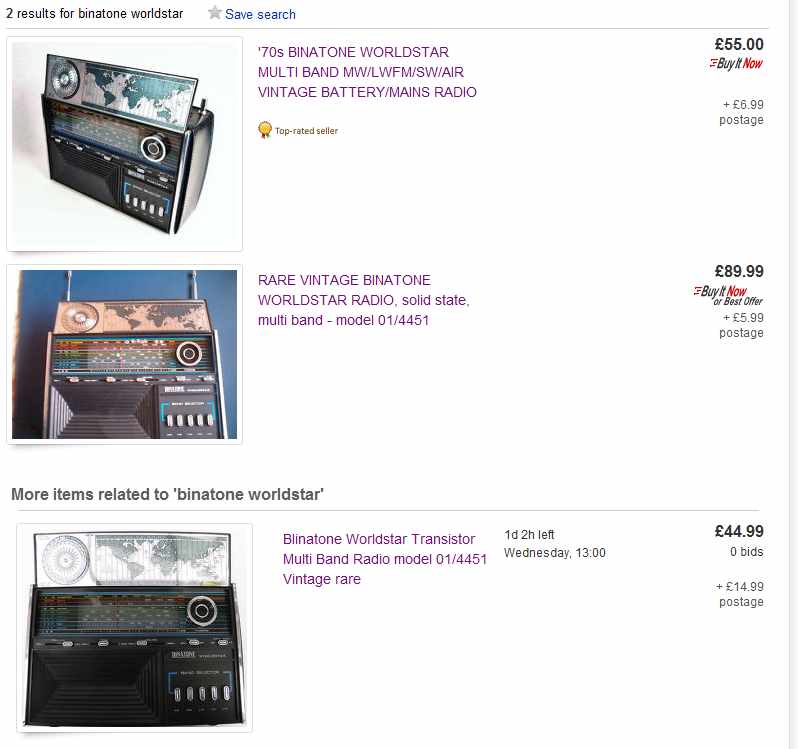
I did a quick search on eBay this morning and got a shock!


The Binatone World Star was my Christmas present back in 1978 and really got me hooked on short wave listening despite it only covering up to 4.4MHz, I posted a blog entry (now redacted) back in 2011 about my childhood memories and the fact I had rescued my somewhat battered original radio from my late Fathers shed where it was slowly decaying and intended on restoring it.

 photo CIMG7955.jpg

They occasionally pop up on ebay and I had intended purchasing one for old times sake as mine is probably beyond repair. They seem to have become rarer and much sort after judging by the ridiculous prices now being asked!  

I removed my original post after I discovered several eBay sellers linking to it and intended to reinstate it at a later date, unfortunately I seem to have forgotten where I backed it up, but I still have the embarrassing pictures.

 photo xmas1978.jpg

Friday, 14 June 2013

No not a number station!

While on holiday last week I stumbled across some interesting transmissions on 11175kHz, my immediate reaction was some form of 'number station' however the messages finish with "Andrews Out" The American accent made me think immediately of Andrews Air Force base.

A bit of Internet research and I identified the transmissions as being part of the High Frequency Global Communications System (HF-GCS) and these messages being Emergency Action Messages (EAM) whilst apparently originally designed as part of the U.S. military's strategic nuclear weapon command and control system, they must have other uses during peacetime (I hope)

There is an interesting post on the Milcom Monitoring Blog which has more details about what they may be.


Thursday, 13 June 2013

Freeband SSTV Reception with RTL-SDR

Over the last few days there has been a lot of activity on some of the normally quiet amateur and 'CB' bands due to some Sporadic-E propagation yesterday the 50MHz (6 metre band) was a mass of SSB signals as operators chased some DX contacts.

I set up a WSPR receiver using my FUNCube Dongle and got a few contacts on 6 meters over a couple of hours.


The 27 MHz (11 metre band) was also very active, while I know it can be an active band I normally don't receive much here due to location but last night I was getting lots of SSB transmissions by the 'DX Freebanders' and I even caught a couple of SSTV transmissions.

I didn't get many clear pictures not because the signals or audio was weak but mainly because one transmission would be broadcast over another before it had finished, causing noise, or worse stopping the decode and getting a truncated image..


Tonight conditions were similar but instead of the FUNCube Dongle+ I tried the RTL-SDR dongle with the R820T tuner chip which can tune down to the 27MHz frequencies and I managed to get some decent if again noisy and sometimes truncated images.


I used the SDRSharp/SDR# program and the free MMSSTV decoder, here are some more of posts concerning SSTV. I made a quick video showing the decode process.

Cuban Number Station - HM01

Last night I was browsing away whilst monitoring the Sporadic-E opening over Europe, with a lot of SSB activity on the 6 metre (50MHz) band.

I found this website which listed some interesting details about the Cuban Number Station HM01. At midnight (23:00UTC) I tuned into 11.530MHz and this is a small snippet of what I heard. (Sorry the audio quality isn't great) 


Tuesday, 11 June 2013

Number Stations

Just before I went on holiday I happened across a strange but faint transmission which I discovered was probably a Cuban Number Station. This perked my former interest into number stations and doing a little research I have found a number of audio documentaries, from several years ago, produced by the American NPR media organisation, most of them using Akin Fernandez's Conet Project.

Numbers Stations: Mystery Over The Airwaves <article link> <audio download>

Music by the 'Numbers Stations' <article link> <audio download>

Atencion: Seis Siete Tres Siete Cero: The Shortwave Numbers Mystery <old article link> <newer article link>

This last one was one produced and mixed by David Goren, and unfortunately the only audio available from NPR are in RealAudio format (shudders) but luckily David Goren has a SoundCloud page (his username Shortwaveology nice!) with high quality versions of the programs


The Shortwave Numbers Mystery by Shortwaveology

Atencion! Seis Siete Tres Siete Cero: The Mystery of the Shortwave Numbers Stations by Shortwaveology

David also has a number of other interesting audio works on his page created from raw radio reception, I particularly like this one
Mercy, So Much Noise by Shortwaveology

I also installed Ian Wraith's RIVET program which allows decoding of some of the HF data modes used by clandestine operators.

Some other interesting links I found on my travels,
Simon Mason's Shortwave Espionage
Spy Numbers Stations on Shortwave Radio
HF Underground
Numbers & Oddities
Enigma 2000

there is also the Engima 2000 Yahoo Group unfortunately this seems harder than the Freemasons to get into (just joking!) I tried to join just before leaving for my holiday and was then asked send a email back to prove I would be an active participant, which is reasonable enough request. I did send a detailed one back, to then be told they never received anything so I was denied membership, this seemed a little strange as all communication had been done using Yahoo's own email system. In their defence I could have tried again, unfortunately I had neglected to save a copy of the email in my sent folder and being away on holiday at the time when I received the rejection I acted a little petulantly and decided I had better things to do. 

Monday, 10 June 2013

Installing a Custom Android ROM on my defunct phone

Okay, this post isn't really radio related, but...

I have had an Orange San Francisco Android phone for a while now, and have found it very useful for tracking satellites. Then late last year I lost my temper and this was the result.


A new screen (thanks Ebay) and I repaired it with no problems. Until several weeks ago when I noticed what looked like damage in the bottom right corner of the screen and started having problems with an unresponsive touch screen. Taking it apart I discovered it was moisture that had got in, a quick clean seemed to fix the issue until I realised the microphone wasn't working either (I don't use the actual phone very much) and the microphone is situated in the same area of the phone so I assume it is has also been damaged by the water that had got in.

Well I decided it was time for an updated phone and purchased a rather nice unbranded HTC Desire C for the princely sum of £79, it is much more responsive and has a newer version of the Android operating system.

I hate to throw anything out and the old San Francisco is fully functional apart from the microphone and works without a SIM via WiFi but what to do with it? The phone, which is in fact a Orange badged ZTE Blade and was full of uninstallable bloatware, hideous branding and the rather ancient Android Eclair 2.1 operating system.

I decided I would try to update it with new firmware. To be honest the whole experience has been a bit perilous and confusing. At one point thinking I had completely bricked it. I started my voyage by visiting http://sanfranciscoandroid.co.uk/ and followed the 'easy' instructions for updating it using ClockworkMod Recovery and then I came a cropper, the recommended ROM file link no longer worked, no worries the site lists plenty of others, I downloaded several of these and despite the update saying successful the phone would simply refused to boot.

Much Googling later I discovered a post on a forum that said installing the ClockworkMode update the phone from a GEN1 to GEN2 which means you needed a GEN2 rom. However the ones I were trying (Japanese JellyFish etc) were actually for GEN1 - told you it was confusing. I quickly found a link to a valid Swedish Snow RLS7 rom image and hey presto it works. 

From initial impressions it is like having a new phone (be it one without a working microphone!)

Just a disclaimer, despite it working for me anyone attempting to do something similar is warned you could end up making your phone non functional. All links to websites and files, programs are used at your own risk I don't endorse anyone or anything and the usual caveats apply about the risks of downloading any software from unknown sources. 

Tuesday, 4 June 2013

Away from the noise

High up and a hillside in Cumbria at the moment, nine metre fiber glass fishing pole and 10 meters of wire, a ground spike and my FUNCube Dongle PRO+ and the laptop and what a revelation!

The entire HF spectrum spread out before me with little or no noise anywhere, signals booming in! and this was the view last night

As they say Location, Location, Location!