Friday, 23 August 2013

434MHz Balloon flights this weekend

Quite a few HAB flights this weekend, details here

http://www.southgatearc.org/news/august2013/434_mhz_balloons_launch_this_weekend.htm

Hopefully Dave Akerman will be able to complete the Babbage Flight, more details on his website
http://www.daveakerman.com/?p=1355

This wonderful concept of this is to take a Raspberry PI Mascot Teddy Bear into the stratosphere and then launch it Felix Baumgartner style back to earth. Details of the payload here http://www.daveakerman.com/?p=1321  

We wish Babbage well on his travels, won't be able to monitor it myself as have other committments.


Wednesday, 21 August 2013

I'm still here!

My regular readers (if I have any) will have noticed that I haven't posted anything for a month, my apologies, the simply fact is I have been suffering from a bit of burn-out work and hobby wise.

On the radio side I have become a bit despondent by the continual problems of interference I have been suffering, and secondly a few nasty comments on YouTube about my ADS-B antenna made me think is it worth trying to publish anything on line that people might find interesting or informative or should I just keep it to myself. It seems that with the internet everyone wants everything handed to them on a plate, no thought, understanding or appreciation required on their part. Worse are the opinionated know-it-alls who just want to laud it about that what you are doing just won't work (but it does?) These same individuals sit behind their keyboards and don't contribute anything to the collective/cloud call it what you will.

I have done some things over the last month, tracked a few HAB flights and will be attending the UKHAS Conference at the start of September, including sitting a Foundation exam. I monitored some of the Perseid meteor shower using the Graves space radar signal (see my earlier post) 

I have also began Geocaching again, but more on that at a later date.


Wednesday, 17 July 2013

Roger Waters - Radio KAOS - Radio Waves

Well it is hot, sunny and one of Roger Waters' more cheery songs seems appropriate

Tuesday, 16 July 2013

My WRT54G has become noisy!

I haven't done much 'radio stuff' over the last few weeks due to work/family commitments and holidays but when I have found time I have been exasperated by huge levels of interference all across the HF/VHF bands which has suddenly appeared. Manifesting itself as huge regular bands of hash across most of the spectrum (as pictured below)

I assumed that a neighbour had purchased some new electronic device that was responsible. However last night I decided to go around the house again just in case, and discovered my ancient Linksys WRT54G router was the source.

I have had issues with QRM before and I was aware that this router was responsible for some noise in the VHF bands, but I had mitigated this by replacing all the network cables with brand new properly shielded network cables (screened shielded twisted pair) and ferrite clamps. This noise is something new and appears even with the network cables unplugged.

I naturally assumed it was the PSU as poor quality switch-mode power supplies used by most peripherals can be sources of interference, but interestingly the PSU for this router is actually a huge linear type judging by its size, weight and the temperature it runs at. I did try another compatible supply with the same results.  

Doing a Google search shows these routers seem to have a reputation for being RF noisy, but until now I haven't had any real issue on HF.

Due to my ISP upgrading the network I got a Virginmedia SuperHub last year but was forced to put it into 'modem' mode and use my existing WRT54G after struggling to configure it. I couldn't find anyway to configure the LAN to use the correct subnet (it kept defaulting to 192.168.0.1-255) never mind configuring the port forwarding and wireless access! The GUI and firmware was atrocious and I refused to go around reconfiguring all my devices. Maybe I might have to swallow my pride...


Wednesday, 26 June 2013

ISS - Russian EVA-33 Comms received using RTL-SDR

Back in April I managed to receive some of the communications downlink from the Russian section of the International Space Station during a EVA/Spacewalk using a FUNCube Dongle Pro+ connected to my discone.

On Monday this week I was alerted to another ambitious EVA being performed by Cosmonauts Fyodor Yurchikhin and debut spacewalker Alexander Misurkin. Details of the EVA can be found here.

The EVA lasted over six hours on the outside of the ISS. The duo conducted a large array of tasks, including the replacement of a fluid flow regulator on the Russian segment’s Zarya module.

As luck would have it the EVA was in progress during several passes over the UK. Unfortunately as I was unaware of it at the time I hadn't prepared and was stuck in work. I can remotely access my computers and the only receiver I had available was an RTL-SDR which was connected to a random HF long-wire antenna in the loft!

Undeterred I set it recording using SDR# and was surprised at the quality and strength of the signal during the first two passes, so much so I left it connected for the third pass in the evening, again the downlink signal was on 143.625MHz, with the obvious doppler shift.   

I have played back the recorded IQ files and made a video using CamStudio to record directly off the computer screen, the audio and video go out of sync and the frame rate isn't brilliant.


Tuesday, 18 June 2013

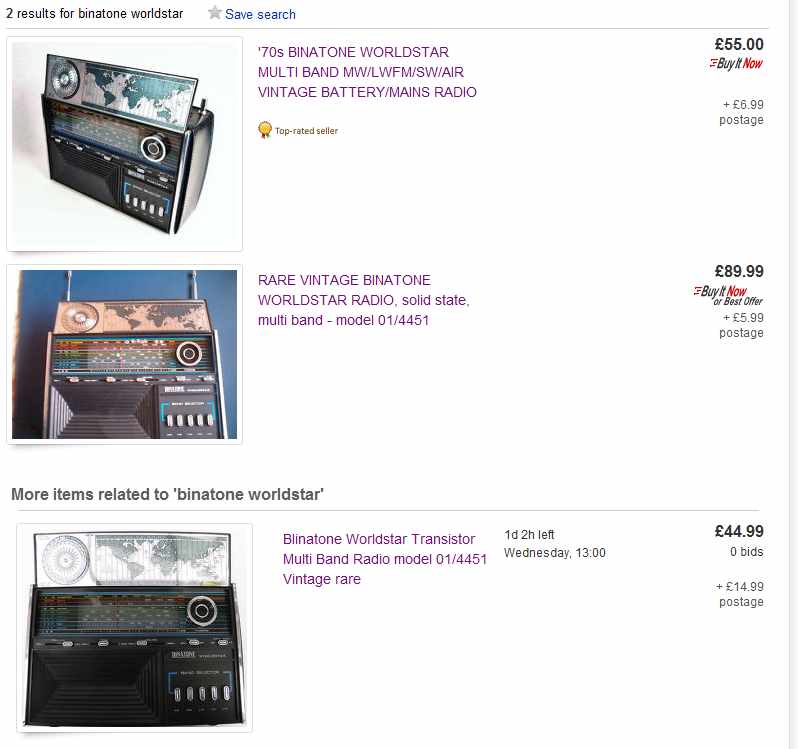
HOW MUCH??

I did a quick search on eBay this morning and got a shock!


The Binatone World Star was my Christmas present back in 1978 and really got me hooked on short wave listening despite it only covering up to 4.4MHz, I posted a blog entry (now redacted) back in 2011 about my childhood memories and the fact I had rescued my somewhat battered original radio from my late Fathers shed where it was slowly decaying and intended on restoring it.

 photo CIMG7955.jpg

They occasionally pop up on ebay and I had intended purchasing one for old times sake as mine is probably beyond repair. They seem to have become rarer and much sort after judging by the ridiculous prices now being asked!  

I removed my original post after I discovered several eBay sellers linking to it and intended to reinstate it at a later date, unfortunately I seem to have forgotten where I backed it up, but I still have the embarrassing pictures.

 photo xmas1978.jpg

Friday, 14 June 2013

No not a number station!

While on holiday last week I stumbled across some interesting transmissions on 11175kHz, my immediate reaction was some form of 'number station' however the messages finish with "Andrews Out" The American accent made me think immediately of Andrews Air Force base.

A bit of Internet research and I identified the transmissions as being part of the High Frequency Global Communications System (HF-GCS) and these messages being Emergency Action Messages (EAM) whilst apparently originally designed as part of the U.S. military's strategic nuclear weapon command and control system, they must have other uses during peacetime (I hope)

There is an interesting post on the Milcom Monitoring Blog which has more details about what they may be.


Thursday, 13 June 2013

Freeband SSTV Reception with RTL-SDR

Over the last few days there has been a lot of activity on some of the normally quiet amateur and 'CB' bands due to some Sporadic-E propagation yesterday the 50MHz (6 metre band) was a mass of SSB signals as operators chased some DX contacts.

I set up a WSPR receiver using my FUNCube Dongle and got a few contacts on 6 meters over a couple of hours.


The 27 MHz (11 metre band) was also very active, while I know it can be an active band I normally don't receive much here due to location but last night I was getting lots of SSB transmissions by the 'DX Freebanders' and I even caught a couple of SSTV transmissions.

I didn't get many clear pictures not because the signals or audio was weak but mainly because one transmission would be broadcast over another before it had finished, causing noise, or worse stopping the decode and getting a truncated image..


Tonight conditions were similar but instead of the FUNCube Dongle+ I tried the RTL-SDR dongle with the R820T tuner chip which can tune down to the 27MHz frequencies and I managed to get some decent if again noisy and sometimes truncated images.


I used the SDRSharp/SDR# program and the free MMSSTV decoder, here are some more of posts concerning SSTV. I made a quick video showing the decode process.

Cuban Number Station - HM01

Last night I was browsing away whilst monitoring the Sporadic-E opening over Europe, with a lot of SSB activity on the 6 metre (50MHz) band.

I found this website which listed some interesting details about the Cuban Number Station HM01. At midnight (23:00UTC) I tuned into 11.530MHz and this is a small snippet of what I heard. (Sorry the audio quality isn't great) 


Tuesday, 11 June 2013

Number Stations

Just before I went on holiday I happened across a strange but faint transmission which I discovered was probably a Cuban Number Station. This perked my former interest into number stations and doing a little research I have found a number of audio documentaries, from several years ago, produced by the American NPR media organisation, most of them using Akin Fernandez's Conet Project.

Numbers Stations: Mystery Over The Airwaves <article link> <audio download>

Music by the 'Numbers Stations' <article link> <audio download>

Atencion: Seis Siete Tres Siete Cero: The Shortwave Numbers Mystery <old article link> <newer article link>

This last one was one produced and mixed by David Goren, and unfortunately the only audio available from NPR are in RealAudio format (shudders) but luckily David Goren has a SoundCloud page (his username Shortwaveology nice!) with high quality versions of the programs


The Shortwave Numbers Mystery by Shortwaveology

Atencion! Seis Siete Tres Siete Cero: The Mystery of the Shortwave Numbers Stations by Shortwaveology

David also has a number of other interesting audio works on his page created from raw radio reception, I particularly like this one
Mercy, So Much Noise by Shortwaveology

I also installed Ian Wraith's RIVET program which allows decoding of some of the HF data modes used by clandestine operators.

Some other interesting links I found on my travels,
Simon Mason's Shortwave Espionage
Spy Numbers Stations on Shortwave Radio
HF Underground
Numbers & Oddities
Enigma 2000

there is also the Engima 2000 Yahoo Group unfortunately this seems harder than the Freemasons to get into (just joking!) I tried to join just before leaving for my holiday and was then asked send a email back to prove I would be an active participant, which is reasonable enough request. I did send a detailed one back, to then be told they never received anything so I was denied membership, this seemed a little strange as all communication had been done using Yahoo's own email system. In their defence I could have tried again, unfortunately I had neglected to save a copy of the email in my sent folder and being away on holiday at the time when I received the rejection I acted a little petulantly and decided I had better things to do. 

Monday, 10 June 2013

Installing a Custom Android ROM on my defunct phone

Okay, this post isn't really radio related, but...

I have had an Orange San Francisco Android phone for a while now, and have found it very useful for tracking satellites. Then late last year I lost my temper and this was the result.


A new screen (thanks Ebay) and I repaired it with no problems. Until several weeks ago when I noticed what looked like damage in the bottom right corner of the screen and started having problems with an unresponsive touch screen. Taking it apart I discovered it was moisture that had got in, a quick clean seemed to fix the issue until I realised the microphone wasn't working either (I don't use the actual phone very much) and the microphone is situated in the same area of the phone so I assume it is has also been damaged by the water that had got in.

Well I decided it was time for an updated phone and purchased a rather nice unbranded HTC Desire C for the princely sum of £79, it is much more responsive and has a newer version of the Android operating system.

I hate to throw anything out and the old San Francisco is fully functional apart from the microphone and works without a SIM via WiFi but what to do with it? The phone, which is in fact a Orange badged ZTE Blade and was full of uninstallable bloatware, hideous branding and the rather ancient Android Eclair 2.1 operating system.

I decided I would try to update it with new firmware. To be honest the whole experience has been a bit perilous and confusing. At one point thinking I had completely bricked it. I started my voyage by visiting http://sanfranciscoandroid.co.uk/ and followed the 'easy' instructions for updating it using ClockworkMod Recovery and then I came a cropper, the recommended ROM file link no longer worked, no worries the site lists plenty of others, I downloaded several of these and despite the update saying successful the phone would simply refused to boot.

Much Googling later I discovered a post on a forum that said installing the ClockworkMode update the phone from a GEN1 to GEN2 which means you needed a GEN2 rom. However the ones I were trying (Japanese JellyFish etc) were actually for GEN1 - told you it was confusing. I quickly found a link to a valid Swedish Snow RLS7 rom image and hey presto it works. 

From initial impressions it is like having a new phone (be it one without a working microphone!)

Just a disclaimer, despite it working for me anyone attempting to do something similar is warned you could end up making your phone non functional. All links to websites and files, programs are used at your own risk I don't endorse anyone or anything and the usual caveats apply about the risks of downloading any software from unknown sources. 

Tuesday, 4 June 2013

Away from the noise

High up and a hillside in Cumbria at the moment, nine metre fiber glass fishing pole and 10 meters of wire, a ground spike and my FUNCube Dongle PRO+ and the laptop and what a revelation!

The entire HF spectrum spread out before me with little or no noise anywhere, signals booming in! and this was the view last night

As they say Location, Location, Location!


Friday, 31 May 2013

QRM - It is a very noisy Friday

My last post was about the joys of SDR, this one is about the bane of not only SDR but radio in general namely the amount of electromagnetic rubbish that is thrown into the ether by shoddy equipment, with SDR you just see just how much s**t there is.

These are some waterfalls captured today, first exhibit showing lovely evenly space spikes, and a mass of hash and splatter.


A little further up the spectrum, another splatter, this I am convinced is some form of Power Line Network Adapter. You know the ones someone thought was a clever and expensive solution to that problem "How do you get network data from one room to another without the hassle of running a cheap proper shielded network cable or using wifi?" Their answer was to use unshielded mains wiring to transmit data at radio frequencies turning them into efficient antennas!
 

Mind you even using shielded network cabling isn't always the answer especially if you have cheap probably Chinese made network equipment which some one is using nearby. It generates this pretty pattern right across the VHF 2 meter band, especially bad on 144MHz.


Hold on VHF is immune to PLA interference you say? Yeah right!


I have posted before about problems I have had before including some videos including the one below. Thanks to my direction finding skills I know which direction this annoying interference was coming from, but I haven't seen it for a while, someone got themselves a new Plasma/LCD TV?


I am aware some of my equipment generates some noise, but even powering down the entire house and running on laptop batteries I see just as much rubbish, rubbish that disappears as soon as you remove the antenna.

Wednesday, 29 May 2013

The joys of RTL-SDR and Taxi MDT Decoding

I have owned and used radio scanners for many years, and loved them as my posts before December 2011 will testify.

In that month I became the proud possessor of a FUNCube Dongle Plus and discovered the joys of software defined radio, since then I purchased a FUNCube Dongle Pro+ and extended my SDR adventures in to the realms of HF and I have several of the insanely cheap RTL2832 based dongles.

As much as loved my scanners there was a major flaw with them, which has been brought into sharp focus now that I have used SDR.

No matter how fast or as sensitive as the scanner is are you are still playing a game of chance. You are limited by the frequency steps, demodulation modes and scanning rate of the receiver and you could zip through the band all day and still miss those elusive signals.

SDR and the waterfall display is a revolution, you can view a portion of the spectrum in real time and actually see the signals, they may be short lived bursts of data and voice, or continuous data transmissions.

The RTL-SDR dongles excel in this respect with their wide sampling rate you can view up to 2MHz of the spectrum at once, the following images show typical waterfalls captured this morning using one of my RTL-SDR dongles.


The first one, shows the cluster of data channels (was the old Vodaphone Paknet system) around 164.2 - 164.4 MHz, a trunking control channel and various data bursts, which are mostly Taxi Mobile Data Terminal (MDT) transmissions.


A little lower down the spectrum and another trunking control channel, a speech conversation, more data bursts and a faint digital channel.


Further up the spectrum into the UHF, a cluster of data transmissions.

Simply moving the cursor on the display and you can hear the transmission, if necessary change the demodulation type, widen or narrow the filter bandwidth, save the frequency. If you capture the IQ file you can then replay it endlessly tweaking and refining until you extract the information you want.

During the weekend I was experimenting and noticed there was lots of data bursts in the 163-168MHz range, I confess that I already knew what most of them were as I have experimented before with a scanner (with a discriminator tap) and Ian Wraith's Java based Taxi MDT decoder. I decided to reinvestigate them using the RTL-SDR as the receiver.

While many taxi companies still use voice transmissions, many have adopted automated data terminal systems, where the dispatcher sends information about jobs to terminals in the cars, the drivers then can accept jobs, get information and send information back to the dispatcher.

Ian's decoder which requires the Java runtime environment decodes systems that use the same physical layer as MPT1327 i.e 1200 Hz and 1800 Hz tones transmitted at 1200 bps. The two main systems used in the UK, are the Autocab and Auriga. The Taxi MDT Decoder currenly decodes the Autocab, but the coding for the Auriga system is still an unknown, so just outputs the raw data.

More information about Taxi MDT Decoder can be found here I confess to having one slight niggle with it, often I couldn't get it to accept sound from the selected input. A work around I found was to first open the Audacity sound editor which I had installed and select the input and start a recording, then opening the decoder seems to make it work!

Ian has also written the excellent DMRDecoder which allows analysis of the DMR digital mode which is becoming more widespread. I intend to post some details soon about decoding digital modes, keep watching.

I created a video showing the Taxi MDT Decoder in action, the quality is pretty dire but you can get the idea, I identify the Auriga as being encrypted, it might be but as nobody on the team knows the protocol yet!

Monday, 27 May 2013

Spanish Shortwave Ident


Sunday, 26 May 2013

Some more HAB tracking

I have been tracking some more of the High Altitude Balloons (HAB) that have been released over the last few weekends.

Last weekend (18th May 2013) saw the release of STRATODEAN2 from the Stratodean team, which I received quite well as can be seen from the telemetry stats.


Mark and Cassie have posted an update of the flight on their blog including an entertaining video


This weekend, there have been three more flights which I have managed to decode, track and update telemetry to the habitat website,

MONDO-12 which flew on Saturday 25th May 2013


BABSHAB which flew early this morning 

and finally this afternoon Dave Akerman's PIE6, which used a Raspberry PI to preform the radio tracking. Details of the payload can be found here. In addition to the GPS the payload also contained a camera and the captured images were also transmitted using the SSDV protocol.

Each image is broken into smaller packets, while a receiver may receive all packets for an image it is unlikely it would receive all so by using the distributed network of multiple receivers the images are reconstructed on the habitat server. http://ssdv.habhub.org/

The screen shot below shows my PC as it receives the packets and attempts to reconstruct the image, hopefully you can see some portions of the image are missing.

Dave used a very fast 600Baud RTTY so he could transmit the high quality images, so was impressed to receive anything as the combination of SDR# and DL-Fldigi can be hard work for my ageing PC.


However these are all the images I contributed to (from the habitat site)


One thing I didn't receive much of were the interlaced telemetry packets.

Friday, 24 May 2013

Pinneberg (DDK3) HF Weather Facsimile Transmissions

I have posted before about receiving weather and shipping facsimile transmissions on HF, for a couple of days I have been using the FCDP+ and WXSat to do some decoding, also been investigating some of the mysterious RTTY transmissions you also find.

Interestingly my previous experiment was using an Alinco Scanner with SSB capability, produced better results than using the FCDP+ and SDR#. not really sure why. It appears the some processing of the audio upsets WXSat, I have tried many settings and adjustments but the decodes haven't been brilliant clear despite the signal being very strong and clear, many of the faxs have come in with odd 'stepping' where portions of the image go out of sync which I have corrected in PaintShop Pro.

Any way, here is a small selection of the images I've decoded from the Deutscher Wetterdienst, broadcast on 7880 kHz (DDK3) from Pinneberg in Germany,