Monday, 28 July 2014

Back from Skye


It is back to the real world after a great week in the Isle of Skye with almost constant sunshine, temperatures topping 28°C (83 °F) and very humid conditions. Some great walks with the wife and the dogs to some new locations, the highlight was watching a school of porpoises playing in Loch Bharcasaig.


The cottage was booked last year primarily for our holiday requirements with no thought of radio operating as this has come later. As I feared in my previous post my unpreparedness meant disappointing operating as 2M0NRD/A

Located on the main tourist route up the Waternish peninsula I didn't want to have any unsightly aerials up at the front of the property. It is situated part way up a hill side and knew there was a wooden fence at the rear and to the right separating it from the neighbouring croft. I had taken a couple of 6 meter long fiberglass poles which I could bungee cord to the fence and then string the OCF dipole between them or alternatively use one of them to hoist the M0CVO Magitenna as a sloper. These poles and wires would be largely be obscured from view by the cottage.

The rear fence runs north to south, meaning the main lobes of the antennas would be to the west and east, not ideal for any ‘inter-g’ UK operating, so I had planned to use the side fence. What I hadn't spotted on the photographs was the overhead power line running on that side of the property. I could have put them up but opted for safety and used the rear fence.


I set up base in the spare bedroom at the back of the cottage but I really didn’t get to operate very much. We were out and about during the day and I did dabble on HF for an hour or so on some evenings. I could certainly hear a lot more than I do at home with very little noise and had some very strong signals coming in. I made a few QSOs but other than the contesting I am still finding my feet as an operator and being mike-shy I find the HF bands intimidating. I struggled to find a free frequency but did call CQ on 40m and 20m but with no response even after several minutes, eventually giving up as I was invariably swamped by another operator.

Last week was also the start of the 2014 Commonwealth Games in Glasgow, not only did I see some of the stadiums and venues while driving up to Skye but I also heard the special event station GA14CG operating out of Stirling on 40m some evenings. It was a huge S9+ signal and despite several sustained attempts I was unable to break the pile up. Seems they were beaming south and being north of them in Skye I stood little chance being at the back of their Cushcraft X-240 with just 50W and my OCF dipole being end on in their direction..!

Having holidayed in Skye before I was aware of the terrain but having surveyed the cottage using Google Streetview it seemed nicely situated. Upon arriving at the cottage it became apparent that the mountainous terrain was a bit more imposing than Streetview had shown, so not unexpectedly the 50MHz UKAC on the Tuesday evening was a disaster!

I spent the best part of an hour tuning around the band, occasionally hearing faint voices in the static but nothing legible. I vainly called out “CQ Contest” for a while but nothing was heard, even using the tuned dipole – even if I had managed to build the planned Quad beam it is unlikely I would have fared any better. 

The cottage was meant to have broadband and Wi-Fi facilities but a fault meant this wasn't working all week, coupled with no mobile phone signal left me feeling cut off, ironic really given the founding principle of amateur radio communication. I did do some digi-modes but without an NTP connection the error in the laptop clock (several seconds a day) meant I was initially too far out of synchronisation for JT65 or WSPR until I realised I could use the clock on my Garmin GPS which I use for geocaching. Doh!

It is likely we will be going back next year and hopefully will be a bit more experienced as an operator and will be more prepared. 

Oh and here are the porpoises I mentioned earlier

Wednesday, 16 July 2014

Skye Activations? Remember the 7 Ps!

As the military adage goes "Proper Planning and Preparation Prevents P*** Poor Performance" well I have fallen foul of this in getting ready for my imminent holiday to the Isle of Skye.

Last year we went back to the Isle of Skye after our first visit over a decade ago.  We rented a self catering cottage near Dunvegan and a great time. The scenery (and the whisky) is spectacular and the dogs loved it, so we decided to go back this year. 

The cottage
The view from the cottage
The tasting experience at the Talisker Whisky Distillery
The cottage is no longer available for holiday lets, but we have found another which promises even better facilities. Last year I wasn't licensed, so this time I planned to take the rig and operate from the island.
  
The holiday coincides with the 50MHz/6 Meter UKAC contest and the opportunity to operate from the rare IO67 locator square was something I was looking forward to, I was totally realistic as to my chances given my set up, the terrain and power restrictions.

IO67 Locator Square
I planned to build a quad beam, there are plenty of designs on the web and ordered some fibreglass pole to make the spreaders but over the past few weeks have got sidetracked and left the construction till the last minute and it has turned into a disaster!

I abandoning the idea of a multi-element quad beam once I realised the sheer size it would be and the lack of space in the car and so opted to make a manageable two element quad.

I modelled up the antenna in MMANA-GAL to check the dimensions, made a nice short wooden boom, and cut the fibreglass pole for the spreaders, initially cutting them all to the wrong length! Cue expletives!

So I cut another set to the correct length and made the wire loop elements and tried to put it all together. Unfortunately the fibreglass spreaders are far too thin and bend and sag under the weight of the wire! Cue even more colourful expletives!

Plan-B is now just a simple tuned dipole and all I can hope for is some Sporadic-E on Tuesday evening!

I am packing the HF antennas a Magitenna and the HW-20HP from Nigel at M0CVO Antennas. I haven't done a great deal on HF finding the operating a little intimidating however I will endeavour to be on air during the week having realised in the last couple of days that I can 'activate' the island and some 'rare-ish' grid squares for the Worked All Britain (W.A.B) scheme, as well as 'activating' for the Island On The Air (IOTA) scheme. I might convince the wife to let me take the rig portable on a planned trip across to the Isle of Raasay for another activation.

With just 48 hours left I am rapidly reading up on what I need to do... as my wife pointed out I have had weeks/months to prepare for this... the 7Ps indeed!

If I do get on the air as 2M0NRD/A or 2M0NRD/P during the week please be patient and treat me gently! I will be on voice and maybe JT65 and PSK. The cottage has wi-fi so will post updates on my twitter feed @nerdsville.

Wednesday, 9 July 2014

Antenna Update

Tuesday night is RSGB UKAC contest night, this week on 432MHz. Following the frustrations of the weekend I spent a therapeutic Monday evening cutting various lengths of RG213 and fitting N-Type connectors.

I have now got a coax run through the wall into the shack, with another to follow soon. To facilitate 'switching' between multiple aerials I have fitted each aerial with a length of coax running down the pole, terminating in an in-line N-type socket near the base. It is a simple case of connecting the appropriate shack coax, fitted with a n-type plug, to the appropriate socket.

To keep everything water and weatherproof I have opted for a DRi-BOX. These are inexpensive plastic boxes sold as waterproof housings for outdoor electrical installations such as garden or Christmas lights.


The lid has a silicon seal and there are a number of cable entry points with a flexible seal. When the lid is firmly clamped securely in place the box is effectivly watertight.


It is a bit of a fiddle with the thick RG213 but it seems to work well. There was a vicious thunderstorm and downpour yesterday afternoon and the Dribox lived up to its claims after sitting in a few inches of water.

Still awaiting the X-50 collinear on the top!
The pole now has the 2M Yagi and the 70cm 7-element ZL-Special fitted. The 70cm aerial is far from optimal but I was looking forward to giving a go with some decent coax.

Tuning around prior to the start of the contest and the band seemed quiet, hearing just a strong local operator. The contest start time passed and I was met with a wall of static only hearing the occasional very weak signal. I tried unplugging and reconnecting plugs, new patch lead, took the VSWR/Power meter out with no effect after 20 minutes I gave up. I decided something was obviously wrong with my new installation at the top of the pole.

I went back into the house where the wife was watching some dreadful house/diy/makeover program on TV which I could only manage for about 15 minutes. Grumpily I went upstairs and fired up the FUNCube Dongle and twitter and realised I'd forgotten and completely missed the first pass of the newly launched UKube-1, unlike some lucky ones. Idly I tuned to 70cm using the discone in the loft and could see a waterfall of signals! Including that local operator with a lot of splatter considering he was running just 10W


Going back into the shack and things had improved, so perhaps it wasn't my setup! After missing nearly a hour I searched and pounced again, just making 14 contacts but achieved my highest score so far for a 432MHz UKAC contest, still operating as M6GTG in the low power section.


Various operators have commented on the weird/poor/flat conditions last night, so perhaps I shouldn't have been so dismissive of my ability to put up a decent antenna!

Monday, 7 July 2014

The best laid schemes o' Mice an' Men

To quote Robert Burns
The best laid schemes o' Mice an' Men, Gang aft agley,
An' lea'e us nought but grief an' pain, For promis'd joy!
That sums up my weekend perfectly.

After becoming licensed my eagerness got the better of me and in a moment of weakness I'd purchased a couple of 10m ready made cables from a major supplier only to discover quite quickly they were made from low grade RG58 coax (you can literally count the number of strands in the braid) and the connectors while serviceable were so poorly fitted they fell off!

James that PL259 has fallen off again!

I had refitted the connectors using some solder this time and had managed to blag a 20m length of good quality RG58 (this actually has some braid) and I am ashamed to say these cables have been the weak link in my set up for far too long and needed to be upgraded.

I also needed to sort out the mounting for my aerials. Up till now I have been using a 5 meter telescopic painting pole that had cost around £16 from B&Q, it was okay when I was just clamping one aerial at a time to it but with the purchase of the rotator I has been chancing my luck with the loading, narrowly avoiding catastrophe when pushing the pole. I also couldn't fully extend the top section as the tube and joint were potentially weak. It was guyed quite well but was far from aesthetically pleasing, even in the summer sunshine!

6M Moxon up on temporary pole
I couldn't fit anything to outside of the house, not only for logistical reasons but also it wasn't sanctioned by the station manager. Anything on the side of the house would be highly visible from the road and the back wall of the house has too many large windows and an extension making it inconvenient to fit and access anything.

Never fear I had a plan, a 20ft (6m) scaffold pole bolted using swivel joints on to to an another pole concreted in the ground in the back garden. The garden was extensively landscaped a few years back but it was before I became licensed, so I hadn't planned ahead. With careful negotiations with the station manager I secured a location where I could put it.

Thanks to my local handy man I now have two 10ft scaffold poles, sunk to a depth of nearly 5ft and encased in concrete in the corner of the lawn. A few inches of soil was left on the top to allow the grass to grow. They have been left for over a fortnight to completely set.

Scaffold pole sunk in ground

I ordered a 100M reel of RG213 coax from Nevada Radio along with plenty of high quality N-Type connectors and various clamps and intended to sort out my antenna set up this weekend and banish the abysmal RG58 coax and PL259 connectors to some dark corner of the shack.

Before I took everything down on Saturday I managed to make contact with GB0TDF the special event station being run by the Denby Dale Radio Society from Cartworth Moor, Holmfirth for the Tour de France Grand Départ

A few months back I picked up a cheap rotator at the Dambusters Hamfest. It is designed for television aerials and isn't heavy duty but I was sure it would cope turning with the small 2M, 70cm Yagi and a 6M antenna on the same pole, with the X-50 collinear on the very top. However I was concerned by the potential lateral loading.

The rotator is a generic design and I spotted that an optional support bearing is available as an accessory. I chanced on one via Ham Radio Deals and had salvaged several good lengths of galvanised pole from a skip where I work. So the plan arrangement was as shown.. simple right? 

Planned arrangement

It turned it a frustrating morning after cutting the metal pole to length, bolting and clamping everything together I tested it at ground level with no antennas and the rotator refused to turn correctly and I narrowly avoided burning it out.

I checked poles and they were true, the rotator was free running as was the bearing. I unbolted, fettled and just couldn't make it work. I went away and had a beer while watching some of the Tour de France on the TV and in a moment of clarity realised what the issue was.

The problem was the diameter of the salvaged pole I was using. It was was slightly narrower (a couple of millimetres) than the hole in the bearing. I'd assumed it would line up with the rotator as it was similarly clamped, however when all clamped up top and bottom the pole wasn't perfectly perpendicular and wouldn't turn due to the eccentricity, Hopefully the drawing illustrates the problem.


Annoyed by this basic school-boy error I reverted to Plan-B for the short term, no support bearing! I was in bad mood now and so decided to leave the rewiring to another day. So I quickly put the 2M yagi on the existing coax as a test on the new scaffold pole to make a few contacts for the VHF NFD.

Temporary installation to test scaffold pole

Walking up the scaffold pole is straight forward, I have bolted a small cut off of scaffold across the top of support poles to act as a safety stop, lowering it likewise easy and I will certainly build up the muscles!

I managed to grab just 8 QSOs but was otherwise engaged for the rest of the weekend, however I was encouraged by the distances.
I hope to get the 70cm antenna up tonight on the RG513 ready for the 432MHz UKAC on Tuesday evening.
The birds like the new setup


Wednesday, 2 July 2014

Grantham ARC HAB Talk

Yesterday I gave my talk and demonstration at the Grantham Amateur Radio Club on High Altitude Ballooning and tracking.

This follows on from the South Kesteven ARS (SKARS) and the Spalding and District ARS (SDARS) talks I gave in May

It was very well attended with a large number of GARC members turning out. It was a case of everyone going in at the same time once the venues key holder turned up and I initially got a little stressed as I hurriedly tried to get everything set up while everyone sat patiently waiting.

Picture by Kevin Burton‎

The first issue I had was the projector seemed to be limited to just 800x600 pixels, which was fine for the PowerPoint presentation but for demonstrating reception using a RTL-SDR with SDRSharp and decoding using DL-FLDIGI and the UKHAS Habitat tracking system spacenear.us/tracker the lack of screen space was a problem, DL-FLDIGI couldn't be shrunk down to fit, so there was a lot of scrolling about!  

The second issue was the venues wi-fi connection, my laptop stubbornly refused to connect to it (I wished I'd taken a ThinkPad laptop I have instead of the one I did as it has a better wi-fi adapter) so was forced to use my mobile phone as a tethered hotspot - while it worked the connection was painfully slow.

Despite these issues I was able to give the presentation about the HAB community and the technology. It contains a lot of information to digest but there is some light relief with its videos of Felix Baumgartner, Dave Akerman’s Babbage Teddy Bear free fall and wacky chef Heston Blumenthal's ‘Spud-in-space’ feature from his recent television program.

I demonstrated Project Hab's VAYU-NTX tracker and thanks again to Steve Smith  (G0TDJ) for its loan.


I ran my own prototype tracker (NERDTEST) which I had updated to simulate a local flight, the transmission, reception, decoding and uploading to the UKHAS Habitat system was completely genuine, both using SDR and a traditional radio (Alinco DX-10) hooked up to the sound card. The only thing fictitious were the GPS coordinates and altitude.  (A programming error in the first version of this simulator had the balloon travelling at near 10km/s, thankfully I had corrected it to something more realistic)  

The poor internet connection cause issues with spacenear.us/tracker but was able to use Phil Crump's (M0DNY) version at at habmap.philcrump.co.uk to demonstrate the real time map tracking.

Checking the spacenear.us map this morning and the receiver station at the club house and the demo flight could still be seen - it was programmed to take off from a nearby high point!


By lucky coincidence Chris Stubbs (M6EDF) had launched a balloon CARS-1 from the Chelmsford Amateur Radio Society meeting at Oaklands Museum where he was giving a talk and demonstration at the same time as my talk, so I was able to show how multiple receiver stations were tracking a real flight.

I was also able to demonstrate SSDV image decoding using some recorded SDR files of the HiPi flight

I thought I had overloaded the attendees with too much information, lots of references to Arduino, Raspberry PIs, SDR, dongles, GPS could be quite daunting to the uninitiated but again feedback has been very positive. Grantham Amateur Radio Club on Facebook

Now I just to sort out doing a proper flight!

Wednesday, 25 June 2014

Noises Off!

Radio frequency interference (RFI) is the bane of a lot of amateur radio operators. Sadly it is becoming a real issue at my QTH.

RFI is referred to as QRM or QRN and I am learning the difference.

QRM means "I being interfered with" and is interference coming from someone using radio equipment. This covers deliberate jamming, people tuning up or just normal operations on a crowded band that causes QRM.

QRN means "I am troubled by static" and technically means interference from a natural noises but has come to refer to interference coming from anything that is not an intentional radio emission and interferes with reception of transmissions. So now covers atmospheric noise, static or the noise generated by electronic devices.

Noise isn't a new issue here as I have posted before. It has tended to be sporadic and bearable but since becoming licensed I have become more sensitised to it. Until now I have tended to focus on the VHF/UHF side mainly contesting venturing only briefly onto HF.

My HF set up is limited at the moment with just a single antenna which isn't optimal for the lower bands. Due to the day job I am largely restricted to evening/night time operation when the upper bands have largely been closed anyway so haven't really attacked HF with much enthusiasm apart from data modes such as JT65 and WSPR which have immunity to noise.

When I have got the chance for some early morning daytime operation or at the weekend I have struggled with noise.  Recent weekends have seen some special event stations operating for the Museums On The Air and the GB1JSS Summer Solstice which have been predominately on the 40M band but I just cannot hear anything on that band due to noise.

I am aware the Sun has been particular active recently producing a number of large flares and CMEs that have caused a number of radio blackouts, but this noise isn't due to atmospherics I am certain it is man made by one of neighbours.

I made this video last weekend


and this video was from the weekend before that


This weekend was the 50MHz Trophy Contest which I was looking forward to, sadly it was also to become a victim of the QRN as this screenshot from my SDR will confirm, for much of the time I was operating I was just listening to noise.


I wasn't operating constantly, just grabbing a few minutes here and there and I did manage to make some decent contacts when the QRN subsided even catching some of the sporadic E opening to get EF7X in Spain.


I have ruled out any noise being generated by myself by powering everything off and running on battery. This leaves me in a bit of a quandary I could go around and locate and confront the culprit or even contact OFCOM but at the same time I don't want to antagonise anyone who could then object to any antennas I might want to put up in the garden.

Rotating the 6M Moxon around at the weekend during the contest as at least pointed me in the direction of one strong noise source. I am also convince that much of my problem is due to an evil PLT device in an adjacent property.

Following on from the weekend last night was the UKAC 50MHz contest and yet again I was troubled with noise leading to mostly local contacts.


I have been looking at some of the noise cancellers that are available from MFJ and others. I have heard conflicting options on their effectiveness but I am willing to try one if I can obtain one cheaply, or even home-brew one from the numerous designs available.

These devices work by using a second antenna which receives just the noise which is then mixed out of phase with the main antenna signal hence nullifying the noise. By all accounts they are tricky to use and often  need constant adjustment but may be my only viable solution at present.

Monday, 23 June 2014

Using the Ultimate3

I have dusted off the Ultimate3 QRSS beacon kit that I built earlier in the year while a foundation licensee. Having progressed to a intermediate licence I can now operate something I've constructed.


Until now it has been attached it to a dummy load with the FUNCube Dongle Pro+ SDR in close proximity as a receiver for experimental purposes.

One unresolved issue was it being consistently off frequency. The DDS modules used are prone to temperature fluctuations and component variances so the Ultimate 3 has the option of using a GPS module to provide both an accurate time source and an accurate 1PPS input which can be used to self calibrate. Except in my case it had proved to be unreliable.

I am using one of the inexpensive GY-GPS6MV2 modules containing the U-Blox chipset I posted about previously with the additional tap off to provide the 1PPS TTL signal.

Initially the GPS module was connected in close proximity to the Ultimate3 but struggled to maintain lock probably due to interference from the DDS module. Even when lock was achieved the calibration never seemed to work. I posted a question on the yahoo support group and from the answers I verified the calibration setting were correct so the only likely culprit was the quality of the 1PPS signal.

The serial NMEA sentences and the 1PPS signal from the GPS are likely to be required in other planned projects, such as an 'shack clock' and a GPS disciplined frequency standard. So I decided to put the GPS module  into a waterproof housing that can fitted on the shack roof in clear view of the sky and away from any potential interference. A multi-cored cable supplies power and the TTL RX/1PPS signals being fed back to the bench.

Sourcing an inexpensive weatherproof enclosure (£2) and waterproof cable gland were straightforward enough. I mounted the GPS module on a piece of strip board and replaced the on board LED with one mounted in the enclosure so I easily determine if the GPS had achieved lock, since it only flashes when it has. The LED is sealed with epoxy resin. It should be noted that the outputs of the U-BLOX chip are only rated at 10mA so bear it mind when selecting an LED and calculating the current limiting resistor. The connecting cable is some surplus unscreened alarm cable fitted with a couple of ferrite clamps.


The GPS now has no trouble achieving lock and quickly sets the Ultimate3 clock. Researching the 1PPS problem I hadn't come up with anything definite, as the signal looked okay on the oscilloscope. But I decided to fit a 10K resistor pull up resistor between the 1PPS output and the 3.3V supply on the GPS module. If this actually made the difference I have no idea but the Ulimate3 now successfully calibrates the DDS using the GPS.

At the moment I have configured the beacon to run WSPR and I have been spotted by other operators. Initially I wasn't getting much RF out of the device and it turned out to be a combination of poor connection caused by me not removing the enamel properly on a toroid winding and an iffy antenna connector. Both have been corrected and now get a measurable deflection on the SWR/Power meter. With the additional of a second power amplifier FET it is around 200-250mW.


I purchased the Ultimate3 with a low pass filter for the 40M band and while I have had some European spots the results have been a little disappointing. 40M has turned out to be almost unusable at my QTH due to QRN/M so not sure if that is having an effect, also the antenna I have isn't naturally resonant on 40M so is going through a tuner which will certainly be introducing some losses, without the tuner the FETs get very warm!

With this in mind I have purchased some additional LPFs for the 30M and 20M bands and the LPF relay switching board for the Ultimate 3 so can try/run multiple bands.

Sunday, 15 June 2014

144MHz Backpackers Contest

I had a great time today competing in the 2nd RSGB 144MHz Backpackers contest. I entered the 10W Hill Toppers (10H) section since I could operate from the comfort of the car and I could use the FT857 as the Hill Toppers section in the RSGB contest allow operation up to 10W.

The Backpacker (3B) section and the concurrent Practical Wireless 144MHz QRP Contest are limited to just 3W. Normally the FT857 can only be lowered to 5W but by applying a negative voltage to the transceivers ALC line via the accessory socket the transmitters output can be lowered. This method is detailed here it is a simple circuit and I will make one up in due course, I didn't have the parts to make one in time.

Anyway I digress, firstly I had to find a suitable hill top that wasn't too far from home. I wanted somewhere quiet and minimised the risk of any confrontation with societies undesirables. A quick look on the local Ordnance Survey map and I spotted a viewpoint symbol.

1:50,000
1:25,000
It isn't exactly a mountain at just 82m above sea level but is nearby and seemed quiet when I drove out to inspect it. It is the Maplebeck View Point and has a metal plate highlighting hills and structures that can be seen from the 'summit' sadly the overgrown hedges did limit the view but it did seem a decent spot with an off road parking area and picnic tables.

The viewpoint
The information plate on the viewpoint

I now needed to sort out the equipment. Operation from a motor vehicle is permitted but all equipment used during the contest must be battery, wind or solar powered. So I made a trip to grab the spare leisure battery from our caravan and the cast iron parasol stand to act as a base for my pole, the antenna would be the Sandpiper 3 element Delta Beam I used in the Lake District.

battery wedged behind drivers seat
Parasol stand and painter's telescopic pole
Operating from the passenger seat, FT857 on dashboard
Antenna up
I had the FT857 on the dashboard and sat in the front passenger seat, the pole was within easy reach out the window and I had fitted a small pointer on the pole so I knew which way the antenna was pointing, so could turn it by hand.


I was initially quite nervous setting up as it turned out the road was actually quite busy and I was getting a lot of quizzical looks from passersby, but once I got going I just ignored them and enjoyed the contest a lot. A number of walkers asked what I was up to and it seemed the viewpoint was a stop off on a MG owner's outing this morning.


I made a reasonable amount of contacts, given most people were operating QRP with some decent distances. I did suffer one brain fade and missed another potential locator square when the other station repeated my report back and I blindly wrote it down and then lost them before I was able to correct it.

At one point I thought I would have to pack up as I was getting huge static crackles and pops which were due I think to some nearby high tension electricity pylons and what appeared to be a gathering storm, there was some brief rain but it quickly dissipated.

Next month I am looking forward to the VHF National Field Day and the 3rd Backpackers Contest as a number of members of the South Kestevan ARS are keen to have a serious attempt.

Tuesday, 10 June 2014

Planning some more /P and /A

All too quickly and the holiday is over

Apart from the UKAC on the Tuesday night I didn't do anything else with the radio, I did have the HF antenna up but the trapped nerve in my back meant I was in a lot of discomfort after being out and about during the day and so rested and zonked out on painkillers rather than struggling to set up the rig.

I must sort out a proper portable station that I can just open it up and start operating, I am impressed with Charlie's M0PZT porta-pack frame idea being an excellent solution especially for back packing.

In the past the wife and I used to be keen walkers, tackling many of the peaks in Cumbria, Snowdonia, the Peak District and elsewhere. We completed the Coast-To-Coast Walk back in 1991 and The Cleveland Way the following year.

Dipping my boots at Robin Hood's Bay in 1991 at end of the Coast-To-Coast

Sadly I am too overweight now to be a serious Summits On The Air (SOTA) operator but I plan on getting back to a reasonable level of fitness. As it happens if I'd been more prepared our walk of Latrigg last week could have been my first Wainwright On The Air (WOTA) activation.

Next month we are off to the Isle of Skye. We are staying in a self-catering cottage with plenty of room so rather than being /P portable I can be /A alternative and will be able to set up the rig in the cottage so can use it as and when I want.

I've already mentioned the holiday coincides with the 50MHz/6 Meter UKAC and am currently toying with the antenna choice, one advantage of being so far North is I won't need to rotate it as pointing it South South East should cover most of the UK. From the photographs of seen the cottage is reasonably elevated with clear views across Loch Bay in that direction. There are mountains ranges to contend with but who knows with propagation? I'll be in the rare IO67 locator square so might even have to contend with a pile up!

I will almost certainly operate as 2E0NRD rather than M6GTG for that week as using just 10W might be a bit optimistic.

IO67 Locator Square
I got somewhat excited last week when I received an email announcing the RSGB First 50MHz Contest results I was down in 35 place in the SF section but with a rosette next to my callsign? Wow I'd got an award! Pleased with myself I jumped on twitter to spread the news...


Perhaps I shouldn't have been quite as quick to brag as it appears I was the only Foundation Level entrant!

Still I managed 4 verified QSOs on what by all accounts was a very difficult contest, with low activity and poor conditions. In fact I almost missed the contest altogether and was only alerted to the contest by a tweet by Robert @G1ZJP and was late starting as I needed to get the antenna up. I actually made 5 QSOs but one was broken because I mistakenly put 59 in as the serial number.. Doh!

This weekend is the 2nd RSGB 144MHz Backpackers contest and the Practical Wireless 144MHz QRP Contest Unfortunately the FT857 is too powerful for the QRP contests as the limit is 3W but I could have a go at the Hill Toppers section in the RSGB contest which is limited to 10W and as luck would have it I am left to my own devices this weekend so might take a drive in the car..


Wednesday, 4 June 2014

M6GTG/P The results are in!

Last nights 144MHz UKAC Contest gave me the opportunity to try operating portable for the first time. Caravanning in the Lake District just outside the town of Keswick I had spent the previous evening preparing (see earlier post) and after a day out walking I set up the station in the awning.


I hoisted the 3-Element Delta Beam to full height and waited for the appointed time. The campsite was very quiet but I still attracted some strange looks as people wandered past!


In the end I struggled only making 6 contacts, I searched and pounced initially and then called CQ for a time with no response. The caravan site has a strict no-noise policy after 22:30 so shutdown and packed up just before 22:00 Despite the low number of QSOs I wasn't disappointed, given my location and low power (10W) I was glad of any contacts.


Earlier in the day my wife and I took the dogs on a walk to the top of Latrigg which is just to the North of the campsite and is one of the lowest fells in the Lake District at 381m asl. From the summit we could clearly see the campsite below at just 218m.  So perhaps not the best spot to be operating from, being surrounded on all sides by mountains.


Next month I am away to the Isle of Skye for the UKAC 6m contest, encouraged by the Delta Beam I might have a go at constructed one for then (if the wife agrees)

In the meantime I have got the magitenna up for HF but haven't used it yet after all I am here on holiday and have to spend time with the wife and dogs!

Just a correction in my earlier post about passing my intermediate I neglected to acknowledge the help of Nigel (M0CVO) and SKARS for the assessments and organising the exam.

Tuesday, 3 June 2014

First time working portable

Have taken one further step up the amateur radio licensing ladder, passing the Intermediate exam and assessments. A big thank you to Grantham ARC and Alan and Keith for invigilating and congratulations to my fellow candidate Mark Orbell who also passed.

My new callsign is 2E0NRD

Current QTH

I am currently writing this blog entry while on holiday sitting in the caravan watching the sun rise over the Lake District. I have brought the rig along with a M0CVO magitenna for HF and not wanting to miss out on the 144MHz UKAC tonight have a Sandpiper 3-Element Delta Quad.

It has already caused some strange looks on the campsite while I built it up and tested it last night and I hope I won't have any RFI issues as caravans are often fitted with wideband TV amplifiers! Thankfully the site is currently very quiet as the school holidays have finished.

Testing the Delta Quad last night

Initially was going to make a Moxon for 2m but I messed up my first attempt and ran out of time to make another so at the last minute ordered the Delta Quad from Sandpiper. It is a well built antenna I just had to cut the three loops and solder them up, the instructions were very clear. It is easily dismantled and seems ideal for portable work so is an investment for the future.  I hope to use it during July's VHF NFD.

The antenna has an excellent VSWR match and when testing I clearly heard a cw/jt65 beacon around 144.480MHz which must have been GB3NGI on the Slieve Anorra Mountain in County Antrim, Northern Ireland (IO65VB)

I will be operating as M6GTG/P tonight as don't want to upset my UKAC scores and I am not really sure what to expect as surrounded by mountains in most directions here but should be fun. I might even rope in Boris to give me a hand

Boris not looking too impressed

Last Tuesday (27 May) was the 50MHz UKAC. I had intended to do some operating over previous Bank Holiday weekend and with reports of Sporadic E propagation picking up on 6m I had put my homebrew Moxon back up on the pole with the new rotator. Unfortunately the operating was curtailed due to the discomfort I am currently suffering due to a trapped nerve in my back.

That weekend saw some horrendous weather and it rained heavily for several days, indeed it had rained most of Tuesday, checking the VSWR in the evening before the start of the contest I was shocked to see it had risen from 1:1.5 to nearly 1:3!

I knew the bad weather was forecast before putting the antenna up so had made sure all the coax connectors and the feedpoint were properly sealed with self amalgamating tape so was somewhat perplexed. In the end I decided what I thought the issue was, the moxon frame was untreated softwood and in the bad weather had become very wet and damp and suspect it was affecting the resonance.

Despite this I decided to carry on as I was only running 10W and had a productive few hours despite some local noise.

I
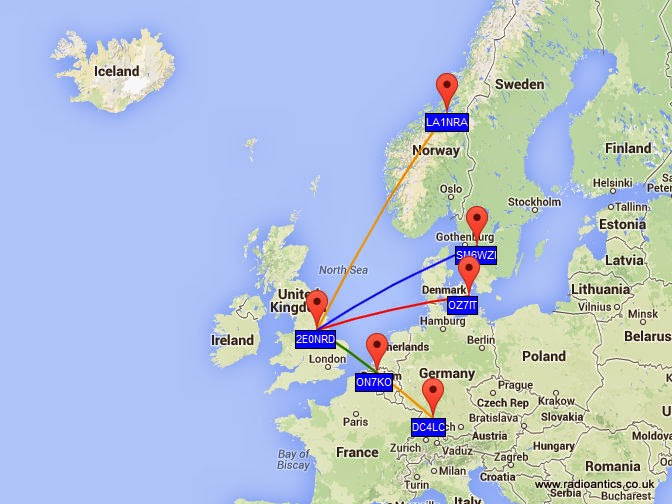
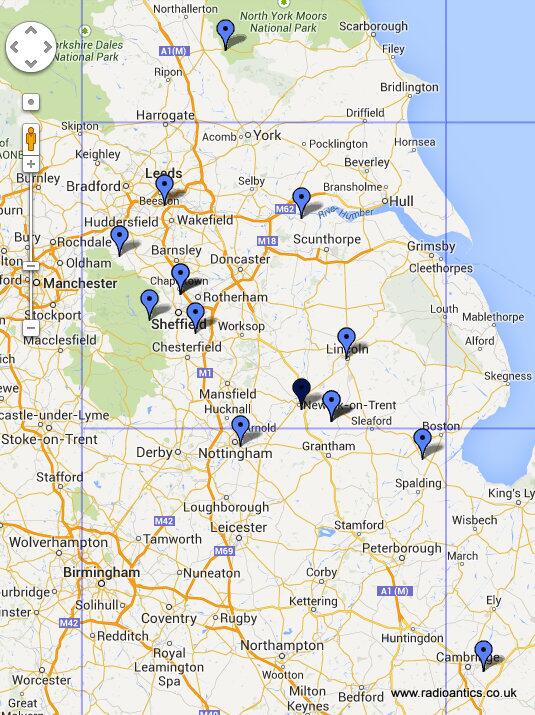
27 May 2014 - M6GTG 50MHz UKAC QSO Map

Anyway time to put the kettle on and I will post an update about how I get on tonight.

Monday, 19 May 2014

HAB Talks

I was shocked when I realised it has been nearly two months since my last update. The pace of life really hasn’t let up and neither have the time pressures of work, however on with recent radio antics...

Last week I gave two talks and demonstrations at local radio societies on High Altitude Ballooning in the UK and how to track them.

The first was at South Kesteven ARS (SKARS) the club I am a member of. The second was at Spalding and District ARS (SDARS)

This was an updated version of the talk I gave last year at SKARS. Since then I have started work on my own tracker NERD-1. Sadly development has stalled and is still only at the prototype stage (NERDTEST) but I was able to use it to demonstrate reception and tracking using the UKHAS Habitat system spacenear.us/tracker

The SDARS venue had a projector and a decent WiFi Internet connection which allowed me to demonstrate how to set up DL-FLDIGI for a ground station and NERDTEST being received and both showing up on the map in real time.

My original PowerPoint presentation has been given a total makeover and I has included some videos of Felix Baumgartner, Dave Akerman’s Babbage Teddy Bear and wacky chef Heston Blumenthal's ‘Spud-in-space’ feature from his new television program.

To show a real tracker Steve Smith (G0TDJ) of Project Hab had been kind enough to loan me his VAYU-NTX unit.

I am not the most confident of people when it comes to public interaction and it was encouraging to see people genuinely interested in what I was talking about and keen to have a look and I have had some very nice feedback.


Giving these talks has spurred me to pull my finger out and get on with actually flying something and finishing the payload!

Another mothballed project is my Ultimate3 beacon kit, still being only a Foundation licence means I cannot use it to transmit but that may be about to change as tomorrow I am sitting my Intermediate exam which will allow me to properly experiment with transmitters. The exam was arranged through SKARS by Chairman Nigel Booth and the date came through a little sooner than I was expecting so perhaps not quite as prepared as I really should be, but with a decent electronics background and some quick revision it should be fine....

My operating has been largely limited to the UKAC VHF contests, setting aside a few hours per week is manageable and my results are gradually improving, even getting some complements on my operating.
  
Two weeks ago I was able to attend the local Dambusters Hamfest at Thorpe Camp and managed to pick up a decent rotator, this has proved invaluable for the UKAC as I don’t have to keep going outside the shack to turn the antenna.


Now if I hear someone calling CQ and can monitor a QSO to get the locator and the bearing a quick turn of the dial and I have a better chance. The program I use is BD_2004 from W1GHZ, running in console window it is a simple case of setting up your own locator and then entering other locators the bearing and distance are given.

As well as the weeknight UKAC there have been a couple of weekend VHF contests, I managed a couple of hours this weekend on the RSGB 144MHz May Contest and I had the best DX ever and nearly every QSO was in a new locator square!


I wasn’t able to spend more time on the contest as we took the dogs on a sponsored dog walk on Sunday in aid of the local hospice and on Saturday I attended the British Astronomical Association, Radio Astronomy Group General Meeting at the National Space Centre.

The notion of amateur Radio Astronomy is something that has fascinated me, up to now the only dabbling I have done has been with meteor detection using reflections from the Graves space radar (blog entry). This year some of the talks dealt with using RTL-SDR and Arduino/Raspberry PI in low-cost observation. Also at the meeting was a number of demonstrations and stands from other projects we I was able to garner a great deal of useful information.

Being able to detect ‘Hydrogen-Line’ emissions to map the Galactic plane using a FUNCube or RTL-SDR dongle is astonishing, not to mention low cost VLF receivers to detect Sudden Ionospheric Disturbances SIDs and magnetometers to measure the effect of the solar wind on the earth’s magnetic field!

It is all on the to do list, but it was a great day with some really fascinating talks and some exciting plans by the group. It was a shame I had to leave earlier than I wanted as I did miss some of the later presentations.

Anyway best get an early night!