Not much to report, but have had a few decent monitoring sessions with the FUNCube Dongle.
A couple of ISS ARISS School Contacts took place over Europe during the last couple of weeks, with another taking place on Sunday morning. I was in work during the passes but managed to remotely log in to my computer to do some 'unattended' SDR-Radio recordings.
ARISS School Contact 31-Aug-2012 by nerdsville
ARISS School Contact 07-Sep-2012 by nerdsville
Late last night there was a bit of a lift on VHF and managed to receive the GB3VHF 144MHz Beacon which while it may not seem very news worthy is given there is a huge hill in the way when you look towards Kent! I have received it before using the Yagi in an horizontal polarization. But last nights reception was via the discone in the loft, which was a first. Love the JT65B tones, very musical.
GB3VHF by nerdsville
Earlier last night was also quite amusing when I stumbled across the Hucknall Rolls-Royce Amateur Radio Club who were trying to run an Amateur Radio Direction Finding Fox-hunt but were being completely blotted out by another, seemingly deaf, local operator pumping out 100W, though he did turn it down to 10W eventually.
Amateur Radio Direction Finding - Or Not! by nerdsville
Finally last weekend was the RSGB 144MHz Trophy Contest, again I got to get some decent SSB reception.
144MHz Trophy Contest - Part 1 by nerdsville
144MHz Trophy Contest - Part 2 by nerdsville
Friday, 7 September 2012


Friday, 24 August 2012
Shack Update

Again it has been a very busy month since my last post, but I did manage to get a few days to finally start sorting out my workshop/shack.
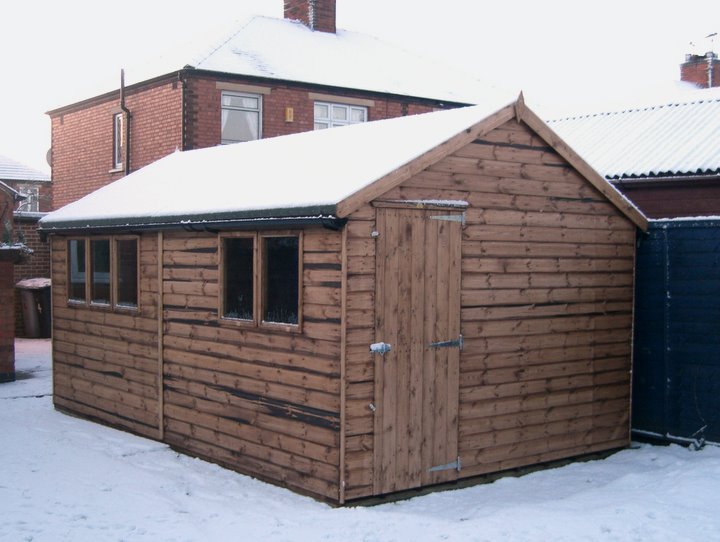
Just before the horrendous winter of 2010 struck I had purchased a 16' x 10' wooden workshop, in fact you can see it in the picture below the day after it was erected complete with a coating of snow! The workshop was subdivided into two separate sections a smaller 6' x 10' area with it's own door for storage of garden paraphernalia and the remaining 10' x 10' section was intended to be a 'man cave' where I could keep my junk, set up a small workspace and experiment to my heart's content without an accountability. The intention was to free up a small bedroom in the house and remove some of the accumulated junk from the loft!
Well for the past 18 months despite my best intentions the workshop had become nothing but yet another store room! The first task was to empty the workshop and sort out the rubbish, almost immediately I became rather dispirited as it seemed a huge task, however after several temper tantrums, a beer or two and some ruthless decisions followed by several trips to the local tip I had got rid of a large portion of the contents.The remaining good stuff including tools, screws, nails and other items were sorted roughly into boxes to be properly organised at a later date.
I had already run an armoured electrical cable supply into the workshop but no internal wiring. The distribution/RCD unit, cabling, sockets, switches and lighting were still sitting in the screwfix box. Several hours of hard work in the sweltering heat and I had it wired it up with some decent lighting and power sockets. I also took the opportunity to install some
proper thick moisture resistant chipboard tongue and groove flooring to strengthen the existing floor and
that has been covered in some vinyl flooring for ease of cleaning.

I had always intended to line out the workshop with plywood and insulate it but I had a change of heart, mostly due to cost but also for aesthetic reasons since it has a lovely rustic wooden feel inside with roof beams and the tongue and groove panelling, I will probably regret the decision in the winter, but given the fact that everything stored in it has survived two harsh winters with no signs of damp I have left it alone for now.
I have furnished it with some unwanted items including a nice sturdy table, chest of draws and some old book shelves and have gradually been moving my junk into the workshop. I am now in the process of sorting out some more shelving and a soldering station and workbench so I can finally start tinkering again!
I have also installed a wireless access point configured using WDS to connect to the main house WLAN and that seems to be reasonably fast and reliable and have an old PC which gives me access to the Internet and my music library I can listen to without being told to turn it down!
I should add the whole shed/workshop are protected by a proper security alarm with PIR and door contact sensors.
Sunday, 15 July 2012
Experiments with an SDR4+ and a scanner refurb
Seems the holiday in early June broke the blogging momentum and unfortunately work commitments since and the stresses involved as a major project nears deployment have sapped my time and energy, so not had much to post.
Family commitments too have also eaten into my spare time not leaving me time or inclination to experiment. The FUNCube Dongle and the Ultra-cheap RTL-SDR have been unplugged for several weeks and I am ashamed to say most of my evenings have been sent slumped in front of the TV often nodding off to sleep rather than tinkering away.
That is not to say I have been completely idle! I have spent the last couple of weeks with a Cross Country Wireless SDR4+ receiver courtesy of my younger brother. For a while I have toyed with purchasing one after seeing them at last years Hamfest and have read some decent reviews. The SDR4+ is a HF Software Defined Radio covering 0.85 - 30MHz, the full specifications can be found on their website.

My brother shares a similar interest in radio, probably as he was forced to share a room with me when we were younger and I would subject him to listening to all sorts of strange signals late into the night! Well he decided to purchase one several weeks ago, but was frustrated when it didn't seem to work. On one of visits to see my Mother I took a cursory look and couldn't make it work either. To cut a long story short while he went away on holiday I borrowed the unit away to see if I could figure it out.
Following some experimentation and discussions with Chris Moulding on the Cross Country Wireless Yahoo Group turned out the problem was some dodgy USB ports and/or USB leads! The thread can be read at http://uk.groups.yahoo.com/group/cross_country_wireless/message/2136
I strung up a long random-length wire antenna in the loft and have managed to get some decent results on some bands, but interestingly very little on others, probably due to the lack of an ATU. But I have received lots of broadcast AM, some DRM (but not actually decoded) and buckets loads of Amateur transmissions, LSB/USB voice and Morse, RTTY and PSK31 from Europe, and decoded some HF-FAX. Sadly the SDR4+ will soon be off back to it's rightful owner, but has certainly wetted my appetite.
I have also refurbished my Realistic PRO2022 scanner, as I posted back in 2010 this was my very first scanner and sadly was looking a little bit worse for years of wear. It is still functional, especially for listening to airband but the displays electro-luminescence back light had faded and it was looking a little grubby.


I found a cheap supplier of a suitable EL panel on Ebay and quickly had the new one cut to size and fitted, giving a lovely new blue display.

The next thing was to clean the grime and grease that was encrusted on the case and knobs, using a small amount of Clit-Bang degreaser and being very careful soon had the case looking almost as good as new!

Family commitments too have also eaten into my spare time not leaving me time or inclination to experiment. The FUNCube Dongle and the Ultra-cheap RTL-SDR have been unplugged for several weeks and I am ashamed to say most of my evenings have been sent slumped in front of the TV often nodding off to sleep rather than tinkering away.
That is not to say I have been completely idle! I have spent the last couple of weeks with a Cross Country Wireless SDR4+ receiver courtesy of my younger brother. For a while I have toyed with purchasing one after seeing them at last years Hamfest and have read some decent reviews. The SDR4+ is a HF Software Defined Radio covering 0.85 - 30MHz, the full specifications can be found on their website.
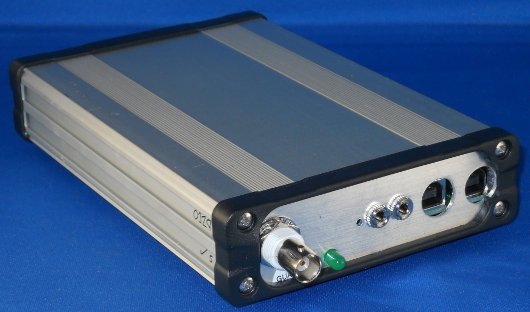
My brother shares a similar interest in radio, probably as he was forced to share a room with me when we were younger and I would subject him to listening to all sorts of strange signals late into the night! Well he decided to purchase one several weeks ago, but was frustrated when it didn't seem to work. On one of visits to see my Mother I took a cursory look and couldn't make it work either. To cut a long story short while he went away on holiday I borrowed the unit away to see if I could figure it out.
Following some experimentation and discussions with Chris Moulding on the Cross Country Wireless Yahoo Group turned out the problem was some dodgy USB ports and/or USB leads! The thread can be read at http://uk.groups.yahoo.com/group/cross_country_wireless/message/2136
I strung up a long random-length wire antenna in the loft and have managed to get some decent results on some bands, but interestingly very little on others, probably due to the lack of an ATU. But I have received lots of broadcast AM, some DRM (but not actually decoded) and buckets loads of Amateur transmissions, LSB/USB voice and Morse, RTTY and PSK31 from Europe, and decoded some HF-FAX. Sadly the SDR4+ will soon be off back to it's rightful owner, but has certainly wetted my appetite.
I have also refurbished my Realistic PRO2022 scanner, as I posted back in 2010 this was my very first scanner and sadly was looking a little bit worse for years of wear. It is still functional, especially for listening to airband but the displays electro-luminescence back light had faded and it was looking a little grubby.

I had already replaced the backlight on my PRO2006, but this was a lot easier due to the display being easily accessible with the simple removal of the front panel, and the EL panel being on flying leads rather than soldered on to a PCB.


I found a cheap supplier of a suitable EL panel on Ebay and quickly had the new one cut to size and fitted, giving a lovely new blue display.

The next thing was to clean the grime and grease that was encrusted on the case and knobs, using a small amount of Clit-Bang degreaser and being very careful soon had the case looking almost as good as new!

Friday, 8 June 2012
Skelton Transmitter Site
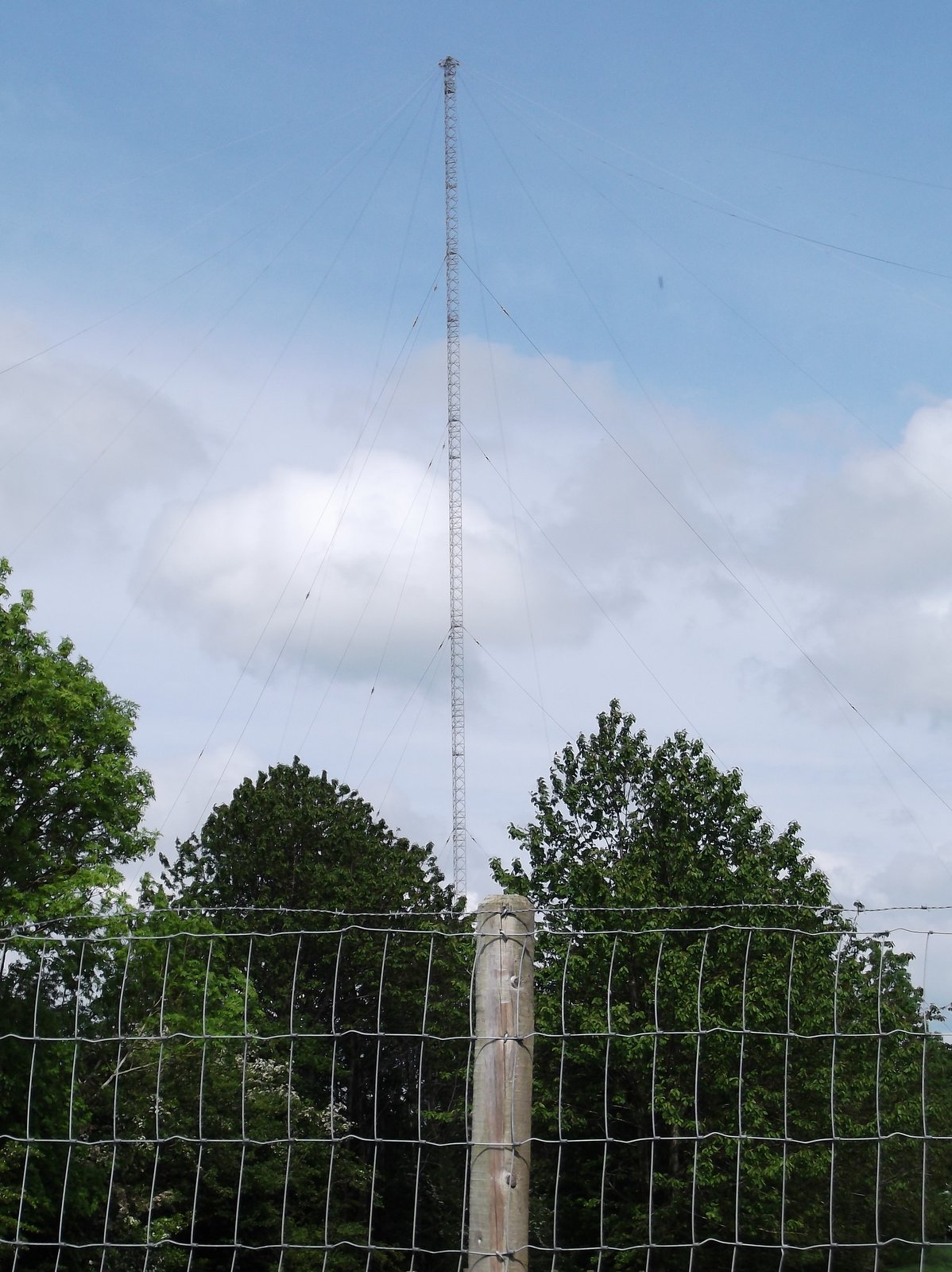
Just spent the last week in Cumbria and the Lake District on holiday, for part of the time we were camped near the village of Skelton around 5 miles north west of Penrith. Skelton is famous for it's huge transmitter site. The primary function is shortwave broadcasting, but it also supposed to be the site of a VLF array used for communication with submarines.
While out finding some geocaches I managed to take a few photos of the impressive antenna arrays.


While out finding some geocaches I managed to take a few photos of the impressive antenna arrays.



Tuesday, 22 May 2012
RTLSDR - Part 4 - Cutting out the noise using a simple coax filter
One major limitation of both the FUNCube Dongle and the RTL-SDR based receivers is the poor front end filtering.
Connecting a wide band antenna such as a discone to the input often results in a spectrum full of noise which swamps the target signal.
In most cases the noise is actually a result of out of band high-power transmissions such as FM and TV broadcast stations and pagers which overload the receiver and get mixed in to the tuned signal. The effects can be mitigated to a degree by turning down the gain of the receiver but at the expense of sensitivity to the signal you are wanting to receive.
The FUNCube Dongle in my experience seems especially susceptible to the effects of FM broadcast signals when trying to monitor the 2-Meter amateur band. I'm not sure if the current weather conditions were the cause but yesterday evening it seemed the breakthrough was especially bad. So I decided to experiment with a simple coax 'notch' filter.
There are two approaches to filtering, one is to use a band-pass filter which passes frequencies within a certain range and rejects (attenuates) frequencies outside that range. The other is to use a band-stop filter that passes most frequencies unaltered, but attenuates those in a specific range to very low levels. A notch filter is a band-stop filter with a narrow stop band.
As it happens you can make an effective filter using ordinary coaxial cable which will generate a sharp, deep notch which can be used to attenuate the unwanted signal.
A coax stub notch filter can be made if you connect the antenna to the receiver using a T-connector then attach a piece of coax of the appropriate length (the stub) to the remaining connector.
I happen to have a fair bit of 10Base2 Thin-Ethernet cabling (RG-58U) and connectors which were repatriated from a previous employer over a decade ago. The network cards they used came supplied with lovely long high quality 10m patch leads with moulded BNC connectors and a T-Connector and terminator! Even back then the 10Base2 was completely redundant as the network infrastructure used Cat-5 cabling.
So I dug out one of the T-Connectors and a BNC connector and set to work, connecting the antenna and receiver was simple, all I needed was to construct the coax stub.
To calculate the length of the stub you must first calculate the wave length of the desired 'notch frequency' for the FM band a good central notch frequency is around 100MHz.
The wave length is found by dividing the speed of light (which is around 300,000km/sec in free space) by frequency
So for a 100MHz signal the wave length is 300/100 = 3 meters.
However the speed of the radio wave in a coax is affected by the material it is made of, this is called the velocity factor. For most solid polyethylene coax (e.g RG-58) this is 66% (a handy table can be found here)
So multiplying 3 x 0.66 = 1.98 meters
The coax stub is 1/4 of this wavelength = 1.98 x 0.25 = 0.495 (49.5 cm)
So cutting a piece of coax of that length, connecting it to the T-Connector and leaving the other end open completes the filter. The filter will have maximum attenuation at 100MHz (assuming the coax is cut accurately) and the attenuation will fall off away from this 'notch frequency' (Note the filter will also notch at 300MHz, 500MHz and so on)
Interestingly it seems my RTL based SDR receiver is more affected by pager breakthrough, so I plan to make an alternative stub, adjusting the calculation to use 153MHz as the notch frequency to reduce this. It is possible to add more than one filter at a time using multiple T-Connectors and alternative higher performance designs for coax notch and band-pass filters can be found with a quick Google search.
I made a quick video showing the effectiveness of this simple filter which took about 10 minutes to make!
Connecting a wide band antenna such as a discone to the input often results in a spectrum full of noise which swamps the target signal.
In most cases the noise is actually a result of out of band high-power transmissions such as FM and TV broadcast stations and pagers which overload the receiver and get mixed in to the tuned signal. The effects can be mitigated to a degree by turning down the gain of the receiver but at the expense of sensitivity to the signal you are wanting to receive.
The FUNCube Dongle in my experience seems especially susceptible to the effects of FM broadcast signals when trying to monitor the 2-Meter amateur band. I'm not sure if the current weather conditions were the cause but yesterday evening it seemed the breakthrough was especially bad. So I decided to experiment with a simple coax 'notch' filter.
There are two approaches to filtering, one is to use a band-pass filter which passes frequencies within a certain range and rejects (attenuates) frequencies outside that range. The other is to use a band-stop filter that passes most frequencies unaltered, but attenuates those in a specific range to very low levels. A notch filter is a band-stop filter with a narrow stop band.
As it happens you can make an effective filter using ordinary coaxial cable which will generate a sharp, deep notch which can be used to attenuate the unwanted signal.
A coax stub notch filter can be made if you connect the antenna to the receiver using a T-connector then attach a piece of coax of the appropriate length (the stub) to the remaining connector.
I happen to have a fair bit of 10Base2 Thin-Ethernet cabling (RG-58U) and connectors which were repatriated from a previous employer over a decade ago. The network cards they used came supplied with lovely long high quality 10m patch leads with moulded BNC connectors and a T-Connector and terminator! Even back then the 10Base2 was completely redundant as the network infrastructure used Cat-5 cabling.
So I dug out one of the T-Connectors and a BNC connector and set to work, connecting the antenna and receiver was simple, all I needed was to construct the coax stub.
To calculate the length of the stub you must first calculate the wave length of the desired 'notch frequency' for the FM band a good central notch frequency is around 100MHz.
The wave length is found by dividing the speed of light (which is around 300,000km/sec in free space) by frequency
So for a 100MHz signal the wave length is 300/100 = 3 meters.
However the speed of the radio wave in a coax is affected by the material it is made of, this is called the velocity factor. For most solid polyethylene coax (e.g RG-58) this is 66% (a handy table can be found here)
So multiplying 3 x 0.66 = 1.98 meters
The coax stub is 1/4 of this wavelength = 1.98 x 0.25 = 0.495 (49.5 cm)
So cutting a piece of coax of that length, connecting it to the T-Connector and leaving the other end open completes the filter. The filter will have maximum attenuation at 100MHz (assuming the coax is cut accurately) and the attenuation will fall off away from this 'notch frequency' (Note the filter will also notch at 300MHz, 500MHz and so on)
Interestingly it seems my RTL based SDR receiver is more affected by pager breakthrough, so I plan to make an alternative stub, adjusting the calculation to use 153MHz as the notch frequency to reduce this. It is possible to add more than one filter at a time using multiple T-Connectors and alternative higher performance designs for coax notch and band-pass filters can be found with a quick Google search.
I made a quick video showing the effectiveness of this simple filter which took about 10 minutes to make!
Monday, 21 May 2012
Some audio from the 144MHz SSB Contest
Not had much radio time since Saturday due to family duties but did managed to find time to edit down some of the audio from the 144MHz SSB Amateur Radio Contest I received.
The first part of the audio was from the FUNCube Dongle, the latter part from the Ultra cheap NewSky DVB-T stick running the RTL-SDR driver.
Both were received using the loft mounted discone antenna which I believe is vertically polarised and so wasn't optimal since SSB is broadcast using horizontal polarization. Even so I was quite impressed with what I did receive with such humble equipment.The stations calling in the audio were G0VHF (morse and voice), M0KWP, M0BAA, 2E0KWM and G4SIV
144MHZ SSB Contest by nerdsville
Please note the corruption that can be heard toward the end of audio appears to be an artifact of the sound editor and/or the transcoding used by soundcloud as it wasn't in the original audio.
The first part of the audio was from the FUNCube Dongle, the latter part from the Ultra cheap NewSky DVB-T stick running the RTL-SDR driver.
Both were received using the loft mounted discone antenna which I believe is vertically polarised and so wasn't optimal since SSB is broadcast using horizontal polarization. Even so I was quite impressed with what I did receive with such humble equipment.The stations calling in the audio were G0VHF (morse and voice), M0KWP, M0BAA, 2E0KWM and G4SIV
144MHZ SSB Contest by nerdsville
Please note the corruption that can be heard toward the end of audio appears to be an artifact of the sound editor and/or the transcoding used by soundcloud as it wasn't in the original audio.
Sunday, 20 May 2012
RTLSDR - Part 3 - CQ CQ Contest
As it's the weekend I have managed to experiment with my new SDR device. I have sorted out an adapter so I can connect it to the loft discone and it has been pulling in some very nice clear signals. I have had to do some tweaking especially of the usb transfer buffer size to get some decent audio out of it. I have also had to learn how to use the HDSDR program which I haven't used much before favouring the SDR-Radio one with the FUNCube Dongle.
One thing that caught me out is that when I last used HDSDR with the FUNCube I had to swap the I and Q signals and I don't need to with the Newsky Tv28t so initially I was very confused as it all seem arse about face! Duh! But now actually growing to quite like it as having a much wider spectrum to see is very nice.
By a pleasant coincidence yesterday saw the start of the RSGB 144MHz May Contest so lots of SSB transmissions to tune in to. The FUNCube definitely has the edge when it comes to quality of audio and sensitivity and being able to tune down the gain helps in preventing out of band signal overloading the front end. With the Newsky device I've had to have the gain right up most of the time, but I suspect there is still more optimising to do.
Just a small video showing some of the SSB Contest signals on the spectrum. Don't you just love the masses of noise? Really must do something about that damn router!
I've also got to discover how to calibrate the Newsky as it shows quite a bit off frequency, I understand I need to discover the actual crystal clock frequency and can feed that into the EXT-IO plugin.
One thing that caught me out is that when I last used HDSDR with the FUNCube I had to swap the I and Q signals and I don't need to with the Newsky Tv28t so initially I was very confused as it all seem arse about face! Duh! But now actually growing to quite like it as having a much wider spectrum to see is very nice.
By a pleasant coincidence yesterday saw the start of the RSGB 144MHz May Contest so lots of SSB transmissions to tune in to. The FUNCube definitely has the edge when it comes to quality of audio and sensitivity and being able to tune down the gain helps in preventing out of band signal overloading the front end. With the Newsky device I've had to have the gain right up most of the time, but I suspect there is still more optimising to do.
Just a small video showing some of the SSB Contest signals on the spectrum. Don't you just love the masses of noise? Really must do something about that damn router!
I've also got to discover how to calibrate the Newsky as it shows quite a bit off frequency, I understand I need to discover the actual crystal clock frequency and can feed that into the EXT-IO plugin.
Friday, 18 May 2012
RTLSDR - Part 2 - Hello.. Hello Can You Hear Me?
As suspected the problem was indeed the computer. I rushed home at lunchtime and in less than 10 minutes I had installed the software on my main PC and it sprang to life just like the video promised.
I only had a short time to try it out, but picked up some FM stations, pager signals and the RAF Waddington ATIS which should have been on 291.675MHz but the frequency on the HDSDR screen was way off.
It does appear to be a little deaf but I hadn't got a decent antenna connected so I won't conclusively say that yet as I've got to make up an adapter this evening so I can connect the loft antenna on. Also the EXT-IO interface has a gain control that I didn't alter from the default.
I only had a short time to try it out, but picked up some FM stations, pager signals and the RAF Waddington ATIS which should have been on 291.675MHz but the frequency on the HDSDR screen was way off.
It does appear to be a little deaf but I hadn't got a decent antenna connected so I won't conclusively say that yet as I've got to make up an adapter this evening so I can connect the loft antenna on. Also the EXT-IO interface has a gain control that I didn't alter from the default.
RTLSDR - Part 1 - Failed to Launch!


Well that was quick! The USB Receiver with the RTL2832 receiver I ordered it on Tuesday afternoon and arrived yesterday (Thursday) morning (from Jersey based retailer Cosycave via ebay) so was eager to try it out last night.
Fired up the old laptop and went off to http://www.rtlsdr.com/ and the getting started section to download the drivers and software and everything seemed to be going well. Following the instructions the device appeared to be correctly detected and the appropriate drivers installed, but then it went pear shaped.
HDSDR would open, the EXT-IO window would appear and attach to the device but as soon as I tried to tune the stick or start receiving various errors would appear and nothing worked... I tried a number of different option settings but still no luck!
Feeling a bit disappointed I put it down while I watched some TV and tried again later. I uninstalled everything and went through the process again but still ended up with the same errors.
I decided to rule out a defective receiver so I uninstalled everything again and installed the manufacturers supplied software.
The drivers and something called BlaseHDTV installed without a hitch. I connected the little supplied antenna to the receiver and set off scanning for TV and radio stations. It didn't complain but found nothing! By now it was well past midnight so I went off to bed in a huff.
This morning I connected the receiver to the roof aerial and it did find TV channels from the two local transmitters Waltham (60% signal strength and 100% quality) and Belmont (low signal strength and quality) but when I tried to watch anything I just got random coloured blocks and random noise. Interestingly it didn't find anything using the DAB or FM radio applications.
So is the receiver defective? Unlikely as it did go away and find TV channels.
The culprit is almost certainly the computer. Being an untrusting soul when it comes to software 'off the internet' I didn't want to try any of this out on my main computers in case it messed anything up. However the laptop is an old Sony Vaio with a Pentium 4-M processor and only 512MB of RAM and can be prone to sluggish behaviour, especially when trashing the hard drive. Saying that it will happily run SDR-Radio with the FUNCube Dongle.
Checking back over the specifications of the receiver it clearly states on the packaging that it requires a USB2.0 port... mmmm the old laptop only has USB1.1! Unfortunately I have grown accustomed to ignoring the pop-up balloon which appears I plug something in...
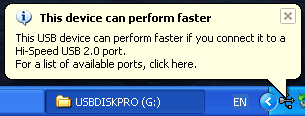
The looks like the most likely reason for the problems, not enough bandwidth - which would certainly explain the DTV issues. So I will have to try it on another PC...
As Captain Picard would say!

Wednesday, 16 May 2012
Ultra-cheap VHF-UHF Software Defined Radio

Over the last few months various forums and websites I visit have been buzzing with conversations about the RTL-SDR project (e.g Hackaday)
The idea is to take a cheap USB FM/DAB/DTV receiver (for less than £20) that contains a Realtek RTL2832U chipset and an appropriate tuner chip (such as the Elonics E4000) then by using new custom drivers you get yourself a SDR-Radio with a frequency range of around 64 – 1700 MHz
Sound familiar? Yes it is similar to the FUNCube Dongle.
There are a couple of limitations, unlike the FCD the device doesn't have a pre-amplifier so sensitivity might be limited. The IQ sampling is only in 8 bits so the dynamic range will be limited, but because the device doesn't use a USB Soundcard interface like the FCD to pass the IQ samples to the PC the sample rate can be much higher (theoretically 3.2 MS/s) which allows potential decoding of wideband signals which the FCD cannot do.
Over the last few week I have seen a few Youtube videos and read of peoples experiments so my curiosity was piqued and decided to get one to have a go.
There in lies the problem, since news of this hit the internet demand for suitable devices has rocketed and dealers are cashing in and prices have risen and stocks are low. Also as not every USB FM/DAB/DTV receiver has a suitable chipset it is very easy to buy one that won't actually work. There is a list of known working devices here and yesterday while browsing ebay I found a dealer claiming to be selling the Newsky TV28T for around £16 including postage so thought what the hell!
Should be arriving in the next few days so I will keep you posted!
Before I go I should point out that on some forums and discussion groups I visit that some are under the illusion that they are getting a high quality wide band receiver for peanuts and then have complained because they have got a unsupported device or don't understand how the software works. I am under no illusions it will undoubtedly be fiddly, unreliable and inaccurate but it should be FUN!
If nothing else I will have a way of listening to DAB and watching DTV on my PC, which is hopefully better than my last purchase (which I should really dig out and check what chipset it has!)
Tuesday, 15 May 2012
POCSAG and FLEX Decoding with the FCD
With today's modern mobile and wifi networks pagers might seem terribly old fashioned. But pagers are still in use today in places where mobile phones typically cannot reach and also in places where the operation of the radio transmitters contained in mobile phones is problematic or prohibited.
Whilst many of the national networks have closed down some are still going and some locations such as large hospitals have their own systems and are still popular with birdwatchers in Britain and Ireland with companies Rare Bird Alert and Birdnet Information offering news of rare birds sent to pagers that they sell.
Decoding pager messages using a PC involves some software and a receiver usually with a discriminator tap and using the sound card and/or a data-slicer. The most popular software is the PDW suite.
I decided to use the FUNCube Dongle to attempt some decoding as being able to keep everything digital within the PC rather than having audio leads from a scanner plugged into the soundcard meant no problems with audio circuitry messing up the signal. Also the ability to alter the bandwidth should mean I could get some excellent decoding - and I did, both the higher speed and more problematic FLEX and the easier POCSAG protocols.
Whilst many of the national networks have closed down some are still going and some locations such as large hospitals have their own systems and are still popular with birdwatchers in Britain and Ireland with companies Rare Bird Alert and Birdnet Information offering news of rare birds sent to pagers that they sell.
Decoding pager messages using a PC involves some software and a receiver usually with a discriminator tap and using the sound card and/or a data-slicer. The most popular software is the PDW suite.
I decided to use the FUNCube Dongle to attempt some decoding as being able to keep everything digital within the PC rather than having audio leads from a scanner plugged into the soundcard meant no problems with audio circuitry messing up the signal. Also the ability to alter the bandwidth should mean I could get some excellent decoding - and I did, both the higher speed and more problematic FLEX and the easier POCSAG protocols.
Tuesday, 1 May 2012
Rainy Sunday, Damp Monday SSTV
With the total washout at the weekend with very heavy rain on Sunday I was able to spend a decent amount of time monitoring. I recently brought a dry-cell adapter for the Alinco DJ-X10 receiver (EDH-16) allowing me to power it using normal AA Ni-MH batteries as the rechargeable battery pack it came with doesn't hold its charge any more.

So as the rain hammered on the window I decided to decode some SSTV images on the amateur bands. I connected up the discone and the computer tuned to 14.230Mhz USB and fired up MMSSTV. Some of the better decoded images I've got over the last couple of days are included below.
I did have an attempt at decoding some digital SSTV using EasyPAL but despite some strong signals couldn't quite get a full sync, but I think that was down to the conditions and the relatively poor rejection of the DJ-X10. With no ATU the out of band signals and nearby signals from what I suspect are high power operators were just too much for it, as the following sound file demonstrates.
Swamped SSTV by nerdsville


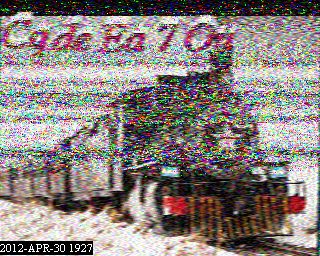

So as the rain hammered on the window I decided to decode some SSTV images on the amateur bands. I connected up the discone and the computer tuned to 14.230Mhz USB and fired up MMSSTV. Some of the better decoded images I've got over the last couple of days are included below.
I did have an attempt at decoding some digital SSTV using EasyPAL but despite some strong signals couldn't quite get a full sync, but I think that was down to the conditions and the relatively poor rejection of the DJ-X10. With no ATU the out of band signals and nearby signals from what I suspect are high power operators were just too much for it, as the following sound file demonstrates.
Swamped SSTV by nerdsville
Monday, 30 April 2012
The interference continues!
I am still suffering from that horrendous interference and am no nearer tracking down its source.
I have made another video showing the effects. As I mentioned before the signal seems to build in intensity and tends to drift frequency and then fade away. I know the FUNCube dongle filtering can be susceptible to out of band signals and images especially in the VHF but the video shows the same interference on a normal receiver with a different antenna.
Interestingly I have monitored a few local amateurs also mentioning problems with noise that has been affecting them, one even described an "annoying pulsing sound"
I have made another video showing the effects. As I mentioned before the signal seems to build in intensity and tends to drift frequency and then fade away. I know the FUNCube dongle filtering can be susceptible to out of band signals and images especially in the VHF but the video shows the same interference on a normal receiver with a different antenna.
Interestingly I have monitored a few local amateurs also mentioning problems with noise that has been affecting them, one even described an "annoying pulsing sound"
Monday, 16 April 2012
ISS Video
There are some really nice visible passes of the International Space Station at the moment over the UK in the evening. I have tried a couple of times to video them but don't have the right equipment. My ancient Digital8 camcorder just isn't sensitive enough when the sky is dark, the image is just a mass of noise!
However saying that last night one of the passes was just after sunset and did manage to get something.
It was a real pity I couldn't video the later pass as the sky was dark and clear of clouds and the ISS was amazingly bright as it passed across a star filled sky.
However saying that last night one of the passes was just after sunset and did manage to get something.
It was a real pity I couldn't video the later pass as the sky was dark and clear of clouds and the ISS was amazingly bright as it passed across a star filled sky.
Thursday, 12 April 2012
Saw and Heard the ISS on Yuri's Night
Today is Cosmonautics Day in Russia, a holiday that celebrates the first manned space flight made on April 12, 1961 by the 27-year-old Soviet cosmonaut Yuri Gagarin. Gagarin circled the Earth for 1 hour and 48 minutes aboard the Vostok 1 spacecraft. Coincidentally, it is also the anniversary of the first Space Shuttle launch that occurred 20 years after the historic Vostok flight.
Tonight on what is known as Yuri's Night cosmonauts on board the International Space Station made contact with St Petersburg in Russia.
The pass of the ISS over the UK starting aat 20:28 UTC was extremely bright and visible despite the cloudy sky and as it passed into Eastern Europe the contact began on 145.800MHz. I managed to capture some very scratchy audio with my FUNCube Dongle and the loft antenna.
ISS St. Petersburg contact 12-04-2012 by nerdsville
Tonight on what is known as Yuri's Night cosmonauts on board the International Space Station made contact with St Petersburg in Russia.
The pass of the ISS over the UK starting aat 20:28 UTC was extremely bright and visible despite the cloudy sky and as it passed into Eastern Europe the contact began on 145.800MHz. I managed to capture some very scratchy audio with my FUNCube Dongle and the loft antenna.
ISS St. Petersburg contact 12-04-2012 by nerdsville
Thursday, 29 March 2012
Well I've finally 'seen' the ISS
I have received many transmissions during day and night time passes from the International Space Station, mainly APRS and some ARISS school contacts both using the scanners and the FUNCube dongle.
However until yesterday I had never actually 'seen it' pass overhead, either due to a combination of weather or timing of the pass. The space station is huge and hence is one of the most visible man made objects in the sky when it reflects sunlight and will then appear in the sky like a moving star.
To actually see the space station the conditions must be right. The space station needs to be lit by the Sun on the side visible to the observer and the viewing point needs to be in relative darkness. A 'visible pass' can run from a few seconds to five minutes or more and the space station takes an arc through the sky.

I have created a crude diagram to try to explain what is happening, it is not to scale by any means! The observer is in shadow. The space station which is in a higher orbit comes out of the shadow and is illuminated by the sun and the light is reflected back and can be seen by the observer.
There are many many websites and applications to predict when these visible passes occur, and at the moment in the UK some extremely bright almost overhead passes are occuring in the early morning around the time I normally get up.
So yesterday and this morning I have stood outside in my dressing gown and witnessed the very bright man-made 'star' as it majestically arced overhead.
I even tried unsuccessfully to video it this morning but just got a black screen with a bright white spot... but honestly this is the International Space Station!

Given a decent pair of binoculars or a low power telescope you can see the structure and even with the naked eye it is obviously not a simple 'circle' of light.
The ISS is even larger at the moment as it has the ATV-3 resupply vehicle has just successfully docked with it and will stay attached for several months.
http://www.nasaspaceflight.com/2012/03/europes-atv-3-dock-iss-antenna-deployment-issue-resolved/
However until yesterday I had never actually 'seen it' pass overhead, either due to a combination of weather or timing of the pass. The space station is huge and hence is one of the most visible man made objects in the sky when it reflects sunlight and will then appear in the sky like a moving star.
To actually see the space station the conditions must be right. The space station needs to be lit by the Sun on the side visible to the observer and the viewing point needs to be in relative darkness. A 'visible pass' can run from a few seconds to five minutes or more and the space station takes an arc through the sky.
I have created a crude diagram to try to explain what is happening, it is not to scale by any means! The observer is in shadow. The space station which is in a higher orbit comes out of the shadow and is illuminated by the sun and the light is reflected back and can be seen by the observer.
There are many many websites and applications to predict when these visible passes occur, and at the moment in the UK some extremely bright almost overhead passes are occuring in the early morning around the time I normally get up.
So yesterday and this morning I have stood outside in my dressing gown and witnessed the very bright man-made 'star' as it majestically arced overhead.
I even tried unsuccessfully to video it this morning but just got a black screen with a bright white spot... but honestly this is the International Space Station!

Given a decent pair of binoculars or a low power telescope you can see the structure and even with the naked eye it is obviously not a simple 'circle' of light.
The ISS is even larger at the moment as it has the ATV-3 resupply vehicle has just successfully docked with it and will stay attached for several months.
http://www.nasaspaceflight.com/2012/03/europes-atv-3-dock-iss-antenna-deployment-issue-resolved/
Thursday, 15 March 2012
Back In The Shack - Reception report VO-52
Things are hopefully get back to some form of normality here after a difficult few weeks.
During my downtime I missed the news that VO-52 HAMSAT had fallen silent on the 28th February a week after my last post. But good news the Dutch built CW/SSB transponder was reactivated yesterday so last night and this morning I monitored a couple of passes. The transponder was certainly busy and I got some nice captured IQ files to analyse later.
Using just the loft mounted discone I monitored quite a little QSO between G7SVF and I8CVS this morning which I managed to capture using the audio recorder.
VO-52 (15-Mar-2012-0823) by nerdsville
The discone It isn't the best antenna for satellite work, especially with the FUNCube dongle as it's wideband characteristics heavy overload the front end, but it is nice capture all the same, even if it made me slight late this morning and so got caught in the school run traffic.
I did a Google search on the call signs and discovered I8CVS is Domenico Marini from Napoli Italy. Dom appears to be a well known expert in amateur satellite operation. On that page is a picture of Dom in 2003 next to an impressive antenna array which appears to be sited on top a high rise building (oh the envy!)

While my own set up is much more modest. I have done a little tinkering, building a small UHF Yagi out of some metal coat hangers but have yet to test it in anger. I have also become a little more familiar with my FUNCube setup. I use the SDR-Radio.com application and having updated to a much later beta version have had much more success. There were some issues that involved the swapping the I and Q signal on early versions but these appear to have now been corrected.
After listening to the ICQ Podcast I have been monitoring a few propagation beacons (GB3VHF and GB3BUX) (I will post more on this later) and using those beacons have got the frequency calibration more or less spot on now. I have also discovered that the Doppler Invert option needed setting so now SDR-Radio more or less correct perfectly as the satellites passes (still occasionally needs some manual interaction)
I really must make a real effort to get a licence and become less passive in this hobby, just not sure how I am going to afford an all-modes transceiver mind!
During my downtime I missed the news that VO-52 HAMSAT had fallen silent on the 28th February a week after my last post. But good news the Dutch built CW/SSB transponder was reactivated yesterday so last night and this morning I monitored a couple of passes. The transponder was certainly busy and I got some nice captured IQ files to analyse later.
Using just the loft mounted discone I monitored quite a little QSO between G7SVF and I8CVS this morning which I managed to capture using the audio recorder.
VO-52 (15-Mar-2012-0823) by nerdsville
The discone It isn't the best antenna for satellite work, especially with the FUNCube dongle as it's wideband characteristics heavy overload the front end, but it is nice capture all the same, even if it made me slight late this morning and so got caught in the school run traffic.
I did a Google search on the call signs and discovered I8CVS is Domenico Marini from Napoli Italy. Dom appears to be a well known expert in amateur satellite operation. On that page is a picture of Dom in 2003 next to an impressive antenna array which appears to be sited on top a high rise building (oh the envy!)
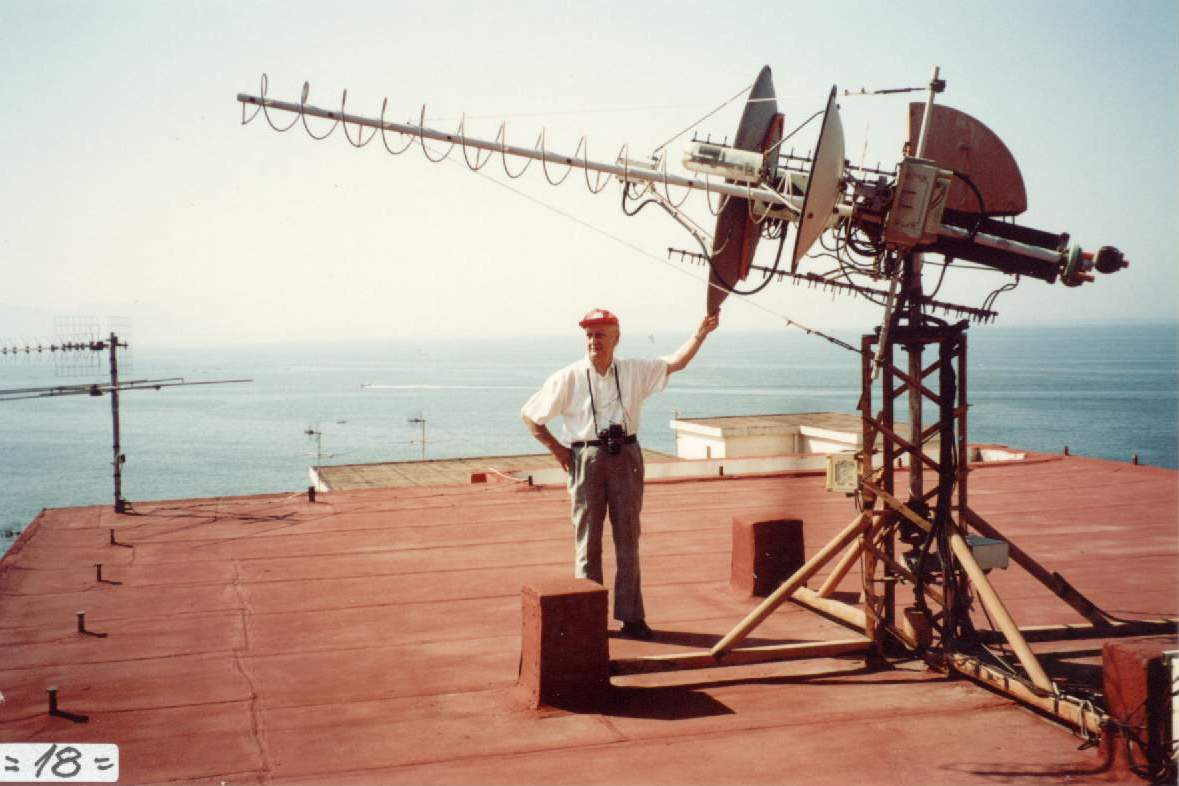
While my own set up is much more modest. I have done a little tinkering, building a small UHF Yagi out of some metal coat hangers but have yet to test it in anger. I have also become a little more familiar with my FUNCube setup. I use the SDR-Radio.com application and having updated to a much later beta version have had much more success. There were some issues that involved the swapping the I and Q signal on early versions but these appear to have now been corrected.
After listening to the ICQ Podcast I have been monitoring a few propagation beacons (GB3VHF and GB3BUX) (I will post more on this later) and using those beacons have got the frequency calibration more or less spot on now. I have also discovered that the Doppler Invert option needed setting so now SDR-Radio more or less correct perfectly as the satellites passes (still occasionally needs some manual interaction)
I really must make a real effort to get a licence and become less passive in this hobby, just not sure how I am going to afford an all-modes transceiver mind!
Wednesday, 22 February 2012
Video of VO52(HAMSAT)
Due to work and family commitments and the currently inconvenient timing of the passes I really haven't had a serious attempt at receiving any of the downlinks from the numerous Cubesats launched on the Vega rocket back on Monday February 13.
I have managed to get some faint transmissions from what I believe is Masat-1 which has now been officially designated MagyarSat-OSCAR-72 (MO-72) I have also seen a number of other traces on the waterfall display of the sdr (using the FUNCube dongle) They are in the correct frequency range and appear and disappear as the cluster of cubesats were predicted as passing overhead.
I have managed to make a video of a pass of the SSB VO52(HAMSAT) downlink being received by the FCD this morning using just the antenna in the loft.
Operating a camera in one hand and trying to track the signal isn't that easy, but you get the idea!
I have got a chance this weekend to have a proper attempt at the Vega cubesats.
I have managed to get some faint transmissions from what I believe is Masat-1 which has now been officially designated MagyarSat-OSCAR-72 (MO-72) I have also seen a number of other traces on the waterfall display of the sdr (using the FUNCube dongle) They are in the correct frequency range and appear and disappear as the cluster of cubesats were predicted as passing overhead.
I have managed to make a video of a pass of the SSB VO52(HAMSAT) downlink being received by the FCD this morning using just the antenna in the loft.
Operating a camera in one hand and trying to track the signal isn't that easy, but you get the idea!
I have got a chance this weekend to have a proper attempt at the Vega cubesats.
Friday, 10 February 2012
Video - CubeSats on Vega qualification flight
Frequencies and URLs for the student amateur radio satellites on Vega can be seen at http://www.uk.amsat.org/4180
as seen on http://www.uk.amsat.org/4542
Thursday, 9 February 2012
Vega rocket launchs on Monday

The first qualification Vega flight from the space center at Kourou in the Caribbean is scheduled to take place on February 13.
Vega is a new launch vehicle from ESA/Arianespace to handle small to medium-sized satellite payloads. It is a four-stage launcher tailored to carry the growing number of small scientific spacecraft and other lighter-weight payloads.
The first flight is carrying eight student built amateur radio satellites comprising seven CubeSats and a microsatellite called ALMASat, Arianespace have just released a video showing the payloads.
A full list of the satellites and frequencies and other information about the launch is listed on the Amsat-UK website http://www.uk.amsat.org/4180
ALMASat-1 – University of Bologna, Italy
437.465 MHz 1200 bps FSK and 2407.850 MHz
http://www.almasat.unibo.it/02_projects/almasat-1/almasat1.htm
e-st@r – Politecnico di Torino, Italy
437.445 MHz 1200 bps AFSK
http://areeweb.polito.it/ricerca/E-STAR/
Goliat – University of Bucharest, Romania
437.485 MHz 1200 bps AFSK
http://www.goliat.ro/
MaSat-1 – Budapest University of Technology and Economics, Hungary
437.345 MHz GFSK 625/1250 bps, CW
http://cubesat.bme.hu/en/
PW-Sat1 – Warsaw University of Technology, Poland
There are 5 modes of operation:
- Receive only – no downlink
- CW Beacon CW – On-Off Keying (OOK) CW 12 WPM on 435.020 MHz
- BPSK Beacon – BPSK 1200 bps AX25 (1 frame on 20 sec) on 435.020 MHz
- Control communication mode. Downlink BPSK 1200 bps AX25 on 435.020 MHz
- Voice Repeater mode (aka “AO-16″ mode) – uplink 435.020 MHz FM and downlink 145.900 MHz DSB
http://tinyurl.com/CubeSatPW-Sat
Robusta – University of Montpellier 2, France
437.325 MHz 1200 bps FM telemetry with one data burst of 20 secs every 1 min
http://www.ies.univ-montp2.fr/robusta/satellite/?lang=en
UNICubeSAT -University of Rome, Italy
437.305MHz 9600 bps FSK
http://www.gaussteam.com/index.php?option=com_content&view=article&id=97%3Aunicubesat&catid=36%3Aunicubesat&Itemid=145
There is a lot there to have a go at receiving with the old FUNCube Dongle! I will have to get around to finally construct myself a homebrew 70cm antenna in the next few days.
Tuesday, 31 January 2012
Really annoying QRM Splatter!

Given the excellent positioning of the moon in the evening sky over the next few days I have been attempting some more decoding of weak signal EME (Earth-Moon-Earth) transmissions using my loft mounted homebrew wideband antenna, FUNCube dongle and SDR-Radio coupled with the MAP65-IQ application.
As you can see from last nights log, I had some success with this fairly rudimentary equipment, getting a reasonable number of decodes in a short space of time.
UTC Date: 2012 Jan 30
---------------------
  144.099 -215  0  0  0 -6.8    0  1 -26 2106  K1JT IW0DJB JN61        0 10  3
  144.100  320  0  2  0 -6.2    0  1 -24 2106  CQ VE4AAZ EN19          0 10  3
  144.100  352  0  1  1 -5.1    0  1 -25 2106  CQ DH6ICE JO61          0 10  3
  144.102  441  0  0  0  1.9    0  1**** 2106  RRR                     0  0  0
  144.104  301  0  1  0 -5.3    0  1 -24 2106  K1JT ZR6ABU KG33        0 10  3
  144.105  217  0  0  0  2.1    0  2**** 2106  RRR                     0  0  0
  144.107 -248  0  1  2 -4.5    0  1 -25 2106  CQ 9A1Z JN86            0 10  3
  144.107  -28  0  0  0  1.9    0  1**** 2106  RO                      0  0  0
  144.109 -470  0  0  0  1.9    0  1**** 2106  RO                      0  0  0
  144.110 -464 -4  1  0 -5.7    0  1 -23 2106  CQ OK1DCF JO80          0 10  3
  144.110   74  0  0  0 -4.1    0  1 -25 2106  K1JT N4LXB EM83         0 10  3
  144.110  440  3  1  2 -5.2    0  1 -25 2106  K1JT F9IE IN86          0 10  3
  144.114 -200 -2 -1  2 -5.2    0  1 -24 2106  K1JT EA6VQ JM19         0 10  3
  144.114  317  0  0  0  2.1    0  1**** 2106  73                      0  0  0
  144.115  113  0  0  0  2.1    0  1**** 2106  73                      0  0  0
  144.116  497  0  1  0 -6.5    0  2 -24 2106  K1JT N0AKC EN44         0 10  3
  144.117 -399  1  0  0 -5.2    0  2 -25 2106  CQ KB5WMY EM32          0 10  3
  144.117  136  0  0  0 -6.8    0  2 -23 2106  CQ W4AME EM75           0 10  3
  144.121  304  2  0 -1 -5.3    0  2 -26 2106  CQ EB2AYV IN83          0 10  3
  144.123  490  1 -3  0 -5.2    0  1 -25 2106  CQ EB2DTP IN82          0 10  3
  144.124 -115  3  0  1 -5.0    0  1 -26 2106  CQ DH8IAB JO30          0 10  3
  144.125  193 -1  0  0 -5.2    0  1 -24 2106  K1JT ES5RY KO38         0 10  3
  144.134 -463  1  0  1 -5.1    0  2 -25 2106  CQ IW0AKA JN61          0 10  3
  144.134 -419  0  0  0  2.1    0  2**** 2106  RO                      0  0  0
  144.134  -67  0  0  0  2.1    0  1**** 2106  RRR                     0  0  0
  144.136  316  0  0  0 -5.1    0  2 -25 2106  K1JT W6CAP DM14         0 10  3
  144.141 -202  0  0  0  1.9    0  2**** 2106  RRR                     0  0  0
  144.142  274  2  0  0 -7.0    0  1 -23 2106  CQ DC3VM JN39           0 10  3
  144.143 -180  1  0  1 -4.3    0  2 -25 2106  CQ W0DJM EN25           0 10  3
  144.143   33  4  0 -1 -7.0    0  1 -23 2106  CQ RK1B KO69            0 10  3
  144.143  155  6  0  0 -4.5    0  1 -24 2106  K1JT WA8CLT EN80        0 10  3
  144.143  274  7  0  0 -4.2    0  2 -18 2106  K1JT WD0APF EN10        0 10  3
  144.146  233 -1  0  0 -6.2    0  2 -23 2106  K1JT WN4KKN EM10        0 10  3
  144.148 -460  0  0  0  1.9    0  1**** 2106  RRR                     0  0  0
  144.149    5  2  0 -2 -4.2    0  1 -31 2107  K1JT K9JK EN52          0 10  3
  144.149   87 -1  0  2 -4.9    0  1 -30 2107  CQ YU1S JN94            0 10  3
  144.150  464  2  0  0 -4.2    0  2 -32 2107  K1JT WB0TEM EN12        0 10  3
  144.151 -323  0  0  0 -4.2    0  1 -31 2107  K1JT F5KCR JN26         0 10  3
  144.151  499  2  0  1 -5.3    0  1 -25 2107  CQ DJ9KV JN68           0 10  3
  144.152 -164 -1  1  1 -3.2    0  1 -37 2107  CQ DL3BWG JO62          0 10  3
  144.152   77  1  0  0 -6.0    0  1 -28 2107  CQ DH8IAB JO30          0 10  3
  144.152  115 -8  0  0 -5.6    0  2  -6 2107  CQ GW8ASA IO81          0 10  3
  144.152  263  4  0 -1 -4.7    0  1 -33 2107  CQ DH8IAB JO30          0 10  3
  144.153  -68  0  0  0  2.1    0  1**** 2107  RO                      0  0  0
  144.153  429 -1  0  0 -2.6    0  1 -25 2107  CQ DL3BWG JO62          0 10  3
  144.154   86 -1  0  0 -4.6    0  1 -36 2107  CQ RN6BN KN95           0 10  3
  144.155 -394 -3  0  0 -6.6    0  2 -36 2107  K1JT RL1X KO59          0 10  3
  144.155  164  0  0  0 -5.6    0  1 -23 2107  K1JT N5KWB EM32         0 10  3
  144.157 -179  0  0  0  1.9    0  2**** 2107  73                      0  0  0
  144.157    1  2 -1  3 -6.1    0  1 -25 2107  CQ ZS6MRK KG34          0 10  3
  144.157  193  0  0  0  1.9    0  2**** 2107  RRR                     0  0  0
  144.158  -81  2  0  0 -5.0    0  1 -23 2107  K1JT DL4SUN JO63        0 10  3
  144.158  -55  0  0  0  2.1    0  1**** 2107  73                      0  0  0
  144.099  206  1  0 -1 -5.0    0  1 -24 2114  CQ PA6T JO32            0 10  0
  144.100   23  2  0  1 -7.2    0  1 -24 2114  K1JT DK9ZY JO40         0 10  0
  144.100   55  1  0 -2 -5.2    0  1 -25 2114  K1JT K4DD EM60          0 10  0
  144.100  270  0  0  0  1.9    0  1**** 2114  RRR                     0  0  0
  144.100  477  2  0  0 -7.0    0  1 -22 2114  CQ N9XG EN60            0 10  0
  144.102 -152  0  0  0  1.8    0  7**** 2114  RRR                     0  0  0
  144.102    8  0  0  0  2.1    0  2**** 2114  73                      0  0  0
  144.102  331 -2 -1  1 -6.8    0  2 -25 2114  K1JT 9A1DFG JN85        0 10  0
  144.103 -111  0  0  0  1.8    0  1**** 2114  RRR                     0  0  0
  144.103  197  1  0  1 -5.7    0  2 -25 2114  K1JT K0RL EM49          0 10  0
  144.104 -364 -2  0  0 -6.7    0  1 -25 2114  K1JT IW1DJS JN35        0 10  0
  144.105 -382 -2  0  0 -5.3    0  1 -24 2114  K1JT RZ3QS KO91         0 10  0
  144.107  310 -1  0  0 -5.3    0  1 -25 2114  K1JT DJ8MS/P            0 10  0
  144.108 -138 -2 -1  0 -7.2    0  1 -24 2114  K1JT F1VJQ IN95         0 10  0
  144.110 -362  0  0  0  1.9    0  2**** 2114  RO                      0  0  0
  144.111 -124  0  0  0  2.5    0  2**** 2114  73                      0  0  0
  144.113 -401  0  0  0  1.9    0  1**** 2114  RO                      0  0  0
  144.113  102  1  0  0 -5.2    0  2 -24 2114  K1JT OE3R JN88          0 10  0
  144.117  -27  0  0  0  1.6    0  1**** 2114  RRR                     0  0  0
  144.118  -70  4 -3  0 -4.9    0  1 -24 2114  CQ LA3BO JO59           0 10  0
  144.118  156  2  0  0 -6.9    0  1 -24 2114  K1JT W9EME EN54         0 10  0
  144.118  357  2  0  0 -6.4    0  1 -24 2114  K1JT VE2WHZ FN08        0 10  0
  144.119 -486  0  0  0 -6.2    0  1 -22 2114  K1JT KI4M EM95          0 10  0
  144.119  278  0  0  0  1.9    0  2**** 2114  RO                      0  0  0
  144.120 -326 -2  0  0 -6.8    0  2 -23 2114  K1JT JO1LVZ PM95        0 10  0
  144.120  -13  2  1 -1 -5.1    0  1 -25 2114  CQ IK1EFM JN44          0 10  0
  144.121  -39  2  0  0 -6.6    0  3 -25 2114  CQ AF6O DM14            0 10  0
  144.121  135  0  0  0 -5.3    0  2 -25 2114  CQ M0VHF IO82           0 10  0
  144.122  225 -3  0 -2 -6.7    0  2 -25 2114  K1JT MM0BQI IO85        0 10  0
  144.123  376 -1  0  1 -6.5    0  1 -24 2114  CQ DL3BWG JO62          0 10  0
  144.124  141 -1  0  0 -6.6    0  1 -25 2114  CQ KB0CY DM79           0 10  0
  144.125  109  2  1  1 -4.8    0  2 -24 2114  K1JT AA1OV FN43         0 10  0
  144.127 -488 -2  0  0 -7.2    0  1 -25 2114  CQ ON1DSQ JO21          0 10  0
  144.127 -302 -2 -1 -1 -6.9    0  1 -26 2114  CQ ON1DSQ JO21          0 10  0
  144.128 -476  0  0  0  1.9    0  3**** 2114  73                      0  0  0
  144.128  -20  3  0  0 -4.9    0  1 -25 2114  CQ JR4BRS PM65          0 10  0
  144.132 -468 -4  0  1 -4.9    0  1 -24 2114  K1JT HV0A JN61          0 10  0
  144.132 -329  1  1  0 -5.1    0  1 -25 2114  K1JT DL9NDD JN59        0 10  0
  144.133   32  0  0  0  1.9    0  2**** 2115  73                      0  0  0
  144.134 -105  0  0  0  1.9    0  1**** 2115  RRR                     0  0  0
  144.135   81  0  0  0  2.1    0  1**** 2115  RRR                     0  0  0
  144.138  196  0  0  0 -6.5    0  1 -24 2115  CQ VA3NFA FN25          0 10  0
  144.140 -426  2  0  0 -5.1    0  2 -25 2115  CQ IK1EFM JN44          0 10  0
  144.140 -173  0  0  0  1.9    0  1**** 2115  RRR                     0  0  0
  144.143 -316  0  0  0  1.6    0  1**** 2115  RRR                     0  0  0
  144.146  140  0 -1 -1 -5.1    0  1 -25 2115  CQ GW0PZT IO72          0 10  0
  144.148  151  1  1 -1 -6.6    0  1 -27 2115  CQ PR8ZX GI64           0 10  0
  144.148  299  0  0  0  1.4    0  2**** 2115  RRR                     0  0  0
  144.150 -480  0  0  0  1.8    0  1**** 2115  73                      0  0  0
  144.151 -172  1  0  0 -7.0    0  1 -24 2115  CQ DF7RG JN68           0 10  0
  144.153  -19  0  0 -1 -6.3    0  1 -25 2115  CQ SV3KH KM07           0 10  0
  144.155  344  0  0  0  2.7    0  1**** 2115  RRR                     0  0  0
  144.156  225  0  0  0 -5.2    0  1 -32 2115  K1JT K4TAX EL96         0 10  0
  144.156  373  2  0  0 -6.7    0  1 -25 2115  K1JT 9A1CCB JN85        0 10  0
  144.157  -63  0  0  0  1.9    0  3**** 2115  RO                      0  0  0
  144.157  -17  4  0 -1 -6.5    0  1 -38 2115  CQ UT8AL KO61           0 10  0
  144.157   13  0  0  0  2.1    0  2**** 2115  RO                      0  0  0
  144.157   44  0  0  0 -6.8    0  1 -35 2115  CQ ON1DSQ JO21          0 10  0
  144.157  158  0  0  0 -6.9    0  2 -31 2115  CQ N0LL EM09            0 10  0
  144.157  324-18  0  0 -6.5    0  1 -13 2115  K1JT F1CCM IN93         0 10  0
  144.159 -281  0  0 -1 -6.4    0  1 -24 2115  K1JT DL8GAM JN37        0 10  0
The only problem is at the moment is an annoying source of interference that keeps popping up across the band!
I have struggled repeatedly monitoring 2 meter amateur radio (144-146Mhz) with my various receivers due to noise and now the FCD watefall display has illustrated exactly how bad it is.
Here is a small video capture of the waterfall display this evening across the 2 meter EME band (no sound)
This QRM 'splatter' is intermittent and when present slowly moves up and down the band. I suspect this might possibly be interference from someone using an evil PLT device (more details at http://www.rsgb.org/emc/the-rsgb-and-ofcom.php) but it could be something more mundane.
I have discovered my own router/access point generate a number of signals (the two distinct bands either end of the waterfall display in that video are from the router) but the source of the more annoying splatter is as yet unidentified.
Thursday, 26 January 2012
January update
January has been a busy month. Work and social commitments aside I have also dusted off the Nintendo Wii and am currently addicted to completing The Legend of Zelda - Skyward Sword. I am not an avid player of video games but really enjoyed Twilight Princess so treated myself to the game just before Christmas but hadn't had chance to play it. It is great fun, but sucks hours of your time without realising it.
Most of my radio monitoring this month has been done with my lovely FUNCube Dongle (FCD) which I have used for terrestrial signals as well as those from space. The ability to adjust the width of the demodulation makes it ideal for data decoding, got some very good VHF ACARS results and it is interesting to see the wonderful patterns the pagers, trunking and telemetry signals make on the waterfall display
I captured another ARISS contact from the ISS on January 18th on my traditional scanner but I haven't got around to editing and uploading the audio as it was conducted in Dutch.I have also done some further decoding of APRS packets from the ISS.
I have been getting to grips with the FCD's various idiosyncrasies and issues. The main one being it is very susceptible to overloading and image problems.One important lesson I have learned is turning down the front end LNA (Low Noise Amplifier) section actually helps to bring in those weak signals as they aren't lost in the mush!
That revelation came about while attempting to listen to some earth-moon-earth transmissions 'moon bounce' inspired by this posting on the Southgate Amateur Radio News website. Using the MAP65-IQ software and SDR-Radio I did manage to successful decode a handful of messages over the course of a few evenings but ironically it was from the loft mounted antenna using my main PC rather than from the hand-held directional YAGI. I suspect this was mainly because the laptop I was using outdoors was struggling to run both applications. The neighbours must have thought I nuts standing out in the garden in the dark, lit only by the security lights waving around a big antenna on a wooden pole - apparently pointing it at the full moon!
I have also had a go at receiving the VO52 - HAMSAT amateur radio satellite with the FCD this week as it currently has a decent morning and evening pass. This is an interesting satellite as the transmissions are SSB rather than FM and during the pass the waterfall display is awash with lots of overlapping transmissions all shifting frequency with what sounded like lots of 'whistling'
You can get a idea of what it sounds like from these videos http://www.southgatearc.org/news/april2010/hamsat_vo52_videos.htm
To be honest I was a bit confused by what I receiving until I saw these videos. What I believe is happening is the operators are trying to correct for the doppler and overshooting or undershooting. I will be making some videos myself once I have mastered the art of chasing the signal!
Most of my radio monitoring this month has been done with my lovely FUNCube Dongle (FCD) which I have used for terrestrial signals as well as those from space. The ability to adjust the width of the demodulation makes it ideal for data decoding, got some very good VHF ACARS results and it is interesting to see the wonderful patterns the pagers, trunking and telemetry signals make on the waterfall display
I captured another ARISS contact from the ISS on January 18th on my traditional scanner but I haven't got around to editing and uploading the audio as it was conducted in Dutch.I have also done some further decoding of APRS packets from the ISS.
I have been getting to grips with the FCD's various idiosyncrasies and issues. The main one being it is very susceptible to overloading and image problems.One important lesson I have learned is turning down the front end LNA (Low Noise Amplifier) section actually helps to bring in those weak signals as they aren't lost in the mush!
That revelation came about while attempting to listen to some earth-moon-earth transmissions 'moon bounce' inspired by this posting on the Southgate Amateur Radio News website. Using the MAP65-IQ software and SDR-Radio I did manage to successful decode a handful of messages over the course of a few evenings but ironically it was from the loft mounted antenna using my main PC rather than from the hand-held directional YAGI. I suspect this was mainly because the laptop I was using outdoors was struggling to run both applications. The neighbours must have thought I nuts standing out in the garden in the dark, lit only by the security lights waving around a big antenna on a wooden pole - apparently pointing it at the full moon!
I have also had a go at receiving the VO52 - HAMSAT amateur radio satellite with the FCD this week as it currently has a decent morning and evening pass. This is an interesting satellite as the transmissions are SSB rather than FM and during the pass the waterfall display is awash with lots of overlapping transmissions all shifting frequency with what sounded like lots of 'whistling'
You can get a idea of what it sounds like from these videos http://www.southgatearc.org/news/april2010/hamsat_vo52_videos.htm
To be honest I was a bit confused by what I receiving until I saw these videos. What I believe is happening is the operators are trying to correct for the doppler and overshooting or undershooting. I will be making some videos myself once I have mastered the art of chasing the signal!
Monday, 9 January 2012
ISS ARISS Contact January 9th 2011
This morning was an opportunity to hear ISS astronuat Dan Burbank, KC5ZSX as he took park in a planned ARISS contact.
At approximately 1014 UTC, an International Space Station (ISS) amateur radio contact took place with students at Descartes High School, located in Montigny-Le-Bretonneux, France.
The contact was in English and the downlink signal was audible in the British Isles and Europe on 145.800 MHz FM.
I was away from the shack so left the Realistic PRO2006 connected to the discone in the loft and set up an unattended recording of the audio on the computer.
I didn't get the full exchange but got over 5 minutes worth and this is the edited version, I have inserted silence during the 'uplink' transmission.
I am suffering from a great deal of interference on the 2 meter band at the moment but it doesn't spoil it too much.
ISS ARISS Contact January 09 2011 by nerdsville
There is a full video of the contact available here, starts at around the 27 minutes in..
Watch live video from f6krk2 on Justin.tv
At approximately 1014 UTC, an International Space Station (ISS) amateur radio contact took place with students at Descartes High School, located in Montigny-Le-Bretonneux, France.
The contact was in English and the downlink signal was audible in the British Isles and Europe on 145.800 MHz FM.
I was away from the shack so left the Realistic PRO2006 connected to the discone in the loft and set up an unattended recording of the audio on the computer.
I didn't get the full exchange but got over 5 minutes worth and this is the edited version, I have inserted silence during the 'uplink' transmission.
I am suffering from a great deal of interference on the 2 meter band at the moment but it doesn't spoil it too much.
ISS ARISS Contact January 09 2011 by nerdsville
There is a full video of the contact available here, starts at around the 27 minutes in..
Watch live video from f6krk2 on Justin.tv
Wednesday, 4 January 2012
Farewell ARISSat-1
There has been no official announcement yet, but it appears that plucky satellite ARISSat-1 finally de-orbited early this morning.
The last frame of received telemetry on ARISSATTLM site hasn't changed since 06:02:14 UTC.
The DK3WN SatBlog posted the last report and some of the last heard voice telemetry earlier this morning. There is a post on the Yahoo FUNCube group from Konstantin RN3ZF claiming a very intermittent later contact at around 08:42, with links to some IQ wav files.
Several users on twitter have also reported no further contact with ARISSat-1, I monitored an pass myself earlier and got nothing.
I will miss it, I have enjoyed experimenting and receiving transmissions and I have learned a lot more about amateur satellites. It prompted me to join AMSAT-UK and am looking forward to having a go with the other satellites out there and the FUNCube project which will be launching later in the year.

Update, AMSAT-UK have confirmed ARISSat-1 is now silent key
The last frame of received telemetry on ARISSATTLM site hasn't changed since 06:02:14 UTC.
The DK3WN SatBlog posted the last report and some of the last heard voice telemetry earlier this morning. There is a post on the Yahoo FUNCube group from Konstantin RN3ZF claiming a very intermittent later contact at around 08:42, with links to some IQ wav files.
Several users on twitter have also reported no further contact with ARISSat-1, I monitored an pass myself earlier and got nothing.
I will miss it, I have enjoyed experimenting and receiving transmissions and I have learned a lot more about amateur satellites. It prompted me to join AMSAT-UK and am looking forward to having a go with the other satellites out there and the FUNCube project which will be launching later in the year.

Update, AMSAT-UK have confirmed ARISSat-1 is now silent key
Monday, 2 January 2012
Howard Long G6VLB 2011 DCC FUNCUBE Dongle presentation
Howard Long G6VLB traveled to the 2011 ARRL/TAPR DCC from London to address the group on this project. He details the trials and tribulations behind designing and manufacturing what turned out to be an extremely popular product.
The primary aim of the FUNcube Dongle is to interest young students in science, satellites and radio. The FUNcube iteslf is a satellite that will be launched specifically to be monitored by all those dongles that Howard has sold.
The primary aim of the FUNcube Dongle is to interest young students in science, satellites and radio. The FUNcube iteslf is a satellite that will be launched specifically to be monitored by all those dongles that Howard has sold.
ARISSat-1 SDR Videos
Just composed a couple of videos showing the use of the FUNCube Dongle Software Defined Radio to decode yesterdays data.
The first shows the FM decode
This video shows the CW/BPSK Telemetry beacon and what appears to be someone using the transponder, both these were using the USB modulation. It also demonstrates the problem of tracking because of the doppler effect.
Note both decodes were preformed on the captured IQ-Wave file.
The videos were created using CAMStudio
The first shows the FM decode
This video shows the CW/BPSK Telemetry beacon and what appears to be someone using the transponder, both these were using the USB modulation. It also demonstrates the problem of tracking because of the doppler effect.
Note both decodes were preformed on the captured IQ-Wave file.
The videos were created using CAMStudio
Sunday, 1 January 2012
First FCD experiments
I was feeling shattered after a hectic Christmas and being back at work, so it was nice with the New Year break to have a chance to recover. I have spent the weekend around the house and so had a good chance to try out my FUNCube Dongle (FCD) to do some proper satellite reception!
First off I spent a while calibrated my dongle using the excellent user guides available on the yahoo group, and getting to grips with the excellent but somewhat daunting SDR-Radio application.
I fired up another of my ancient laptops a Sony Vaio, with XP and a pitiful 512MB of RAM. It is a nice machine, with an excellent large display but is a little underpowered. However undeterred with the prospect of some timely satellite passes I installed the necessary software and set off to the summerhouse at the top of the garden with my YAGI and a warm coat.
NOAA Weather Satellites
As I posted about back in October I was hoping if I did get an SDR radio to capture some of the APT images broadcast by the NOAA polar orbiting weather satellites. (Noaa 15, 18 and 19 are currently active)

The SDR-Radio application has the facility to decode the noaa images directly and along with it's built in satellite prediction and doppler correction features it was fairly easy to get some decent images. The huge advantage of the SDR system is being able to alter the bandwidth to accommodate the 34KHz deviation required (as you can see in the image above)

The image above was captured on 31st December at 13:26 GMT from NOAA-19 on 137.100MHz, the left image is the IR, the right being the visible image. If you click to enlarge you can clearly see Spain and the Balearic Islands at the bottom, the UK and most of Northern Europe is covered in dense cloud and is rapidly going into shadow. There is some noise, caused in part by pager transmissions and some course manual doppler correction.
ARISSat-1
As I posted before Christmas this little satellite is still going strong but it's time is very short as reaches the atmosphere. I have been able to receive four afternoon passes in the last two days

As you can see from the image shows, the FCD makes the entire ARISSat-1 2 meter downlink band plan available. The slight slope shows the doppler effect.


First off I spent a while calibrated my dongle using the excellent user guides available on the yahoo group, and getting to grips with the excellent but somewhat daunting SDR-Radio application.
I fired up another of my ancient laptops a Sony Vaio, with XP and a pitiful 512MB of RAM. It is a nice machine, with an excellent large display but is a little underpowered. However undeterred with the prospect of some timely satellite passes I installed the necessary software and set off to the summerhouse at the top of the garden with my YAGI and a warm coat.
NOAA Weather Satellites
As I posted about back in October I was hoping if I did get an SDR radio to capture some of the APT images broadcast by the NOAA polar orbiting weather satellites. (Noaa 15, 18 and 19 are currently active)

The SDR-Radio application has the facility to decode the noaa images directly and along with it's built in satellite prediction and doppler correction features it was fairly easy to get some decent images. The huge advantage of the SDR system is being able to alter the bandwidth to accommodate the 34KHz deviation required (as you can see in the image above)

The image above was captured on 31st December at 13:26 GMT from NOAA-19 on 137.100MHz, the left image is the IR, the right being the visible image. If you click to enlarge you can clearly see Spain and the Balearic Islands at the bottom, the UK and most of Northern Europe is covered in dense cloud and is rapidly going into shadow. There is some noise, caused in part by pager transmissions and some course manual doppler correction.
ARISSat-1
As I posted before Christmas this little satellite is still going strong but it's time is very short as reaches the atmosphere. I have been able to receive four afternoon passes in the last two days

As you can see from the image shows, the FCD makes the entire ARISSat-1 2 meter downlink band plan available. The slight slope shows the doppler effect.

On the left you can clearly see the Morse code beacon and the BPSK telemetry segment and the right the FM voice and SSTV transmission. I am really really pleased to have successfully managed to decode some telemetry frames before she meets her fiery death. The decode was done after the passes by processing the recorded IQ wav file. I probably have just one more day to have a chance to try to decode some live telemetry and hopefully forward it via the internet to ARISS.

It goes without saying I have some excellent audio and decoded a couple of SSTV images too.
I love my new toy!
Subscribe to:
Posts (Atom)