Thursday, 29 March 2012

Well I've finally 'seen' the ISS

I have received many transmissions during day and night time passes from the International Space Station, mainly APRS and some ARISS school contacts both using the scanners and the FUNCube dongle.

However until yesterday I had never actually 'seen it' pass overhead, either due to a combination of weather or timing of the pass. The space station is huge and hence is one of the most visible man made objects in the sky when it reflects sunlight and will then appear in the sky like a moving star.

To actually see the space station the conditions must be right. The space station needs to be lit by the Sun on the side visible to the observer and the viewing point needs to be in relative darkness. A 'visible pass' can run from a few seconds to five minutes or more and the space station takes an arc through the sky.
 

I have created a crude diagram to try to explain what is happening, it is not to scale by any means! The observer is in shadow. The space station which is in a higher orbit comes out of the shadow and is illuminated by the sun and the light is reflected back and can be seen by the observer.

There are many many websites and applications to predict when these visible passes occur, and at the moment in the UK some extremely bright almost overhead passes are occuring in the early morning around the time I normally get up.

So yesterday and this morning I have stood outside in my dressing gown and witnessed the very bright man-made 'star' as it majestically arced overhead.

I even tried unsuccessfully to video it this morning but just got a black screen with a bright white spot... but honestly this is the International Space Station!


Given a decent pair of binoculars or a low power telescope you can see the structure and even with the naked eye it is obviously not a simple 'circle' of light.

The ISS is even larger at the moment as it has the ATV-3 resupply vehicle has just successfully docked with it and will stay attached for several months.

http://www.nasaspaceflight.com/2012/03/europes-atv-3-dock-iss-antenna-deployment-issue-resolved/

Thursday, 15 March 2012

Back In The Shack - Reception report VO-52

Things are hopefully get back to some form of normality here after a difficult few weeks.

During my downtime I missed the news that VO-52 HAMSAT had fallen silent on the 28th February a week after my last post. But good news the Dutch built CW/SSB transponder  was reactivated yesterday so last night and this morning I monitored a couple of passes. The transponder was certainly busy and I got some nice captured IQ files to analyse later.

Using just the loft mounted discone I monitored quite a little QSO between G7SVF and I8CVS this morning which I managed to capture using the audio recorder.

VO-52 (15-Mar-2012-0823) by nerdsville

The discone It isn't the best antenna for satellite work, especially with the FUNCube dongle as it's wideband characteristics heavy overload the front end, but it is nice capture all the same, even if it made me slight late this morning and so got caught in the school run traffic.

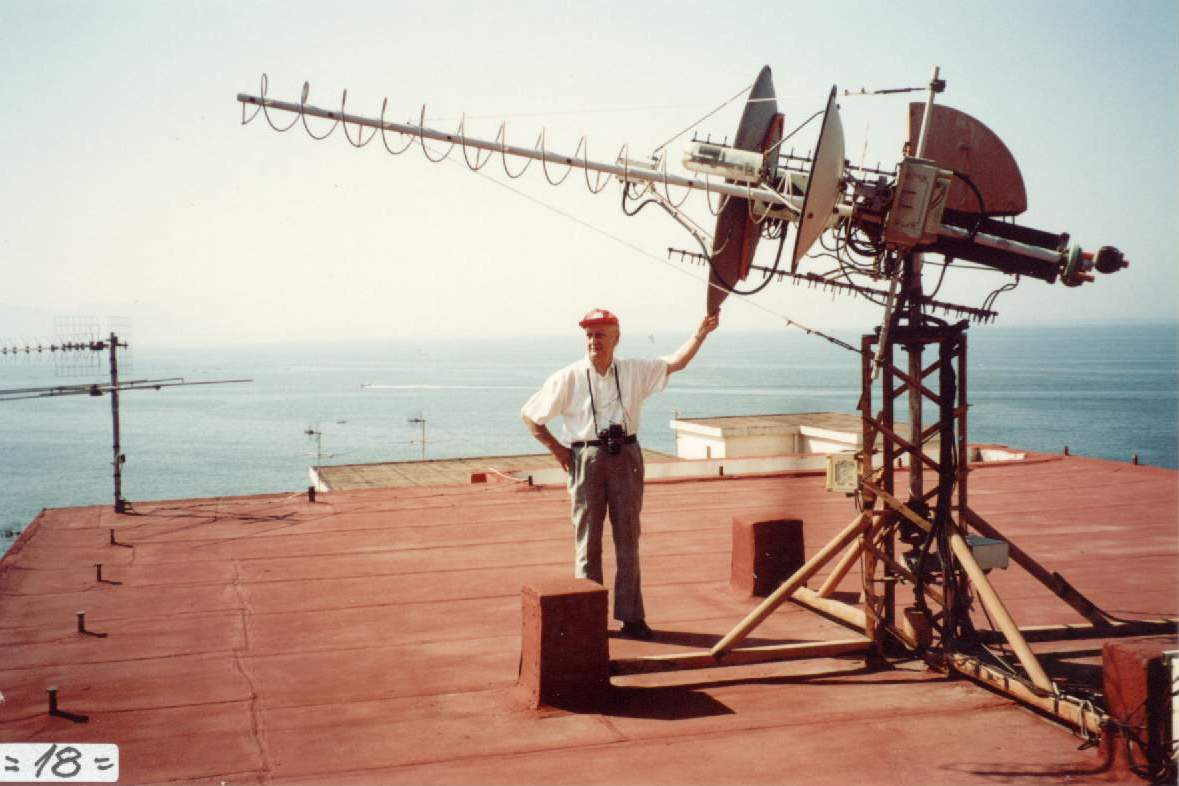
I did a Google search on the call signs and discovered I8CVS is Domenico Marini from Napoli Italy. Dom appears to be a well known expert in amateur satellite operation.  On that page is a picture of Dom in 2003 next to an impressive antenna array which appears to be sited on top a high rise building (oh the envy!)


While my own set up is much more modest. I have done a little tinkering, building a small UHF Yagi out of some metal coat hangers but have yet to test it in anger. I have also become a little more familiar with my FUNCube setup. I use the SDR-Radio.com application and having updated to a much later beta version have had much more success. There were some issues that involved the swapping the I and Q signal on early versions but these appear to have now been corrected.

After listening to the ICQ Podcast I have been monitoring a few propagation beacons (GB3VHF and GB3BUX) (I will post more on this later) and using those beacons have got the frequency calibration more or less spot on now. I have also discovered that the Doppler Invert option needed setting so now SDR-Radio more or less correct perfectly as the satellites passes (still occasionally needs some manual interaction)

I really must make a real effort to get a licence and become less passive in this hobby, just not sure how I am going to afford an all-modes transceiver mind! 

Wednesday, 22 February 2012

Video of VO52(HAMSAT)

Due to work and family commitments and the currently inconvenient timing of the passes I really haven't had a serious attempt at receiving any of the downlinks from the numerous Cubesats launched on the Vega rocket back on Monday February 13.

I have managed to get some faint transmissions from what I believe is Masat-1 which has now been officially designated MagyarSat-OSCAR-72 (MO-72) I have also seen a number of other traces on the waterfall display of the sdr  (using the FUNCube dongle) They are in the correct frequency range and appear and disappear as the cluster of cubesats were predicted as passing overhead.

I have managed to make a video of  a pass of the SSB VO52(HAMSAT) downlink being received by the FCD this morning using just the antenna in the loft.


Operating a camera in one hand and trying to track the signal isn't that easy, but you get the idea!

I have got a chance this weekend to have a proper attempt at the Vega cubesats.

Friday, 10 February 2012

Video - CubeSats on Vega qualification flight

As part of the ESA Education programme, seven CubeSats will be flown on the first qualification flight of Europe's new Vega launcher. This video shows the integration of the CubeSats in the P-POD deployment system and includes some interviews with ESA's experts and European students involved in the programme.


Frequencies and URLs for the student amateur radio satellites on Vega can be seen at http://www.uk.amsat.org/4180

as seen on http://www.uk.amsat.org/4542

Thursday, 9 February 2012

Vega rocket launchs on Monday


The first qualification Vega flight from the space center at Kourou in the Caribbean is scheduled to take place on February 13.

Vega is a new launch vehicle from ESA/Arianespace to handle small to medium-sized satellite payloads. It is a four-stage launcher tailored to carry the growing number of small scientific spacecraft and other lighter-weight payloads.

The first flight is carrying eight student built amateur radio satellites comprising seven CubeSats and a microsatellite called ALMASat, Arianespace have just released a video showing the payloads.


A full list of the satellites and frequencies and other information about the launch is listed on the Amsat-UK website http://www.uk.amsat.org/4180

ALMASat-1 – University of Bologna, Italy
437.465 MHz 1200 bps FSK and 2407.850 MHz
http://www.almasat.unibo.it/02_projects/almasat-1/almasat1.htm

e-st@r – Politecnico di Torino, Italy
437.445 MHz 1200 bps AFSK
http://areeweb.polito.it/ricerca/E-STAR/

Goliat – University of Bucharest, Romania
437.485 MHz 1200 bps AFSK
http://www.goliat.ro/

MaSat-1 – Budapest University of Technology and Economics, Hungary
437.345 MHz GFSK 625/1250 bps, CW
http://cubesat.bme.hu/en/

PW-Sat1 – Warsaw University of Technology, Poland
There are 5 modes of operation:
- Receive only – no downlink
- CW Beacon CW – On-Off Keying (OOK) CW 12 WPM on 435.020 MHz
- BPSK Beacon – BPSK 1200 bps AX25 (1 frame on 20 sec) on 435.020 MHz
- Control communication mode. Downlink BPSK 1200 bps AX25 on 435.020 MHz
- Voice Repeater mode (aka “AO-16″ mode) – uplink 435.020 MHz FM and downlink 145.900 MHz DSB
http://tinyurl.com/CubeSatPW-Sat

Robusta – University of Montpellier 2, France
437.325 MHz 1200 bps FM telemetry with one data burst of 20 secs every 1 min
http://www.ies.univ-montp2.fr/robusta/satellite/?lang=en

UNICubeSAT -University of Rome, Italy
437.305MHz 9600 bps FSK
http://www.gaussteam.com/index.php?option=com_content&view=article&id=97%3Aunicubesat&catid=36%3Aunicubesat&Itemid=145

There is a lot there to have a go at receiving with the old FUNCube Dongle! I will have to get around to finally construct myself a homebrew 70cm antenna in the next few days.

Tuesday, 31 January 2012

Really annoying QRM Splatter!


Given the excellent positioning of the moon in the evening sky over the next few days I have been attempting some more decoding of weak signal EME (Earth-Moon-Earth) transmissions using my loft mounted homebrew wideband antenna, FUNCube dongle and SDR-Radio coupled with the MAP65-IQ application.

As you can see from last nights log, I had some success with this fairly rudimentary equipment, getting a reasonable number of decodes in a short space of time.

UTC Date: 2012 Jan 30
---------------------
  144.099 -215  0  0  0 -6.8    0  1 -26 2106  K1JT IW0DJB JN61        0 10  3
  144.100  320  0  2  0 -6.2    0  1 -24 2106  CQ VE4AAZ EN19          0 10  3
  144.100  352  0  1  1 -5.1    0  1 -25 2106  CQ DH6ICE JO61          0 10  3
  144.102  441  0  0  0  1.9    0  1**** 2106  RRR                     0  0  0
  144.104  301  0  1  0 -5.3    0  1 -24 2106  K1JT ZR6ABU KG33        0 10  3
  144.105  217  0  0  0  2.1    0  2**** 2106  RRR                     0  0  0
  144.107 -248  0  1  2 -4.5    0  1 -25 2106  CQ 9A1Z JN86            0 10  3
  144.107  -28  0  0  0  1.9    0  1**** 2106  RO                      0  0  0
  144.109 -470  0  0  0  1.9    0  1**** 2106  RO                      0  0  0
  144.110 -464 -4  1  0 -5.7    0  1 -23 2106  CQ OK1DCF JO80          0 10  3
  144.110   74  0  0  0 -4.1    0  1 -25 2106  K1JT N4LXB EM83         0 10  3
  144.110  440  3  1  2 -5.2    0  1 -25 2106  K1JT F9IE IN86          0 10  3
  144.114 -200 -2 -1  2 -5.2    0  1 -24 2106  K1JT EA6VQ JM19         0 10  3
  144.114  317  0  0  0  2.1    0  1**** 2106  73                      0  0  0
  144.115  113  0  0  0  2.1    0  1**** 2106  73                      0  0  0
  144.116  497  0  1  0 -6.5    0  2 -24 2106  K1JT N0AKC EN44         0 10  3
  144.117 -399  1  0  0 -5.2    0  2 -25 2106  CQ KB5WMY EM32          0 10  3
  144.117  136  0  0  0 -6.8    0  2 -23 2106  CQ W4AME EM75           0 10  3
  144.121  304  2  0 -1 -5.3    0  2 -26 2106  CQ EB2AYV IN83          0 10  3
  144.123  490  1 -3  0 -5.2    0  1 -25 2106  CQ EB2DTP IN82          0 10  3
  144.124 -115  3  0  1 -5.0    0  1 -26 2106  CQ DH8IAB JO30          0 10  3
  144.125  193 -1  0  0 -5.2    0  1 -24 2106  K1JT ES5RY KO38         0 10  3
  144.134 -463  1  0  1 -5.1    0  2 -25 2106  CQ IW0AKA JN61          0 10  3
  144.134 -419  0  0  0  2.1    0  2**** 2106  RO                      0  0  0
  144.134  -67  0  0  0  2.1    0  1**** 2106  RRR                     0  0  0
  144.136  316  0  0  0 -5.1    0  2 -25 2106  K1JT W6CAP DM14         0 10  3
  144.141 -202  0  0  0  1.9    0  2**** 2106  RRR                     0  0  0
  144.142  274  2  0  0 -7.0    0  1 -23 2106  CQ DC3VM JN39           0 10  3
  144.143 -180  1  0  1 -4.3    0  2 -25 2106  CQ W0DJM EN25           0 10  3
  144.143   33  4  0 -1 -7.0    0  1 -23 2106  CQ RK1B KO69            0 10  3
  144.143  155  6  0  0 -4.5    0  1 -24 2106  K1JT WA8CLT EN80        0 10  3
  144.143  274  7  0  0 -4.2    0  2 -18 2106  K1JT WD0APF EN10        0 10  3
  144.146  233 -1  0  0 -6.2    0  2 -23 2106  K1JT WN4KKN EM10        0 10  3
  144.148 -460  0  0  0  1.9    0  1**** 2106  RRR                     0  0  0
  144.149    5  2  0 -2 -4.2    0  1 -31 2107  K1JT K9JK EN52          0 10  3
  144.149   87 -1  0  2 -4.9    0  1 -30 2107  CQ YU1S JN94            0 10  3
  144.150  464  2  0  0 -4.2    0  2 -32 2107  K1JT WB0TEM EN12        0 10  3
  144.151 -323  0  0  0 -4.2    0  1 -31 2107  K1JT F5KCR JN26         0 10  3
  144.151  499  2  0  1 -5.3    0  1 -25 2107  CQ DJ9KV JN68           0 10  3
  144.152 -164 -1  1  1 -3.2    0  1 -37 2107  CQ DL3BWG JO62          0 10  3
  144.152   77  1  0  0 -6.0    0  1 -28 2107  CQ DH8IAB JO30          0 10  3
  144.152  115 -8  0  0 -5.6    0  2  -6 2107  CQ GW8ASA IO81          0 10  3
  144.152  263  4  0 -1 -4.7    0  1 -33 2107  CQ DH8IAB JO30          0 10  3
  144.153  -68  0  0  0  2.1    0  1**** 2107  RO                      0  0  0
  144.153  429 -1  0  0 -2.6    0  1 -25 2107  CQ DL3BWG JO62          0 10  3
  144.154   86 -1  0  0 -4.6    0  1 -36 2107  CQ RN6BN KN95           0 10  3
  144.155 -394 -3  0  0 -6.6    0  2 -36 2107  K1JT RL1X KO59          0 10  3
  144.155  164  0  0  0 -5.6    0  1 -23 2107  K1JT N5KWB EM32         0 10  3
  144.157 -179  0  0  0  1.9    0  2**** 2107  73                      0  0  0
  144.157    1  2 -1  3 -6.1    0  1 -25 2107  CQ ZS6MRK KG34          0 10  3
  144.157  193  0  0  0  1.9    0  2**** 2107  RRR                     0  0  0
  144.158  -81  2  0  0 -5.0    0  1 -23 2107  K1JT DL4SUN JO63        0 10  3
  144.158  -55  0  0  0  2.1    0  1**** 2107  73                      0  0  0
  144.099  206  1  0 -1 -5.0    0  1 -24 2114  CQ PA6T JO32            0 10  0
  144.100   23  2  0  1 -7.2    0  1 -24 2114  K1JT DK9ZY JO40         0 10  0
  144.100   55  1  0 -2 -5.2    0  1 -25 2114  K1JT K4DD EM60          0 10  0
  144.100  270  0  0  0  1.9    0  1**** 2114  RRR                     0  0  0
  144.100  477  2  0  0 -7.0    0  1 -22 2114  CQ N9XG EN60            0 10  0
  144.102 -152  0  0  0  1.8    0  7**** 2114  RRR                     0  0  0
  144.102    8  0  0  0  2.1    0  2**** 2114  73                      0  0  0
  144.102  331 -2 -1  1 -6.8    0  2 -25 2114  K1JT 9A1DFG JN85        0 10  0
  144.103 -111  0  0  0  1.8    0  1**** 2114  RRR                     0  0  0
  144.103  197  1  0  1 -5.7    0  2 -25 2114  K1JT K0RL EM49          0 10  0
  144.104 -364 -2  0  0 -6.7    0  1 -25 2114  K1JT IW1DJS JN35        0 10  0
  144.105 -382 -2  0  0 -5.3    0  1 -24 2114  K1JT RZ3QS KO91         0 10  0
  144.107  310 -1  0  0 -5.3    0  1 -25 2114  K1JT DJ8MS/P            0 10  0
  144.108 -138 -2 -1  0 -7.2    0  1 -24 2114  K1JT F1VJQ IN95         0 10  0
  144.110 -362  0  0  0  1.9    0  2**** 2114  RO                      0  0  0
  144.111 -124  0  0  0  2.5    0  2**** 2114  73                      0  0  0
  144.113 -401  0  0  0  1.9    0  1**** 2114  RO                      0  0  0
  144.113  102  1  0  0 -5.2    0  2 -24 2114  K1JT OE3R JN88          0 10  0
  144.117  -27  0  0  0  1.6    0  1**** 2114  RRR                     0  0  0
  144.118  -70  4 -3  0 -4.9    0  1 -24 2114  CQ LA3BO JO59           0 10  0
  144.118  156  2  0  0 -6.9    0  1 -24 2114  K1JT W9EME EN54         0 10  0
  144.118  357  2  0  0 -6.4    0  1 -24 2114  K1JT VE2WHZ FN08        0 10  0
  144.119 -486  0  0  0 -6.2    0  1 -22 2114  K1JT KI4M EM95          0 10  0
  144.119  278  0  0  0  1.9    0  2**** 2114  RO                      0  0  0
  144.120 -326 -2  0  0 -6.8    0  2 -23 2114  K1JT JO1LVZ PM95        0 10  0
  144.120  -13  2  1 -1 -5.1    0  1 -25 2114  CQ IK1EFM JN44          0 10  0
  144.121  -39  2  0  0 -6.6    0  3 -25 2114  CQ AF6O DM14            0 10  0
  144.121  135  0  0  0 -5.3    0  2 -25 2114  CQ M0VHF IO82           0 10  0
  144.122  225 -3  0 -2 -6.7    0  2 -25 2114  K1JT MM0BQI IO85        0 10  0
  144.123  376 -1  0  1 -6.5    0  1 -24 2114  CQ DL3BWG JO62          0 10  0
  144.124  141 -1  0  0 -6.6    0  1 -25 2114  CQ KB0CY DM79           0 10  0
  144.125  109  2  1  1 -4.8    0  2 -24 2114  K1JT AA1OV FN43         0 10  0
  144.127 -488 -2  0  0 -7.2    0  1 -25 2114  CQ ON1DSQ JO21          0 10  0
  144.127 -302 -2 -1 -1 -6.9    0  1 -26 2114  CQ ON1DSQ JO21          0 10  0
  144.128 -476  0  0  0  1.9    0  3**** 2114  73                      0  0  0
  144.128  -20  3  0  0 -4.9    0  1 -25 2114  CQ JR4BRS PM65          0 10  0
  144.132 -468 -4  0  1 -4.9    0  1 -24 2114  K1JT HV0A JN61          0 10  0
  144.132 -329  1  1  0 -5.1    0  1 -25 2114  K1JT DL9NDD JN59        0 10  0
  144.133   32  0  0  0  1.9    0  2**** 2115  73                      0  0  0
  144.134 -105  0  0  0  1.9    0  1**** 2115  RRR                     0  0  0
  144.135   81  0  0  0  2.1    0  1**** 2115  RRR                     0  0  0
  144.138  196  0  0  0 -6.5    0  1 -24 2115  CQ VA3NFA FN25          0 10  0
  144.140 -426  2  0  0 -5.1    0  2 -25 2115  CQ IK1EFM JN44          0 10  0
  144.140 -173  0  0  0  1.9    0  1**** 2115  RRR                     0  0  0
  144.143 -316  0  0  0  1.6    0  1**** 2115  RRR                     0  0  0
  144.146  140  0 -1 -1 -5.1    0  1 -25 2115  CQ GW0PZT IO72          0 10  0
  144.148  151  1  1 -1 -6.6    0  1 -27 2115  CQ PR8ZX GI64           0 10  0
  144.148  299  0  0  0  1.4    0  2**** 2115  RRR                     0  0  0
  144.150 -480  0  0  0  1.8    0  1**** 2115  73                      0  0  0
  144.151 -172  1  0  0 -7.0    0  1 -24 2115  CQ DF7RG JN68           0 10  0
  144.153  -19  0  0 -1 -6.3    0  1 -25 2115  CQ SV3KH KM07           0 10  0
  144.155  344  0  0  0  2.7    0  1**** 2115  RRR                     0  0  0
  144.156  225  0  0  0 -5.2    0  1 -32 2115  K1JT K4TAX EL96         0 10  0
  144.156  373  2  0  0 -6.7    0  1 -25 2115  K1JT 9A1CCB JN85        0 10  0
  144.157  -63  0  0  0  1.9    0  3**** 2115  RO                      0  0  0
  144.157  -17  4  0 -1 -6.5    0  1 -38 2115  CQ UT8AL KO61           0 10  0
  144.157   13  0  0  0  2.1    0  2**** 2115  RO                      0  0  0
  144.157   44  0  0  0 -6.8    0  1 -35 2115  CQ ON1DSQ JO21          0 10  0
  144.157  158  0  0  0 -6.9    0  2 -31 2115  CQ N0LL EM09            0 10  0
  144.157  324-18  0  0 -6.5    0  1 -13 2115  K1JT F1CCM IN93         0 10  0
  144.159 -281  0  0 -1 -6.4    0  1 -24 2115  K1JT DL8GAM JN37        0 10  0

The only problem is at the moment is an annoying source of interference that keeps popping up across the band!

I have struggled repeatedly monitoring 2 meter amateur radio (144-146Mhz) with my various receivers due to noise and now the FCD watefall display has illustrated exactly how bad it is.

Here is a small video capture of the waterfall display this evening across the 2 meter EME band (no sound)


This QRM 'splatter' is intermittent and when present slowly moves up and down the band. I suspect this might possibly be interference from someone using an evil PLT device (more details at http://www.rsgb.org/emc/the-rsgb-and-ofcom.php) but it could be something more mundane.

I have discovered my own router/access point generate a number of signals (the two distinct bands either end of the waterfall display in that video are from the router) but the source of the more annoying splatter is as yet unidentified.

Thursday, 26 January 2012

January update

January has been a busy month. Work and social commitments aside I have also dusted off the Nintendo Wii and am currently addicted to completing The Legend of Zelda - Skyward Sword. I am not an avid player of video games but really enjoyed Twilight Princess so treated myself to the game just before Christmas but hadn't had chance to play it. It is great fun, but sucks hours of your time without realising it.

Most of my radio monitoring this month has been done with my lovely FUNCube Dongle (FCD) which I have used for terrestrial signals as well as those from space. The ability to adjust the width of the demodulation makes it ideal for data decoding, got some very good VHF ACARS results and it is interesting to see the wonderful patterns the pagers, trunking and telemetry signals make on the waterfall display

I captured another ARISS contact from the ISS on January 18th on my traditional scanner but I haven't got around to editing and uploading the audio as it was conducted in Dutch.I have also done some further decoding of APRS packets from the ISS.

I have been getting to grips with the FCD's various idiosyncrasies and issues. The main one being it is very susceptible to overloading and image problems.One important lesson I have learned is turning down the front end LNA (Low Noise Amplifier) section actually helps to bring in those weak signals as they aren't lost in the mush!

That revelation came about while attempting to listen to some earth-moon-earth transmissions 'moon bounce' inspired by this posting on the Southgate Amateur Radio News website. Using the MAP65-IQ software and SDR-Radio I did manage to successful decode a handful of messages over the course of a few evenings but ironically it was from the loft mounted antenna using my main PC rather than from the hand-held directional YAGI. I suspect this was mainly because the laptop I was using outdoors was struggling to run both applications. The neighbours must have thought I nuts standing out in the garden in the dark, lit only by the security lights waving around a big antenna on a wooden pole - apparently pointing it at the full moon!

I have also had a go at receiving the VO52 - HAMSAT amateur radio satellite with the FCD this week as it currently has a decent morning and evening pass. This is an interesting satellite as the transmissions are SSB rather than FM and during the pass the waterfall display is awash with lots of overlapping transmissions all shifting frequency with what sounded like lots of 'whistling'

You can get a idea of what it sounds like from these videos  http://www.southgatearc.org/news/april2010/hamsat_vo52_videos.htm

To be honest I was a bit confused by what I receiving until I saw these videos. What I believe is happening is the operators are trying to correct for the doppler and overshooting or undershooting. I will be making some videos myself once I have mastered the art of chasing the signal!

Monday, 9 January 2012

ISS ARISS Contact January 9th 2011

This morning was an opportunity to hear ISS astronuat Dan Burbank, KC5ZSX as he took park in a planned ARISS contact.

At approximately 1014 UTC, an International Space Station (ISS) amateur radio contact took place with students at Descartes High School, located in Montigny-Le-Bretonneux, France.

The contact was in English and the downlink signal was audible in the British Isles and Europe on 145.800 MHz FM.

I was away from the shack so left the Realistic PRO2006 connected to the discone in the loft and set up an unattended recording of the audio on the computer.

I didn't get the full exchange but got over 5 minutes worth and this is the edited version, I have inserted silence during the 'uplink' transmission.

I am suffering from a great deal of interference on the 2 meter band at the moment but it doesn't spoil it too much.

ISS ARISS Contact January 09 2011 by nerdsville
There is a full video of the contact available here, starts at around the 27 minutes in..


Watch live video from f6krk2 on Justin.tv

Wednesday, 4 January 2012

Farewell ARISSat-1

There has been no official announcement yet, but it appears that plucky satellite ARISSat-1 finally de-orbited early this morning.

The last frame of received telemetry on ARISSATTLM site hasn't changed since 06:02:14 UTC.

The DK3WN SatBlog posted the last report and some of the last heard voice telemetry earlier this morning. There is a post on the Yahoo FUNCube group from Konstantin RN3ZF claiming a very intermittent later contact at around 08:42, with links to some IQ wav files.

Several users on twitter have also reported no further contact with ARISSat-1, I monitored an pass myself earlier and got nothing.

I will miss it, I have enjoyed experimenting and receiving transmissions and I have learned a lot more about amateur satellites. It prompted me to join AMSAT-UK and am looking forward to having a go with the other satellites out there and the FUNCube project which will be launching later in the year.


Update, AMSAT-UK have confirmed ARISSat-1 is now silent key

Monday, 2 January 2012

Howard Long G6VLB 2011 DCC FUNCUBE Dongle presentation

Howard Long G6VLB traveled to the 2011 ARRL/TAPR DCC from London to address the group on this project. He details the trials and tribulations behind designing and manufacturing what turned out to be an extremely popular product.

The primary aim of the FUNcube Dongle is to interest young students in science, satellites and radio. The FUNcube iteslf is a satellite that will be launched specifically to be monitored by all those dongles that Howard has sold.


ARISSat-1 SDR Videos

Just composed a couple of videos showing the use of the FUNCube Dongle Software Defined Radio to decode yesterdays data.

The first shows the FM decode


This video shows the CW/BPSK Telemetry beacon and what appears to be someone using the transponder, both these were using the USB modulation. It also demonstrates the problem of tracking because of the doppler effect.


Note both decodes were preformed on the captured IQ-Wave file.

The videos were created using CAMStudio

Sunday, 1 January 2012

First FCD experiments

I was feeling shattered after a hectic Christmas and being back at work, so it was nice with the New Year break to have a chance to recover. I have spent the weekend around the house and so had a good chance to try out my FUNCube Dongle (FCD) to do some proper satellite reception!

First off I spent a while calibrated my dongle using the excellent user guides available on the yahoo group, and getting to grips with the excellent but somewhat daunting SDR-Radio application. 

I fired up another of my ancient laptops a Sony Vaio, with XP and a pitiful 512MB of RAM. It is a nice machine, with an excellent large display but is a little underpowered. However undeterred with the prospect of some timely satellite passes I installed the necessary software and set off to the summerhouse at the top of the garden with my YAGI and a warm coat.

NOAA Weather Satellites

As I posted about back in October I was hoping if I did get an SDR radio to capture some of the APT images broadcast by the NOAA polar orbiting weather satellites. (Noaa 15, 18 and 19 are currently active)


The SDR-Radio application has the facility to decode the noaa images directly and along with it's built in satellite prediction and doppler correction features it was fairly easy to get some decent images. The huge advantage of the SDR system is being able to alter the bandwidth to accommodate the 34KHz deviation required (as you can see in the image above)


The image above was captured on 31st December at 13:26 GMT from NOAA-19 on 137.100MHz, the left image is the IR, the right being the visible image. If you click to enlarge you can clearly see Spain and the Balearic Islands at the bottom, the UK and most of Northern Europe is covered in dense cloud and is rapidly going into shadow. There is some noise, caused in part by pager transmissions and some course manual doppler correction.


ARISSat-1

As I posted before Christmas this little satellite is still going strong but it's time is very short as reaches the atmosphere. I have been able to receive four afternoon passes in the last two days


As you can see from the image shows, the FCD makes the entire ARISSat-1 2 meter downlink band plan available. The slight slope shows the doppler effect.

On the left you can clearly see the Morse code beacon and the BPSK telemetry segment and the right the FM voice and SSTV transmission. I am really really pleased to have successfully managed to decode some telemetry frames before she meets her fiery death. The decode was done after the passes by processing the recorded IQ wav file. I probably have just one more day to have a chance to try to decode some live telemetry and hopefully forward it via the internet to ARISS.


It goes without saying I have some excellent audio and decoded a couple of SSTV images too.


I love my new toy!


Wednesday, 28 December 2011

FUNcube Dongle - Oh, yes, my precious!


I received a FUNcube Dongle for Christmas but being away from the 'shack' over the holiday and now back in work I have had little time to do anything with it. I did manage a hour of so last night and updated the firmware and had a little scan around the spectrum using SDR-Radio to receive a few signals.

It is certainly a voyage into the unknown, the FCD came in a simple plastic box with a single sheet of A4 which simply told you to go to www.funcubedongle.com but I found the site it a bit of a mess to be honest. Did get some guides from there but most information seems to be on the Yahoo group http://uk.groups.yahoo.com/group/funcube/ 

What became obvious last night was I really miss my dual-monitor set up. There were lots of documents, websites and applications that I had open and navigation was a pain on a single 17" LCD....  must replace the dead screen asap.

Friday, 23 December 2011

ARISSat-1 'I'm not dead!"

Seems I might have written off ARISSat-1 earlier this month.. might just might get a chance to grab some some signals before it enters the atmosphere http://forums.qrz.com/showthread.php?325959-Good-signals-from-ARISSat-1


APRS decode of last nights ISS pass


Did manage to get the yagi out last night for the ISS pass at around 19:20 GMT. Opted for the Realistic PRO-26 receiver as I'd forgot to put the DJ-X10 on charge. Managed to capture a decent audio file of the ARPS transmissions that lasted just over 10 minutes long. Processed it later with Multipsk.

As you can see from the map above, did manage decode a reasonable number of APRS transmissions. Had a couple of faint transmissions as the ISS came from the west over the Atlantic but the activity didn't really start till it was in range of mainland Europe.

I know Santa is bringing me a Funcube Dongle, so lots more experiments in the New Year!

Thursday, 22 December 2011

ISS APRS/Packet

This week with the launch of the Russian Soyuz TMA-03M spacecraft to the International Space Station it occured to me that I have never seen it pass overhead or indeed made any effort to hear any transmissions from it. So off I went to the n2yo.com website to check the pass predictions for the week and was pleasantly surprised to discover that over the Christmas period there are a number of good evening passes (the potenitally visible ones are also listed on the Guardian website)


There are a multitude of  frequencies to potentially listen to, some of the operational ones could be quite interesting over the next few days, but at first I was interested in some of the ARISS frequencies.

On Tuesday (20th Dec) evening I popped outside with the 2Meter YAGI, Alinco DJ-X10  and my new found Satellite-AR Android App I did manage to see a faint moving point of light briefly as it came up over the horizon, but quickly lost it due to cloud cover and I think it passed into the Earth's shadow.

I was able to carry on tracking it using the Satellite-AR and picked up some very strong data bursts on 145.825MHz this is the APRS/Packet digirepeater. More details on the ARISS website. APRS in simple terms allows ham operators send a coded data message usually containing their GPS location, call sign and other information. This is received by the digirepeaters and rebroadcast, in the case of the ISS the digirepeater is moving around the earth at nearly 5 miles/second.

Last night (21st Dec) I used the loft mounted antenna and my Realistic PRO-2006 and captured and decoded some of the data on my PC using MultiPSK

Some of the data as it appeared in text form on the screen showing the coordinates, call signs and comments.

@215120h5218.35N/01624.62E-73! via ISS'yI1l -/]Paco en Leganes=
:F6GWB    :ack02!5214.25N/00043.40E`Aprx v2.02 SatGate@215356h5218.35N/01624.62E-73! via ISS=4542.75N/01142.00E`73' Via ISS de Cris {UISS52}=3919.07N/00259.59E`73' Via ISS {UISS52}!5310.76N/00532.86E- - 73 - Roland - www.pd2rld.nl -`vDjl -\`73's via ISS ea5hzz.raul@gmail.com_" :SP1TMN-6 :73{17 'vC$l S\]73 FOR ALL=
=4549.52N/01600.66E`[JN85AT] 73 via ISS de Robert - Zagreb - Croatia
!5310.76N/00532.86E- - 73 - Roland - www.pd2rld.nl -


  Some more good passes this evening that I might get a chance to capture with YAGI and weather permitting might get to see the point of light as it crosses the sky!

Tuesday, 20 December 2011

A last look inside space shuttle Atlantis


collectSPACE had the rare opportunity recently to tour the space shuttle Atlantis to photograph its preparation and capture its glass cockpit powered and lit for one of its last times. The photo gallery starts on Atlantis' flight deck, and then proceeds to its now mostly empty middeck, out into and above the 60-foot payload bay, and then around and under the winged spacecraft. The photographs were taken inside Orbiter Processing Facility-2 (OPF-2) at the Kennedy Space Center.

Photograph from collectSpace

Sunday, 18 December 2011

Video - From OSCAR 1 to Mars and Beyond

Mentioned on the AMSat-UK website is a fascinating video detailing the history of Amateur Radio Satellites

From OSCAR 1 to Mars and beyond
Amateur Space Exploration -- The last 50 years, now, and the future

Radio amateurs have been building and operating satellites for almost fifty years now, and we are aiming for more. In this talk, I'll present who AMSAT is, what we have achieved in the last fifty years, and what we are working on now.

Back in the 1960's, radio amateurs seized the opportunity of launching a satellite into space. It would not be the only one; we are approaching OSCAR 70 now. Building satellites has always been challenging and involves using technology in creative ways. I'll cover some of the more fascinating cases, including some lessons learned during the process. In addition to the satellites in earth orbit, we are also aiming for Mars, and I'll show what are doing to get there.

Speaker: Mario Lorenz
Event: Chaos Communication Camp 2011 (CCCamp 2011) of the Chaos Computer Club [CCC]
Location: Luftfahrtmuseum Finowfurt, Museumstr. 1, 16244 Schorfheide near Berlin, Germany

ARISSAT-1 nears the end

ARISSat-1 the satellite that has given me some pleasure over the last few months is approaching it's fiery death, it looks like it might make it to the New Year just. http://www.southgatearc.org/news/december2011/arissat1_decay_date.htm


It is a real pity that at the moment the orbit mean I have no chance of capturing anything from it before it's demise. All the passes over the UK are when in shadow and due to the battery failure it is silent.

Thanks ARISSat-1 you have been fun.


Saturday, 10 December 2011

Satellite Tracking using AR on my Android

In my quest to get better reception of the Russian navigation satellites I have installed the Satellite AR application on my Orange San Francisco Android phone. Up to now I have used a simple compass and a pass prediction to work out where the satellite will appear and how I think it will travel across the sky. Then after having acquired the signal fettling the antenna to get the best signal. While it has given me good results I wasn't convinced I was getting the best signal I could.

The serious method of doing satellite tracking is to use a motorised azimuth antenna rotor connected to a PC running some prediction software. The commercial solutions are hideous expensive and while there are plenty of home-brew solutions available it would still mean a lot of expense in terms of time and money, so I looked for an alternative method.

Then I discovered this brilliant Android app! I used it for the first time late last Sunday evening when it was dark and was suitably impressed, so had a proper attempt in the fading daylight today and was able to take a few photos.

The AR stands for augmented reality and what you get is a view of the sky through the phones camera and overlaid are the positions of any satellites in view. The application uses the phones GPS, compass and accelerometers  to work out where the camera is pointing, so you get to see the satellite as if it were visible in the sky. It is really quite spooky!.

I selected the Russian LEO Satellites option for a pass this afternoon and using a couple of elastic bands to lash the phone on to the antenna post I could then point the antenna directly at where the satellite was supposed to be. The satellite today being COSMOS 2429 on 150.030MHz. The main thing I seem to have been doing wrong was while I had the antenna point in the correct bearing I had the elevation far too low. I needed to be pointing it much higher up in the sky.


I was able to got some excellent audio, with the signal still booming in when it had disappeared off the display. I have enclosed a small extract below, note some of the signal fading is because I was trying to take the photos while holding the antenna in my other arm... it gets quite heavy!

Cosmos 2429 10122011 by nerdsville

I brought my phone back in January for the pricey sum of £80. While not the most powerful Android around, only having version 2.1 of the operating system and is prone to crashes and resets it is probably one of the best purchases I have ever made, it is even better now I can use it to chase down signals!