Saturday, 23 March 2013

Digital SSTV Decoding

I've decoded analogue SSTV transmissions before (check out some earlier posts) using the MMSSTV program, but another form of picture transmission is referred to as Digital SSTV.. It isn't technically slow scan the the SSTV part has stuck because it sends images. In very basic terms it is file transfer using DRM "Digital Radio Mondiale" encoding.

The advantage over analogue SSTV is the use of error correction, with the error correction you can get a perfect image.

This afternoon while the snow was falling outside I had got SDR# with the FCDP+ running and noticed that there was some activitiy on 14.233 Mhz and fired up the EasyPal software and decoded a few images, and made a small video showing one image being received.


As you will observe in the video Easypal actually decoded the image before the end of the transmission because it didn't need the extra data to error correct because of the very strong clear signal.
 
These were the two nice pictures I decoded today from OE3AWA based in Austria


Interestingly the only other previous D-SSTV image I have received was at the end of December last year, from the same operator!

Friday, 22 March 2013

Hacking the UV3R

Saw this on a number of sites including Hack a day someone has managed to hack the firmware on the UV3R handheld, cheap as chips on ebay and using an SDR chipset looks like something to keep an eye on.


Thursday, 21 March 2013

Decoded some Hellschreiber


While tuning across the HF bands tonight I stumbled upon this strange signal on 40m, firing up Multipsk I took a hunch that it was some form of teletype transmission and discovered it was in fact Hellschreiber.

You can read all about it on Wikipedia http://en.wikipedia.org/wiki/Hellschreiber

The original mechanical Hellschreiber facilimile machine was first developed in the late 1920s, and saw use starting in the 1930s, chiefly being used for land-line press services. During WW2 it was sometimes used by the German military in conjunction with the Enigma encryption system. In the post-war era, it became increasingly common among newswire services, and was used in this role well into the 1980s. Today Hellschreiber is used as a communication mode by amateur radio operators using computers and sound cards; the resulting mode is referred to as Hellschreiber, Feld-Hell, or simply Hell.

Sorry about the poor quality of the video, hopefully you can make out some of the text in this QSO.

ARISS School Contact Downlink

This is the audio I captured from yesterdays ARISS School Contact.

Thought it was a very odd signal, when the ISS is transmitting sometimes was getting what sounded like a carrier which seemed to be undergoing a Doppler shift, but when the transmission stops the carrier stops? I know they have some issues with the radio equipment on board but still very odd.

Wednesday, 20 March 2013

I think I might be mad!


I know it is difficult to believe but Spring is officially here! At 11:02 today the vernal equinox occurred.

Well earlier at 07:00 I was standing out in a snow shower with the 2m yagi monitoring the ISS downlink on 145.800MHz. This was a school contact with Australia being operated via a telebridge using an Italian ground station. Details here http://www.southgatearc.org/news/march2013/ariss_event_2003.htm

I did get a reasonable signal during the pass but sadly it was marred yet again by interference.

The weather is dreadful at the moment, the picture above shows the view out of the shack window last Sunday afternoon. I had hoped to capture various satellite transmissions but the weather was atrocious. It rained most of the day and then around 14:00 it turned into a short lived heavy snow shower.

On Monday night I went to catch the evening pass of STRaND-1 and AAUSAT3 only for it to start raining once I had got set up!

Sunday, 17 March 2013

WSPR using a FUNCube Dongle PRO+


For sometime I have been using my FUNCube Dongle Pro+ SDR as an HF receiver station for WSPR, so. I thought it was about time I posted something.

Introduction
By its very nature radio propagation isn't totally predictable so someone transmitting can never know exactly where their signal will be received. There is whole science behind radio propagation prediction and amateur radio operators are always on the look out for openings or skip conditions for DX communications. To aid operators a number of propagation beacons exist, usually operating in CW mode transmitting their identification (call sign and location). Some of them use frequency shift keying and some transmit signals in digital modulation modes.

While invaluable operators have to actively receive and monitor these signals and what they really want to know is how their signal is getting out to the rest of the world. This is where the WSPR system comes into its own. The WSPR system uses a protocol which probes these potential propagation paths using low-power QRP transmissions.

WSPR (pronounced "whisper") stands for "Weak Signal Propagation Reporter" and is a computer program that enables amateur radio stations to participate in a world-wide network of low power propagation beacons. The station transmits beacon signals and receives signals from other stations operating in the same amateur band. These stations then upload 'spots' that they receive in real time to a central website wsprnet.org enabling operators to find out where and how strongly they were received, and can view the propagation paths on a map.

It is also possible to operate a receive only station uploading 'spots' to the same website, all that is required is a receiver capable of receiving single side band transmissions and feeding the resultant audio into the WSPR program where it is processed. The WSPR program was written by Joe Taylor, K1JT.

These "whisper" signals are often barely audible but their presence can be detected by the WSPR program using signal processing. The WSPR signal uses frequency shift keying (FSK) with a very small shift and a very slow data rate. The signals bandwidth occupied is only about 6 Hz so many stations can operate within the 200Hz WSPR window without interference. WSPR transmissions are encoded to carry a station's callsign, grid locator, and transmitter power in dBm. The program can decode signals with S/N as low as -28 dB in a 2500 Hz bandwidth.

Each transmission lasts for just under two minutes, and starts at the beginning of each even-numbered minute. Therefore it is vitally important that transmitters and receivers are synchronised, so one of the fundamental pre-requisites of success with WSPR is an accurately-set computer clock. This is achieved by using internet or GPS time synchronisation methods.

Setting Up

This diagram shows the set up I am using at the moment. I have a long-wire antenna connected to the FUNCube Dongle Pro+. I am using SDRSharp (SDR#) to operate the FCDP+ and the resulting audio output is then used as the input into the WSPR program.

I am using SDR# but any suitable SDR program could be used, I have used SDR-Radio and HDSDR but I have found the SDR# program uses less resources on my ageing PC.

Routing the sound output from one program to be the input into another can be problematic and depends on the soundcard and its driver, you might be lucky and have a 'stereo-mix' or 'what-u-hear' option to use the main sound card output as a recording input, or alternatively you will need to use something like virtual audio cable VAC.

Since the WSPR signal is very narrow band it is desirable that your receiver is accurately calibrated. Most SDR program that support the FUNCube Dongle PRO+ allow a correction setting so that the tuned signal is at the correct frequency, the use of beacons, repeaters, time signals or broadcast stations is an excellent method to set this correction if required.

You will need to download the WSPR program from http://www.physics.princeton.edu/pulsar/K1JT/ the current stable version is WSPR-2.11. The installation is straightforward and when you start the program a window will appear that looks like a command prompt, don't close this window, it will give important debug messages if there problems. Then the main console window will open along with a window where you set the station parameters.


Don't worry about the Callsign and Grid locator at the moment, the first thing to do is select the correct audio in source, the rest can be ignored as it relates to a transmitter and I am describing how to set up a receive only station.

Firstly slide the Tx fraction (%) to zero, since you won't be transmitting and make sure the upload spots is unchecked at the moment, then select the appropriate band you wish to receive. Then set the appropriate dial frequencies in your SDR receiver program, this is shown in the window and your SDR program will need to operate in USB, with a bandwidth of 2500Hz.

The current WSPR dial frequencies are (MHz)
0.136, 0.4742, 1.8366, 3.5926, 5.2872, 7.0386, 10.1387, 14.0956, 18.1046, 21.0946, 24.9246, 28.1246, 50.293, 70.091,144.489

I suggest you turn off any AGC and any filtering in the receiver, uncheck the idle box in WSPR and then wait for the next 'even' minute at which point the program should show receiving, alter the sound level so the Rx Noise is ideally around 0dB, but it will work between -10dB and +10dB.

When the two minute interval is over a segment will appear in the waterfall in the top panel and the program will decode any WSPR transmissions received, you will see them as lines in the waterfall as the above image shows. Any successful decodes will appear in the bottom panel.

Once you have got it working, the next thing is to register on the WSPRnet.org website for a SWL callsign, mine is G-SWL10 you will also need to know your grid-locator, you can find this easily using http://f6fvy.free.fr/qthLocator/fullScreen.php

Once registered then putting the data into the station parameters and checking the upload spots will send your spots to the website database, where you can view your spots in the database and on a map, the map at the top shows my spots on one day this week on 20m, getting stations from Australia, the Far East and the US as well as Europe.

Some important things to note are ensure you computer clock is accurately set, if it is wrong you will be out of sync and decodes won't happen and ensure you are tuned to the correct frequency as you have set the WSPR program otherwise spots will be reported for the wrong band.

It is a fascinating activity and even as just a receiver you are offering a valuable service to amateur operators.

Saturday, 16 March 2013

Receiving LES1 a satellite built in 1965!

A few weeks ago I read a news article about the miraculous reactivation of LES1, this satellite was built by the Massachusetts Institute of Technology and launched back in 1965. The satellite failed to reach its intended orbit owing to a wiring error and has been drifting out of control ever since, it was abandoned in 1967 as a piece of space junk but has seemingly begun transmitting again after 46 years.

Back in December Phil Williams G3YPQ from Cornwall noticed a peculiar signal and after some research determined it was LES1. The odd signal is probably caused by the satellite tumbling end over end every 4 seconds as the solar panels become shadowed by the engine. ‘This gives the signal a particularly ghostly sound as the voltage from the solar panels fluctuates’ Phil says. It is likely that the on board batteries have now disintegrated and some other component failure has caused the transmitter on 237Mhz, to start up when its in sunlight.

Eager to see if I could receive this ancient satellite I dug out an unused DAB 3-element antenna and mounted it on a tripod and successfully monitored two passes this afternoon.


I used my FUNCube Dongle (original version) and SDR-Radio V1.5 and this was the analysis of the resulting recorded IQ file for the pass that started around 17:30pm. You can clearly see the satellite signal as it undergoes Doppler shift and the four second regular frequency shift caused by the tumbling.


At its most northerly latitude the satellite orbit passes over North Africa, but due to its height has a longer orbit period than most other satellites and is receivable over much of Europe. How long it keeps transmitting is a mystery.

Monday, 4 March 2013

STRaND-1 - I think I have a faulty antenna!

Over the weekend I have made a couple of attempts at receiving the STRaND-1 satellite telemetry and indeed have a few IQ wave files that require processing but I don't expect to get any successful decodes out of them as they have been rather patchy and variable.

During the pass on Sunday evening I wasn't getting anything and as it neared the end of the predicted pass I gave up and picked up the antenna tripod to put it away and suddenly a strong signal appeared on the SDR waterfall! I suspect I have a problem with the antenna, either a faulty connection in the coax or connectors that was briefly corrected by the act of moving the tripod. It isn't the first time I have had issues and will have to investigate further.

The weekend wasn't a total loss, I did manage to capture a reasonable NOAA-18 pass on Sunday afternoon! Between washing the cars and doing some gardening!


Saturday, 2 March 2013

STRaND-1 - First attempts

As I posted earlier this week a number of satellites were launched into orbit on board the PSLV-C20 rocket, this included the first UK CubeSat, STRaND-1.

STRaND stands for Surrey Training, Research and Nanosatellite Demonstration and STRaND-1 is hopefully the first of a long line of STRaND nanosatellites from the academic researchers at the Surrey Space Centre (SSC) based at the University of Surrey in conjuction with Surrey Satellite Technologies Limited (SSTL).

The innovative STRaND-1 CubeSat was built and tested in just three months and is designed to demonstrate the feasibility of using cheap smartphone electronics to control a spacecraft, since it contains a Google Nexus One Android phone as part of its experimental payload. STRaND-1 carries an amateur radio AX.25 packet radio downlink on 437.568 MHz using 9k6 bps FSK modulated data HDLC frame, NRZI encoding.

Official orbital elements (TLEs) have already been produced so the current position and prediction passes can be calculated and available on n2yo.com

At the time of this post STRaND-1 is passing over in UK in the early morning (South-North) and early evening (North-South), both times are not particularly convenient on weekdays due to work commitments, but last night I did manage to have my first proper attempt to capture some of the telemetry.

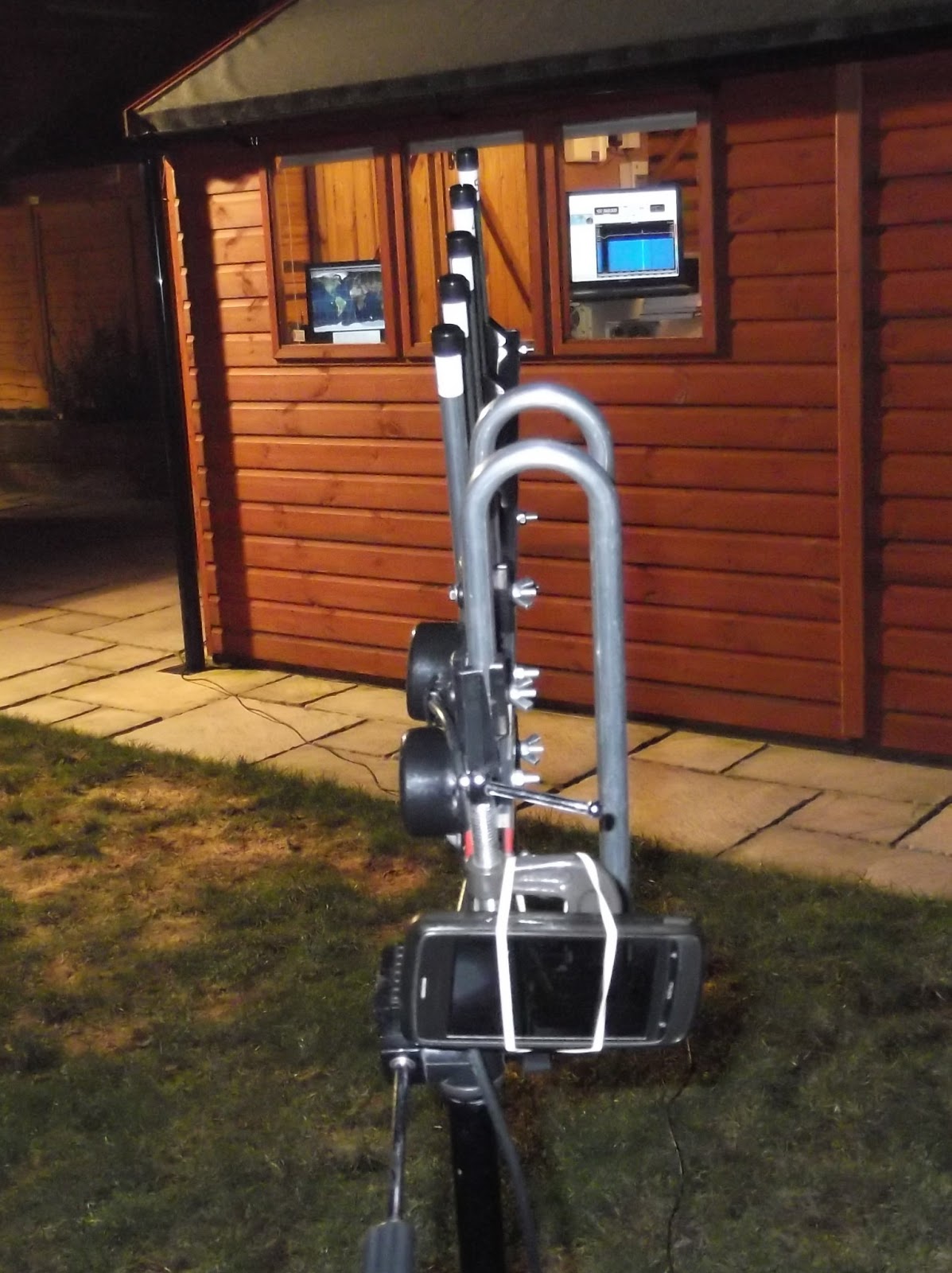
My 'ground station' consisted of a FUNCube Dongle and SDR-Radio (V1.5) with doppler correction enabled. It was connected to a small Moonraker ZL-Special 7-element antenna mounted on a small tripod with my Android phone running the Satellite-AR application mounted behind it. The Satellite-AR assists in pointing it in the correct direction as the pictures below demonstrate.


This slightly blury picture shows the satellite cluster containing STRaND-1 displayed in the Satellite-AR app, by moving the antenna on the tripod I attempt to keep this in the centre of the screen hopefully maximising the signal.


As you can see on the waterfall I did manage to receive the telemetry signal. It isn't a continuous signal, data is broadcast in short bursts with long gaps between the 'frames'


The next stage was to take this and using a number of software packages, including a TNC modem emulator and extract the data. The process is described here by Jan van Gils (PE0SAT) I have had a few attempts with my captured signals, unfortunately with little success I think due to the signal to noise ratio being too low.

This morning I was up nice and early to capture the pass at approximately 05:50, this time I used my FUNCube Dongle Pro Plus on another laptop, but for some reason the received signal was very poor. In desperation I took the antenna off the tripod and held it horizontally rather than vertically and did manage to get a signal, unfortunately it was at the end of the pass and STRaND-1 was heading over the horizon.

Still I am happy with my initial efforts.

Wednesday, 27 February 2013

STRaND-1 Cubesat

Right I have put the CB to one side, it has sadly proved very frustrating but more on that another time.

The current buzz are the newly launched satellites, including STRaND-1 http://amsat-uk.org/tag/strand-1/

This satellite has received quite a bit of media coverage by virtue of the fact it is carrying an Android Google Nexus-One smartphone as part of its payload. (BBC new article)

So I've blown the dust off the the FUNCube Dongles and removed the cobwebs of the 70cm Yagi and am planning on waving it at the sky in the early evening trying to capture some of the telemetry transmissions on 437.568MHz.


Saturday, 16 February 2013

Going mobile

Well mounted the CB radio on a piece of wood, wedged it between the centre console and the passenger seat. Magmount on the roof and now off for a drive to visit relatives through Nottingham and into the West Midlands, only hope the antenna stays put as it does look awfully big! I have flexed it right back and seems secure enough!


Tuesday, 22 January 2013

Breaker - Breaker

It is my long held intention to become a licensed radio amateur, but with limited spare time over the last few years I simply haven't got around to it. I have the necessary technical knowledge but don't have the practical experience. I have dabbled with PMR-446 transceivers but they don't allow many 'legal' experimental opportunities.

So when my family asked me what I wanted for Christmas I said "You can buy me a CB Radio" and they did!


It is a Midland 78 Plus Multi it has the legal 40UK/40EU channels, plus it can be set to European and North American frequency bands.

It isn't the first CB Radio I've used, back in the early 80s when I was at school I managed to blag the use of the a friends set up with a small magmount antenna on a biscuit tin joined in the new craze! My handle was Morroco Mole ;-)

I am experimenting with the set up at the moment, powering it from a modified PC supply which is giving out a nice stable output a little over 12V. I have constructed an inverted-vee antenna out of some spare cable. It is currently in the middle of the back lawn, the central mast is only around four meters high and the elements are set approximately 45 degrees to the vertical. It has an 'ugly' air choke and using a £10 SWR meter I've tuned it and the worst ratio I get is a little over 1:1.5.

It all seems to work but at the moment I don't seem to have anyone to talk to on either the UK or the EU/CEPT channels. I've heard the odd transmission on some channels but they have been from nearby Mansfield and Nottingham.

I have monitored CB frequencies before with my scanner with limited success and was hoping for better with a proper CB radio. It is still early days but I think I may need to rethink my antenna until I get around to getting my mast sorted. I might have to stick the inverted-vee in the loft.

I was tinkering on Sunday afternoon and I switched the radio over to AM just as some more "Superbowl" skip came in, they really are amazing to listen to! 

Tuesday, 8 January 2013

ARISS school contact reception despite the interference

Yesterday morning (10:57 UTC) saw an ARISS School Contact with participants at Ecole Les Muriers, Saint-Maur-Des-Fossés, France.

This was a nice opportunity to listen in since the position of the ground station at the school meant the UK could listen in to the majority (if not all) of the downlink. Usually when it is further east in Europe (Germany/Poland etc) you get the initial calling and the start of the contact but the ISS goes out of range before the session ends.

So I set up my FUNCube Dongle PRO PLUS connected to the discone in the loft and the new SDR-Radio V2 Preview software. I had to start the recording remotely as I was in work, but have played back the IQ file and made a video showing the decoding.


As you can see/hear I appear to get the full contact and the questions were (source)

1. What is the temperature outside the ISS?
2. What does the Earth look like from the ISS?
3. What does the Moon look like from the ISS?
4. Have you already passed through an asteroid belt?
5. Are you able to go outside the station, into the space?
6. What is your speed? Can you feel it?
7. How do you sleep? Do you have the same sleep pattern than on the earth?
8. Do the crew members sleep one after the other, or do you sleep all at the same time?
9. How do you know if it is morning or night on board?
10.Do you do any sports and physical activities? Do you lose weight?
11. Do you shave every day? If so, how?
12. Do you see any space debris? Can you see evidence of pollution of the earth?
13. What are your hobbies on the ISS after a day of work?
14. Are you happy to come back home at the end of your mission?
15. What is your current mission?
16. Why did you choose to become an astronaut?
17. How do you cook food? What is a typical meal in the ISS?

I was lucky to receive it given the interference monster was back! It does manage to get in on the act a few times but thankfully doesn't stop the show completely.

Over the last few months I've been suffering from increasing interference on the VHF/UHF and HF bands. Some of which I know about, the router I have puts out quite a few spikes on VHF but something local to me is putting out huge amounts of QRM.

I know it isn't internally generated as it disappears when I remove the antenna. I have gone around and powered off all the potential culprits in the house and discovered a switch-mode power supply for an external USB hard drive was throwing out some HF noise as was a digital photo frame.

I've suffered with interference on and off since getting back into the hobby back in 2010 and appreciate it is something I have to live with but it is quite annoying at times. I suspect the interference might be one of those power-line networking devices, but if anyone has any idea I would welcome a comment!
 

Thursday, 3 January 2013

Meteor pings 03-Jan-2013


Wednesday, 2 January 2013

Getting ready to monitor Quadrantid meteor show with my FUNCube Dongle


Tonight and tomorrow see the Quadrantid Meteor Shower (article on Telegraph website) Nasa scientists are predicting the morning skies are this week set to be filled with hundreds of shooting stars in the year’s first meteor shower.

Recently I have been reading up on amateur Radio Astronomy, one easy project is the detection of meteors using radio scattering.

On the British Astronomical Association, Radio Astronomy Group website there is an interesting project (a  PDF download) which demonstrates how to use a FUNCube Dongle to detect reflection of the Graves Space Surveillance Radar signal from ionisation trails.

The Graves French space surveillance transmitter located near Dijon, operating on a frequency of 143.050MHz the FCD was capable of receiving the weak backscatter echoes from meteors, indeed I experimented last year and with a simple antenna  picked up many squeaks and whistles from the normal 'background' meteor activity.

So I've set up my equipment again and will be doing some recording overnight.in the hope of a barrage of strange noises!

Monday, 31 December 2012

Some SSTV Pictures

Over the last few days have been trying out the technology preview of SDR-Radio Version 2 with the FUNCube Dongle Pro PLUS and it seems excellent. While monitoring the bands I stumbled across some SSTV broadcasts on 14.230MHz, I haven't decoded any for a while so left it running for a few hours and these are some of the better images.


Posted by Picasa

Tuesday, 18 December 2012

FITSAT-1 QSL Card

I have been busy again, got lots of interesting stuff to post when I find the time..

In the meantime, this arrived last week my first ever QSL card!


See these posts for more details

Monday, 19 November 2012

Dongles, Dongles Everywhere!

It is dongle overload at the moment at Châteaux Nerdsville,

Firstly I purchased a new (and improved) RTL-based USB DAB/DVB stick.

Like the FUNCube Dongle Pro it seems the manufacturers of these cheap USB receivers have been hit by the shortage of the Elonics E4000 tuner chips. Up to now the E4000 has been the most desirable tuner to have in the devices as it's the most capable, giving usable coverage from around 60MHz to 1.7GHz. However Elonics has been liquidated and the intellectual property is up for sale and supply and/or stocks of the E4000 have dwindled. Manufacturers have therefore resorted to different tuners.

One of the alternative devices is the Rafael Micro R820T which has support in Linux drivers so the source code was ported to the rtl-sdr project. Several postings I saw hinted that the device could preform down to around 24MHz (which I have yet to confirm) and was more sensitive, so when I saw a dongle for the grand total of £11 including postage I brought one. It is a Newsky dongle and looks exactly like my previous one.

In the meantime the newly designed FUNCube Dongle Pro PLUS has been in production and lucky customers have been slowly receiving theirs. With over a thousand people in front of me on the waiting list I wasn't expecting one before the new year, so imagine my surprise when I received an email on Thursday inviting me to buy one, which of course I did without hesitation, and it arrived on Friday! So over the weekend I had chance to toy with it and the RTL-USB device.

The first issue I had was my favoured SDR program SDR-Radio doesn't yet support the new FCDP+, but support is being worked on for the V2 release. There is support using a new EXT-IO dll for HDSDR but I was keen to reacquaint myself with SDR#.

The SDR# (SDR Sharp) project which has become a popular application and I have used it occasionally with the original FCD. The latest download comes complete with all the necessary drivers and libraries to use with the FCD/FCDP+ and RTL-USB devices, indeed it was quite painless and everything seemed to work straight out the box.

The most obvious new feature of the FCDP+ and one of the main reasons I got one is the extended frequency range. It works down in the LW/MW and HF bands and that is what I have spent most of the weekend doing, picking up a lot of SSB/CW Amateur contest traffic as well as other CB operators. The VHF/UHF preformance seems much better and less prone to noise that the original FCD, but have yet to use it in anger.

Here is a recordings made using the FCDP+ down in 20 meter band

and one made showing reception in the 10 meter band of what appears to be SSB transmissions from America.

The RTL-USB device unfortunately had less use over the weekend playing second fiddle to the much more expensive FCDP+, however I did have some attempts at using it and first impressions are that it is more sensitive than the older version, but that really isn't much of recommendation as the older device was quite deaf, however it does look quite promising.

This is a recording made of some SSB TX by the RTL-USB in the 70cm band. (The recording that was posted earlier was recorded using the FCD)

Wednesday, 14 November 2012

ARISS/ISS Downlink 14-Nov-2012


Tuesday, 13 November 2012

432MHz UKAC - SSB Contest


Sunday, 11 November 2012

A Frustrating Afternoon

I have recently took possession a 'new' laptop, a nice Lenovo Thinkpad. with a Core i3 and Windows 7 Professional.

I was trying to use it this afternoon with the FUNCube Dongle and having no luck at all getting it to work! I had planned to decode some NOAA-APT transmissions and hastily reverted to my older laptop only to discover that it wasn't receiving anything either.

In the end I traced it down to a faulty BNC coupler! I remember it was raining last time I used it and it did get slightly damp, so suspect there is some corrosion. Unfortunately by the time I had sorted it out I missed most of the overhead pass of NOAA-19.

I did manage to get two poor decodes of NOAA-18 and NOAA-15 but as you can see I was struggling with fading signals and interference.

NOAA-15 11-Nov-2012

NOAA-18 11-Nov-2012

What was interesting, and not seen before was the visible image (on the right) seems to change when it goes into darkness.
Damn you!

Saturday, 3 November 2012

ISS received in the carpark of Derby Hospital

There was an Amateur Radio on the International Space Station (ARISS) school contact planned with participants at Primarschule Aesch, Forch, Switzerland around 13:50 UTC.

Ideally I would have been at home at that time during my lunch hour and would have brought out the big guns to make a decent recording as I've done in the past. Instead yesterday saw me spending most of the day at The Royal Derby Hospital.

But I planned ahead and took along my trusty Realistic PRO-26 to see what I could receive in the car park if I got the chance, which I did!


I actually received a few minutes more but I hadn't packed a spare battery for the camera and it ran out.. doh!


I was using a Watson W-881 Super Gainer but it's length precludes being able to stand it up.. hence the horizontal polarisation!